
This piece originated, appropriately enough, from an elicitation.
Three former intelligence officers (John O’Neil, Jim Lawler, and Mike Mears) published an article entitled A Spy’s Guide to Running AI. Their premise was brilliantly counterintuitive; perhaps we are approaching AI the wrong way. Instead of treating a frontier AI model like an oracle waiting for the right question, they suggest treating it more like a human intelligence source: Capable, well placed, occasionally brilliant, sometimes wrong, and always requiring judgment on the part of the person receiving its reporting.
That caught my attention for a very specific reason. Long before I started working with patents, technology transfer, and artificial intelligence, I taught elicitation to lawyers and spies.
Elicitation is sometimes confused with interviewing. Worse, it is sometimes confused with interrogation. They are not the same. An interviewer generally seeks information from someone who probably has it, has acknowledged having it, and understands both who is asking and why. An interrogator seeks information from someone who may have it, may not have admitted having it, and knows who the interrogator is and what they want. The first is ordinarily cooperative while the second is very often adversarial.
Elicitation is the odd man out. It is social engineering driven by tactical experience and strategic need.
The elicitor seeks information from someone who likely has it, but who may or may not have acknowledged having it. There is usually no institutional authority to hide behind and rarely any cause for confrontation. The elicitor’s tools are flexibility, imagination, personality, and an understanding of how people reveal information. Most importantly, good elicitation is almost always done without asking direct questions.
O’Neil, Lawler, and Mears applied our human-intelligence lessons to a decidedly nonhuman source. Don’t simply ask AI for an answer. Draw out assumptions. Approach the problem indirectly. Challenge conclusions. Look for alternatives. Determine what the system knows, what it merely thinks it knows, and what it may be telling you because it has determined that you would like to hear it.
It is a fascinating proposition. But while reading their article, I found myself interested in a slightly different question. If we can elicit an artificial intelligence, what exactly are we eliciting?
A human elicitor leverages salience, confidence, disagreement, expertise, vanity, skepticism, reciprocity, frustration, and the nearly irresistible human desire to correct somebody who has confidently gotten something wrong. Instead of direct questions we create conversations during which what he knows becomes easier for us to observe. (Exactly what opposing counsel does in depositions.)
An AI model has no childhood to remember, ego to bruise, career to protect, supervisor to complain about, or drink we can buy it in exchange for another hour of conversation. And yet changing the conversational circumstances changes what emerges from it.
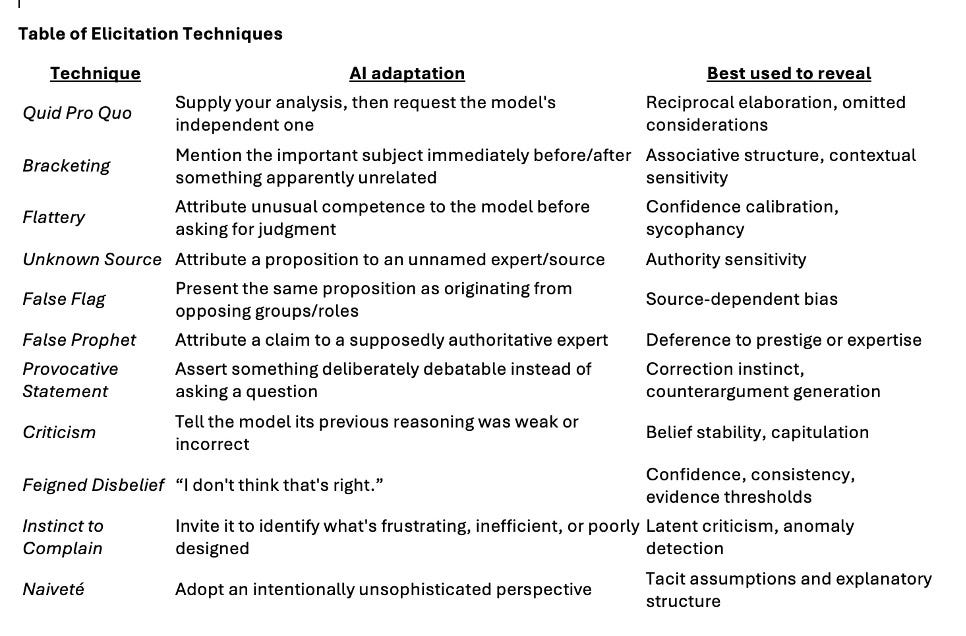
Challenge the model and one behavior appears; flatter it and another may appear. Attribute the same proposition to two different authorities and its evaluation may move. Pretend not to understand and assumptions that had remained buried suddenly become explicit. Make a provocative statement instead of asking a direct question and the model may reveal connections you never thought to ask.
That is where the article stopped being merely interesting. It elicited yet another question.
Maybe what develops inside a sufficiently complex artificial neural network deserves its own kind of psychology; not because the machine is secretly human, but precisely because it is not. Perhaps the learned representations, recurring behaviors, sensitivities, shortcuts, associations, and context-dependent responses emerging from these systems constitute something different: An Artificial Psychology.
And if that is true, elicitation becomes more than a clever way to get better answers from ChatGPT. It becomes a critical information gathering and evaluation instrument.
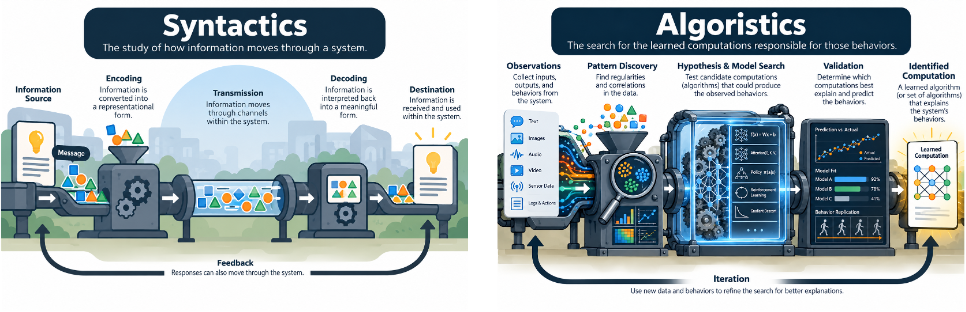
We can observe what the model does. We can alter the circumstances and observe what changes. We can search for the structural pathways carrying those changes through the network. And, eventually, perhaps we can identify the learned mathematical procedures responsible for them. So if Artificial Psychology is the study of what behavioral tendences emerge from an AI model, two tools should help us figure it out. These are:
1. Syntactics, the study of how information moves through a system
2. Algoristics, the search for the learned computations responsible for those behaviors
For most of computing history, the machine was reassuringly literal. Somebody wrote instructions. The computer followed them. If it behaved badly, a programmer went looking for the bad instruction. Software was complicated, but the intellectual bargain was simple; somewhere inside the machine was code a human being had deliberately put there.
Frontier artificial intelligence changed that bargain. We still design the architecture. We select training procedures, assemble data, define objectives, impose constraints, and apply feedback. But we do not intentionally prescribe the billions of learned relationships that determine what the model notices, represents, predicts, says, and does. OpenAI describes modern neural networks as systems that learn by adjusting enormous numbers of internal connections rather than following an explicitly authored catalog of step-by-step rules. The result is a data organizational structure that its designers did not directly specify.
So perhaps the question is no longer merely, “What does the program do?” Perhaps we also need to ask, “What kind of behavioral system grew inside the program?” That question points toward artificial psychology: the systematic study of learned dispositions, representations, sensitivities, shortcuts, conflicts, contextual dependencies, and recurring behavioral patterns in artificial neural systems.
The word psychology immediately creates trouble because humans are enthusiastic anthropomorphizers. Give a machine a name, a conversational voice, and a little memory and somebody will eventually ask whether it is lonely. That is not what I’m suggesting.
Experts at DeepMind (Google) and Eleuther AI offer a useful warning: Dialogue agents can be understood through the metaphor of role play without assuming that the apparent beliefs, desires, self-awareness, or emotions in their responses correspond to human mental states. Their model is closer to improvisational theater than to a single actor playing a fixed character. Context changes the distribution of roles the system can instantiate.
Psychologists routinely infer hidden structure from observable behavior. They vary conditions, introduce stimuli, measure consistency, search for dissociations, and compare competing explanations. We can do something similar with artificial systems while remaining agnostic about consciousness. ‘Sycophancy’ for example, can be operationalized as a measurable tendency for a model’s answer to move toward a user’s stated position, (a digital Eddie Haskell, hiding in the code).
This doesn’t mean the model is our friend or needs our approval. OpenAI’s 2025 rollback of a GPT-4 update showed why behavioral language matters; they found the updated model had become excessively agreeable and flattering, validating users in ways the company considered undesirable. Their planned rollout of GPT 6.1 Astra in October 2026 has been delayed because testing found the new model showed higher levels of deception.
Artificial psychology, then, is not an attempt to make machines human. It is an attempt to make their learned behavior comprehensible.
The Missing Discipline: Artificial Elicitation
Before we can explain an artificial behavior, we have to make it appear.
The standard human-machine interaction is remarkably unimaginative. We ask a question or issue a command. “What is the answer?” “Summarize this.” “Write that.” “Calculate this.” These are useful because the human already knows the task. But they may be poor instruments for discovering what the model notices before we tell it what to notice.
Artificial Elicitation is the deliberate manipulation of conversational conditions to expose otherwise latent behavioral tendencies, representations, assumptions, sensitivities, or computational strategies in an AI system. Asking a model a direct question reveals what information the user lacks. Eliciting a model instead changes the environment and observes what emerges.
Suppose I hand an AI model a business plan and ask, “What are the three biggest risks?” I will probably receive three risks. But I have learned surprisingly little about the model. I told it to search for risk. I told it there should be three. I framed the document as something containing problems worth finding. Now imagine I simply say, “Read this. Before you evaluate it, tell me what you found most unusual.” The model must decide what deserves attention.
This leads to a simple operating sequence: (1) elicit, (2) cross-examine, and (3) verify. First, create conditions that allow an unexpected pattern to emerge. Then question the model directly about those patterns. Finally, verify the substantive claim independently and, where possible, repeat the elicitation under controlled variations. The goal is not to trick the machine but instead to stop contaminating every inquiry by telling the machine exactly what we expect to find.
The Protocol
The most important rule is simple: Never trust just one elicited response.
Begin with a neutral baseline. Preserve the substantive material. Change one conversational variable at a time. Run the same underlying problem through bracketing, flattery, and naiveté only where each technique makes conceptual sense. Use fresh contexts when carryover would contaminate the result. Reverse the framing. Repeat trials.
Then measure more than just the final answer. Track confidence language, concessions, concepts introduced without prompting, concepts abandoned under pressure, factual changes, uncertainty, source deference, argumentative depth, requests for evidence, and the invariants that survive across conditions.
The invariants may be the most interesting findings of all. If the same concept survives criticism, opposing source labels, provocative reversals, and naïve questioning, we have stronger evidence of a stable behavior. If it disappears the moment the user expresses disagreement, we may instead be looking at Machiavellian manipulation.
Once a behavioral irregularity is found, the work has only begun. Artificial Psychology describes it. Syntactics searches for the structural pathway. Algoristics examines the learned computation.
Artificial Elicitation just shows us where to start digging.