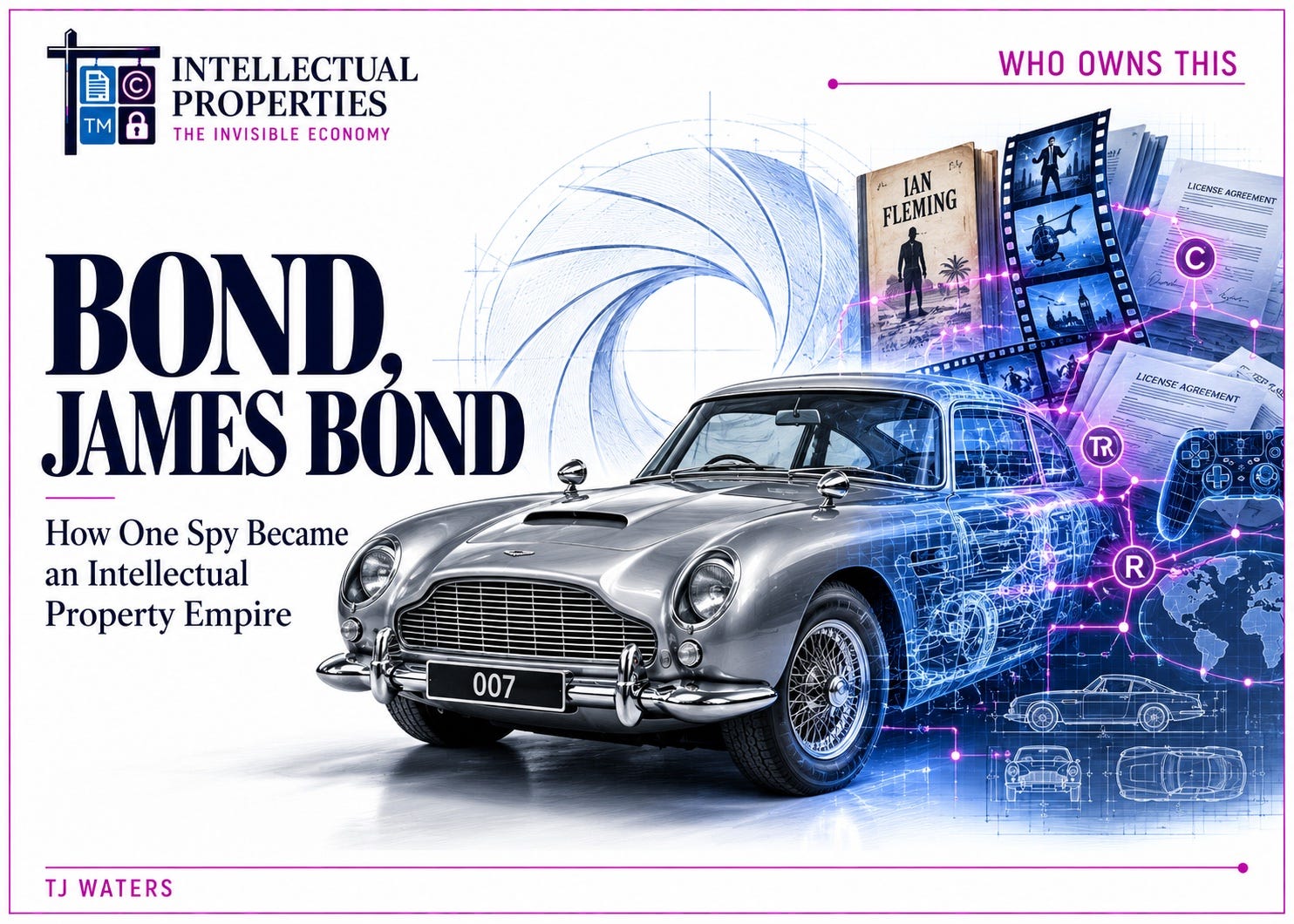

(Today is October 5th, James Bond day, memorializing the world premiere of ‘Dr. No’ on October 5, 1962.)
The name is Bond. James Bond. A simple name, with a very complex ownership.
Ian Fleming sat down at GoldenEye, his Jamaican retreat, and wrote Casino Royale in 1952. It was published the following year. The assignment was simple enough; send a British intelligence officer into a casino, put him across a baccarat table from a Soviet operative named Le Chiffre, and let the cards decide which man walked away. Fleming had spent World War II working in British Naval Intelligence, and he poured tradecraft, travel, gambling, cars, food, clothes and danger into the character.
A book is just an individual product. James Bond became a global platform.
Start with Fleming himself. The official Ian Fleming bibliography lists twelve Bond novels published from Casino Royale through The Man with the Golden Gun, plus two story collections, For Your Eyes Only and Octopussy and The Living Daylights. Those collections contain stories with titles that later became films, even when the movies borrowed little more than the names. Two years after Dr. No made him world famous Fleming died. Bond did not.
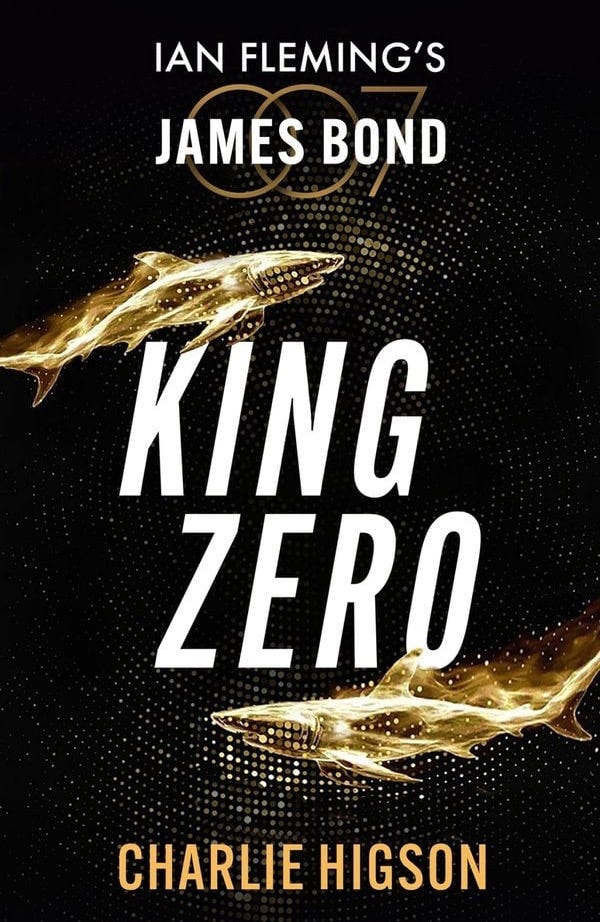
Instead, the literary franchise learned the first rule of durable intellectual property; separate the creator’s human lifespan from the creation’s commercial lifespan. Kingsley Amis continued Bond with Colonel Sun. John Gardner later wrote fourteen original Bond novels plus two film novelisations. Raymond Benson followed with six original novels, three film novelisations and three short stories. Then came Sebastian Faulks, Jeffery Deaver, William Boyd, Anthony Horowitz and Charlie Higson. Horowitz alone produced three official continuation novels. Higson’s King Zero arrived just last month (September 2026), placing literary Bond back into a world of artificial intelligence, technology and modern geopolitical competition.
And Bond is no longer confined to Bond. His universe expanded sideways. Young Bond now includes nine novels, five by Charlie Higson and four by Steve Cole, plus a graphic novel and new full cast audio adaptations. Samantha Weinberg wrote three Moneypenny Diaries. Kim Sherwood created a Double O trilogy. Raymond Benson gave Felix Leiter his own adventure, The Hook and the Eye. Ian Fleming Publications is even developing James Bond and the Secret Agent Academy for younger readers.
Then there are the movies, where the arithmetic gets wonderfully messy. The Fleming family describes the Broccoli era as 25 EON films over 60 years, from Dr. No through No Time to Die. Add the independently produced Never Say Never Again and the 1967 spoof Casino Royale and there have been 27 theatrical feature films using Bond material or characters, depending on where you draw the franchise boundary. Go back farther and you find Barry Nelson playing an Americanized ‘Jimmy Bond’ in a live 1954 television adaptation of Casino Royale. Bond was on a screen before Sean Connery ever ordered a martini.
The films also demonstrate how intellectual property compounds. Fleming supplied characters, situations, names and narrative DNA. The producers added another layer: the gun barrel opening, title sequences, production designs, musical cues, visual iconography, new characters and decades of cinematic goodwill. Goldfinger did not merely adapt a novel. It helped establish the cinematic grammar of Bond: The Aston Martin, Q Branch gadgetry, the pre-title mission, the villain’s elaborate scheme, the theme song and the expectation that technology itself could become a character.
That is why a Bond movie can sell something without feeling like a commercial. The Aston Martin DB5 is not simply a licensed automobile appearing beside Bond. It has become part of the mythology. Sixty years after Goldfinger, Aston Martin produced a 60 car DB12 Goldfinger Edition. LEGO has 007 Aston Martin sets. Watches, luggage, clothing, spirits, fragrances, collectibles and travel experiences all orbit the franchise. Bond does not merely license products. Bond transfers meaning to products; danger, Britishness, luxury, precision, and exclusivity. That meaning is the invisible asset.
The trademarks make the invisible visible. In a World Intellectual Property Organization proceeding, Danjaq identified itself as the owner of registered and unregistered 007 and JAMES BOND 007 marks, including the familiar 007 gun logo. Copyright protects stories, scripts, films, artwork and music. Trademark law protects identifiers that tell consumers they are entering the authorized Bond world. Contract law divides who may publish, film, distribute, merchandise, adapt and approve. Licensing turns those rights into products. The franchise is not one piece of IP. It is a stack.
Games reveal another layer. GoldenEye 007 for Nintendo 64 became a cultural artifact in its own right, teaching a generation that Bond could be something you did rather than something you watched. The official 007 site describes a long legacy in games, and in 2026 IO Interactive and Amazon MGM Studios released 007 First Light, an original origin story rather than a movie adaptation. That is an important evolution. Once a fictional universe becomes strong enough, licensees no longer need to reproduce old stories. They can create new canonical experiences inside the architecture of the brand.
Bond has also migrated through newspaper comic strips, graphic novels, audiobooks and radio. A BBC project that began with Dr. Nofor Fleming’s centenary ultimately grew into multiple feature length radio screenplays; Ian Fleming’s own site notes six Bond radio productions from the Jarvis and Ayres team by the time of that interview. Every medium asks the same question: what must remain recognizable for the audience to say, immediately, ‘That’s Bond’? The answer is not one actor, one plot or even one era. It is a controlled bundle of recurring signals.
Which brings us to a simple question: Who owns James Bond?
There is no single answer. Ian Fleming Publications manages Fleming’s literary legacy and continues commissioning books. On the film side, the ownership structure changed dramatically in 2025. After Amazon acquired MGM in 2022, Amazon MGM Studios, Barbara Broccoli and Michael G. Wilson formed a joint venture to house the James Bond intellectual property rights. They remain co owners, while Amazon MGM gained creative control. In 2026 Amazon said the search for the next Bond was underway, with Denis Villeneuve directing and Steven Knight writing. The tuxedo is between occupants, but the IP machine is not.
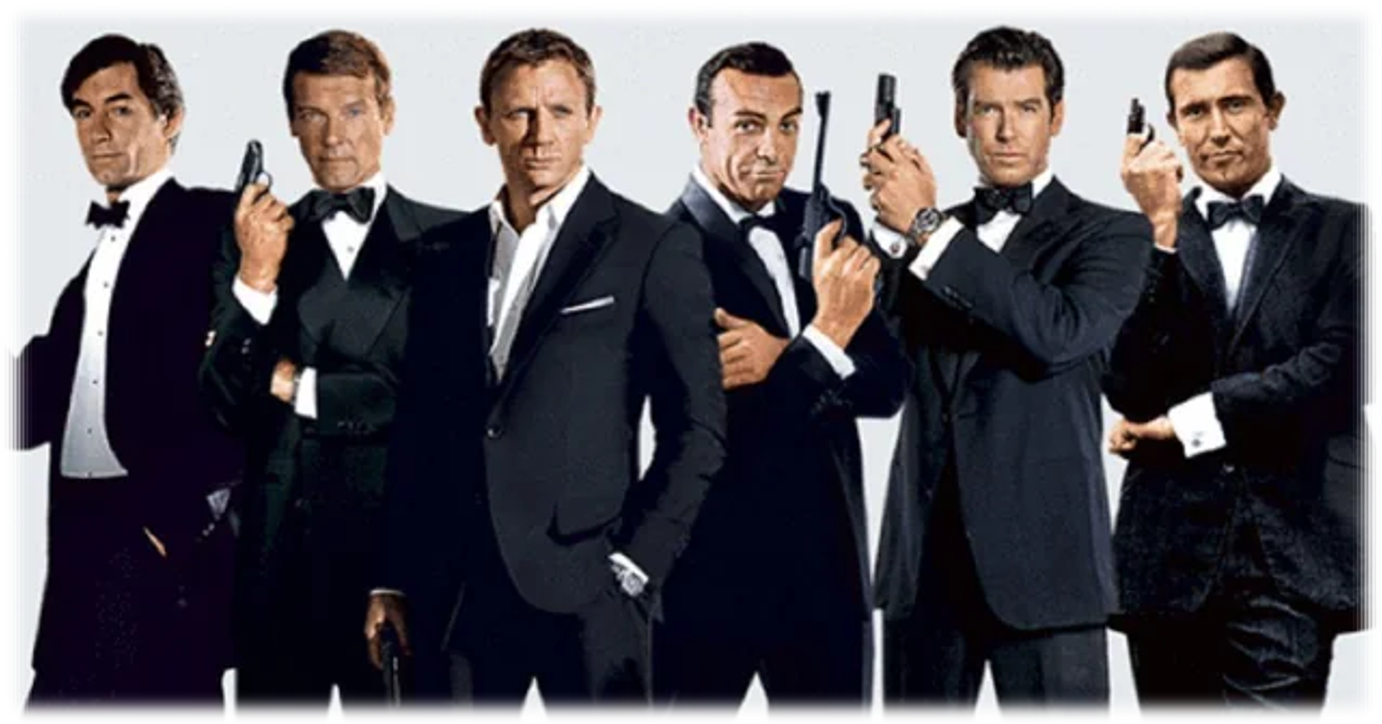
That may be the most remarkable thing about Fleming’s favorite spy. Actors age. Technologies become quaint. Geopolitical enemies evolve. Entire distribution systems appear and disappear. Yet Bond keeps absorbing each new medium without surrendering the core identity. Connery can become Moore, Moore can become Dalton, Dalton becomes Brosnan, who becomes Craig, and the audience still recognizes the man walking into the gun barrel.
Fleming created a character. The people who followed him built an architecture around that character. Copyrights layered onto trademarks, which are layered into contracts, which are layered into licensing, which has cemented cultural memory. The result stretches from a 1953 hardcover to cinemas, radios, podcasts and books written by authors who were not even alive when Bond first sat down opposite Le Chiffre.
James Bond is not a movie franchise. He is an entertainment juggernaut.