
For years, data lived in the junk drawer of intellectual property.
Patents got claims. Trademarks got registrations. Copyrights got ownership analyses. Trade secrets got locked doors and nondisclosure agreements. Data got a sentence, if anything at all.
Sponsored research agreements gave companies rights in “results.” Technology licenses tossed “data” into a broadly ill-defined description of technical information. If somebody wanted a dataset, we negotiated confidentiality, security, permitted use, deletion and (if we were feeling particularly ambitious) what happened to derivatives. That worked fine when the data was mostly evidence behind a research paper.
Then AI showed up.
An Asset Without a Comfortable IP Box
Corporations, universities and medical centers now possess enormous collections of clinical records, images, genomic information, sensor readings, materials data, financial information and research observations. AI has made many of those collections dramatically more valuable.
The problem is that data doesn’t fit comfortably inside the traditional IP boxes.
Facts themselves are not generally protected by copyright, although the selection or arrangement of a database may be. Trade-secrets can protect valuable compilations, but secrecy matters. Research funders may require data sharing. Human-subject data bring privacy and consent obligations. And once a university gives a company a copy, much of the institution’s remaining control comes from the contract.
The strange thing is that the company may never have needed the copy in the first place.
The Question Behind the Data
Imagine a university medical center with fifteen years of patient information. A pharmaceutical company wants the dataset to determine which patients respond best to a cancer treatment. The instinctive licensing question is: What should we charge for the data?
Try a different question. Why does the company need the data?
It probably doesn’t want to read 300,000 patient records. It wants to know which biomarkers correlate with their treatment response? Which combinations of medications produce better outcomes? Which patients belong in the next clinical trial?
Those are not possession questions. They are computation questions. That is where homomorphic encryption gets interesting.
The Library Behind Opaque Glass
Normal encryption is terrific while data are stored or traveling between systems. The awkward moment traditionally comes when somebody wants to use them. The information gets decrypted, a calculation occurs, and the result gets encrypted again.
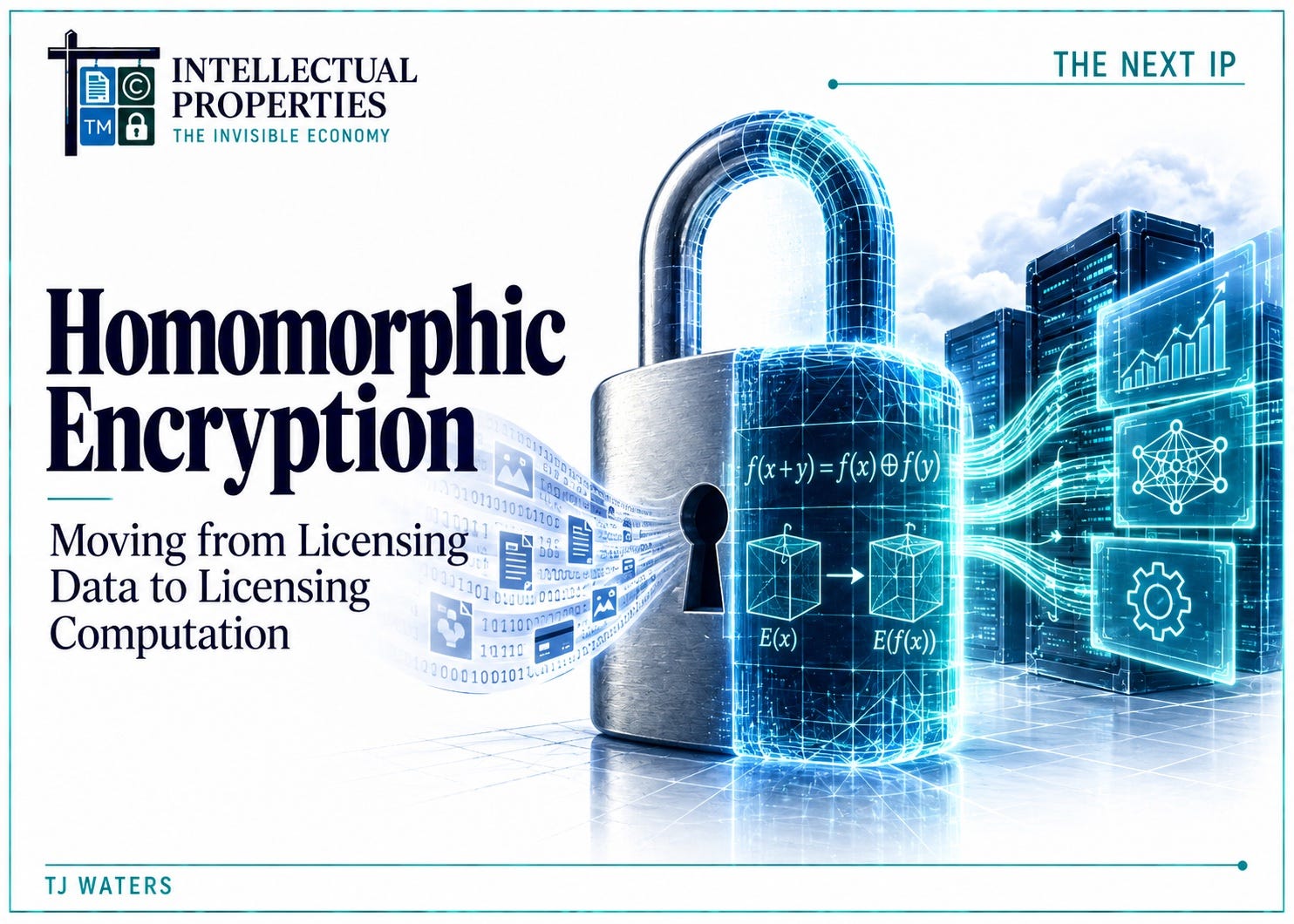
Homomorphic encryption changes that. NIST describes fully homomorphic encryption as a way to compute functions over encrypted data without knowing the secret key. The computation happens while the information remains encrypted. Think of a rare manuscript in a library.
Traditional data licensing is like letting a researcher photocopy the manuscript and take it home. The contract can say what the researcher may do with the copy. But the researcher has the copy.
Homomorphic encryption is closer to putting the manuscript behind opaque glass. The researcher submits a question. The system searches the manuscript. The researcher receives the authorized answer. But the manuscript never leaves the vault.
That small distinction could create an entirely different IP business model. Instead of licensing a dataset, a university could license permission to ask the dataset questions.
The agreement might define the permitted computation, the authorized output, the field of use, the number of queries, the records or cohorts that may be analyzed, whether model training is permitted, who owns a resulting model, and whether a competitor may ask different questions of the same underlying data.
Termination changes too.
Traditional data licenses eventually contain some version of delete all copies. Then everybody hopes they did. A computational license can simply stop answering queries after a certain date. Revocation becomes technical instead of aspirational.
Healthcare and Banking
Healthcare seems almost designed for this application. The data are extraordinarily valuable and equally difficult to share.
Researchers increasingly are demonstrating that privacy-preserving computation can work across decentralized health information. A 2025 NPJ Digital Medicine study used homomorphic encryption in a decentralized clinical-analysis framework involving an international influenza cohort and U.S. COVID-19 mortality data. A 2026 study applied multiparty homomorphic encryption to federated survival analysis.
The solution isn’t one giant medical database. It instead likely to be hundreds of databases capable of computing together without surrendering their underlying patient records.
Now imagine a criminal moving money through five banks. Nothing at Bank A looks particularly alarming. Neither does Bank B. The pattern appears only when the transactions are viewed together. The obvious answer is to combine the information. The equally obvious problem is that banks cannot casually hand one another their customer records.
Mastercard tested a different approach through Singapore’s privacy-enhancing technology sandbox. Its proof of concept used fully homomorphic encryption to explore sharing financial-crime intelligence across Singapore, the United States, India and the United Kingdom.
Again, the important thing was not sharing the database. It was sharing the computation.
There Is No Magic Here
Homomorphic encryption is not a privacy wand.
It can be computationally expensive. Existing software may have to be redesigned. Key management matters. Outputs themselves can leak information. Ask a medical database a sufficiently narrow question and the answer may identify someone even if the cryptography worked perfectly.
That is why NIST treats FHE as one member of a larger privacy-enhancing toolkit alongside technologies such as multiparty computation, private set intersection and zero-knowledge proofs. Sometimes a secure enclave, federated architecture, differential privacy or another approach will be cheaper or better. The point is not that every dataset should be homomorphically encrypted. The point is that we should stop assuming every valuable use of data requires handing someone the data. That matters for technology transfer.
The Next IP
A university could potentially license oncology computations to one company, cardiovascular analytics to another and device-performance analysis to a third. Exclusivity could be assigned to a field, cohort, query or commercial application instead of the entire dataset. The same information could generate recurring commercial value without ten companies walking away with ten copies.
That changes valuation. It changes exclusivity, cybersecurity, and termination. And it changes what we mean when we call data an IP asset. For decades, we tried to write better contracts controlling what companies may do after we give them data. Perhaps the more interesting solution is to stop giving it to them.
1. Let them ask the question.
2. Let the encrypted data do the work.
3. Give them the answer.
4. Keep the asset.
The next generation of data licensing may not license data at all; it may instead license computation.