

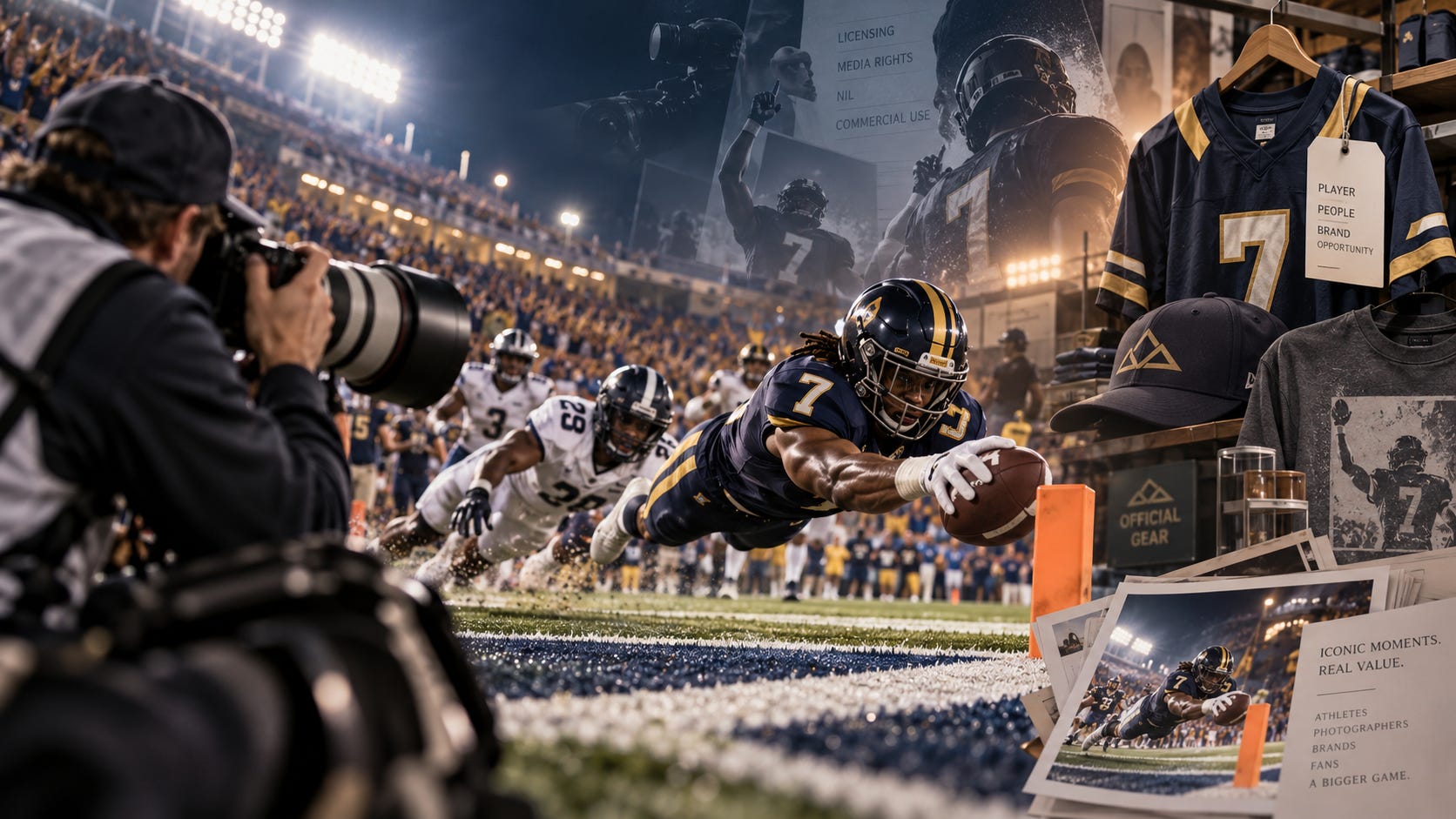
The running back is already airborne when the camera catches him. His right arm is stretched toward the goal line, two defenders are arriving too late, and seventy thousand people are discovering just how much noise a football stadium can make. For the athlete, it may be the finest moment of his young career. For the sideline photographer, it is a fraction of a second of shutter speed, instinct and good fortune. For someone in a marketing department, it is tomorrow’s T shirt.
A newspaper may want the picture tonight. An apparel company may want it next week. A video game publisher may want the player himself, complete with the uniform, the celebration and a digital version of his face. All three customers are looking at the same moment, but they aren’t buying the same thing. There’s a photograph. There’s a person. There’s a university brand. And somewhere behind the lot of them is a small forest of contracts.
For thirty years, Getty Images made an enormous business out of the first item on that list. You’d think it might have wanted to become the place customers visited to clear the others, too.
A Great Business Meets a Different World
Getty didn’t invent photography, and it didn’t invent copyright. What it understood, earlier than most, was that the world needed a dependable way to find an image, determine who could license it and put it to work. The company assembled extraordinary collections, relationships with photographers and news organizations, and a global distribution operation. When somebody needed a picture of a president, a pop star or a championship touchdown, Getty was a natural place to start.
Then the economics began to change. In 2006, Getty bought iStockphoto and its inexpensive, contributor supplied images. Free photography followed. So did creative software that placed pictures inside the same screen where customers designed an advertisement or social media post. Eventually generative artificial intelligence made it possible to describe the picture you wanted without looking for one that already existed. Getty responded to these developments, sometimes aggressively. The notion that it simply slept through the digital revolution isn’t supported by its history.
Still, consider the financial bookends. Getty reported about $807 million in revenue in 2006. Its latest annual filing shows $981 million in 2025. That’s roughly 22 percent growth across nineteen years, before inflation, while the world became almost unrecognizably dependent on digital pictures. The company’s reported revenue actually grew more slowly than the number of uses people found for visual content. Its 2025 accounts also show a substantial net loss, with litigation and financing costs weighing on a business that continued to generate significant operating earnings.
Here’s another curiosity. By the end of 2025, Getty’s balance sheet carried nearly $2 billion in goodwill and identifiable intangible assets. That’s a remarkable amount of invisible property for a business selling something as visible as photography. Yet much of the value in Getty’s photographer relationships, licensing experience, customer networks and potential access to personal identity rights couldn’t be measured so neatly. The accountants could tell us what Getty had paid for some of its assets. They couldn’t necessarily tell us what opportunities those assets might create. And perhaps that was the larger problem. Getty had spent decades learning how to value the picture without fully exploiting the business possibilities surrounding the person inside it.
A proposed merger with Shutterstock looked like one answer. Put two of the great image libraries together, remove duplicated expenses and gain scale. The merger collapsed. On October 21, 2026, Getty commenced a Chapter 11 process that contemplated returning the company to private ownership, with up to $533 million in equity commitments from Getty family affiliates and Koch Equity Development. Debt, legal obligations and the failed merger are central to understanding the immediate restructuring. The deeper question is why a business with such a remarkable collection of valuable rights had found so few new ways to grow.
The Sentence That Gave the Game Away
College sports offered a particularly revealing opening. When NCAA rules changed in July 2021, athletes began pursuing endorsements and commercial opportunities using their names, images and likenesses. The football player who had once appeared on a newspaper sports page could now appear on a cereal box, in a video game or as a compensated spokesperson. Somebody had to bring together the athlete, the company, the school and the rights necessary to make the transaction lawful.
Surely Getty understood that business. It had spent a generation licensing images of famous people. It also understood that owning a picture of a person isn’t the same as owning the commercial rights to that person. Photograph copyrights and rights of publicity can belong to different parties. Put the athlete in a college uniform and university trademarks enter the picture. Recreate him digitally, and consent and contractual permissions become more complicated still.
Then I came across an announcement dated October 27, 2022. The Collegiate Licensing Company named Getty the preferred source of commercial collegiate images for more than 150 participating schools, giving over 2,400 retail licensees a more convenient path to image copyright clearance and institutional approval. The announcement expressly mentioned student athlete NIL as part of the opportunity. Getty knew precisely what was happening.
But read a little further. Institutions retained approval of their intellectual property, and the licensees remained responsible for clearing athletes’ and other third parties’ rights. There it was, almost politely tucked into the business arrangement. Getty could help you obtain and use the photograph. If you wanted to use the person in the photograph commercially, you still had another door to knock on.
That isn’t proof Getty failed, or that the arrangement was poorly negotiated. The athletes had every right to decide whether to participate, and many already had agents, collectives, existing contracts or other representatives. The universities had their own interests. Building a truly comprehensive clearinghouse would have required consent, sophisticated rights records, payment administration and a great many negotiations. But isn’t that exactly the kind of untidy problem a great licensing business ought to love?
What Was Actually for Sale?
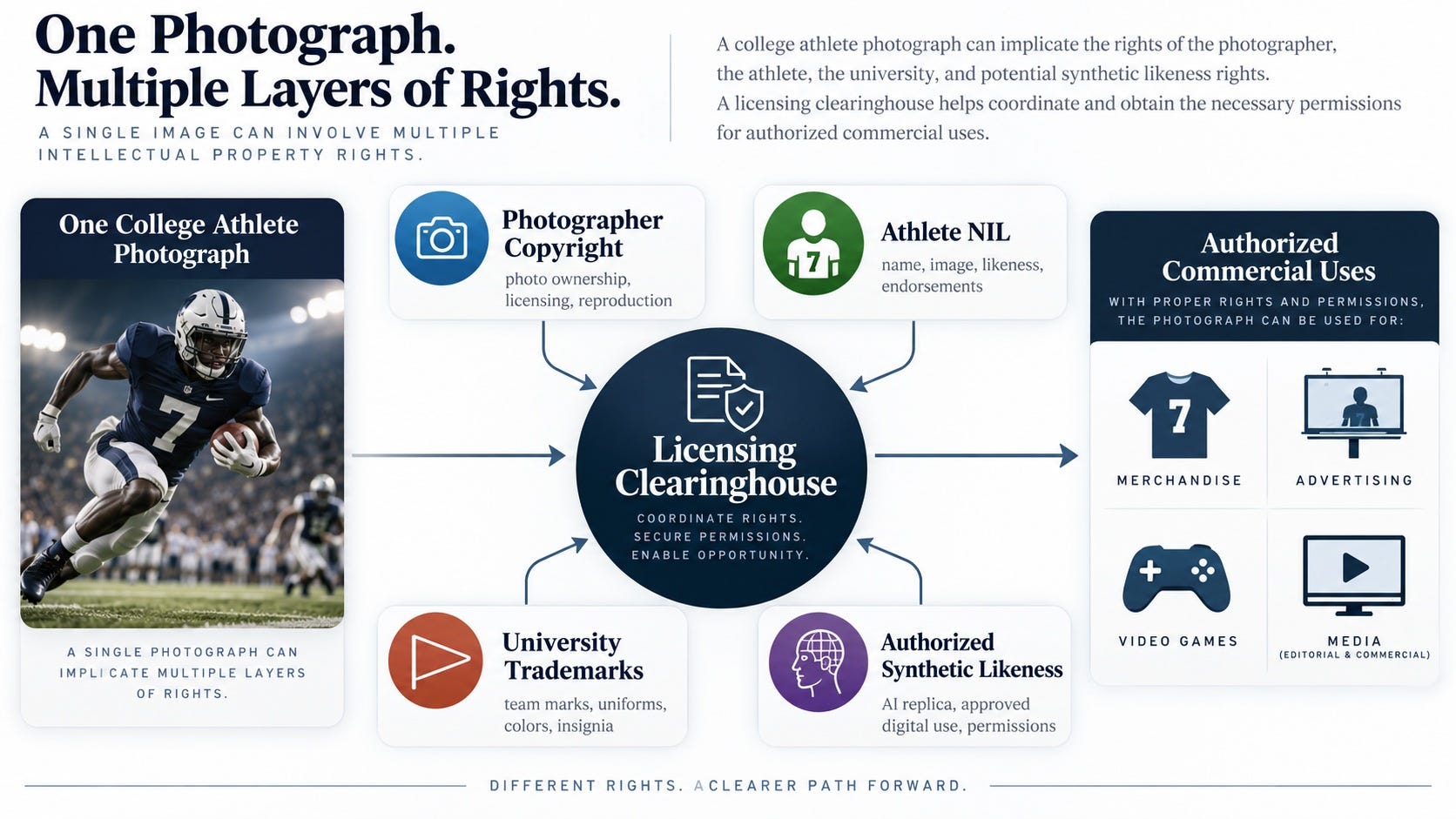
Go back to our touchdown photograph. Suppose a clothing company wants to print it on ten thousand shirts. Licensing the photographer’s copyright is only the beginning. A commercial product exploiting the athlete’s identity may require the athlete’s permission. The university might need to authorize its name and marks. Each permission has a price, a territory, a duration and some rules about how the resulting product can be sold. Without the necessary permissions, what looks like one picture can become several separate legal problems.
Now imagine a single service that could identify those rights, route approvals to the proper owners, collect the money and allocate royalties. Getty wouldn’t have to own every copyright, athlete identity or trademark. It would have to know whose permission mattered, how to get it, and how to record the bargain. A photographer would get paid for the photograph. An athlete would get paid for the authorized use of a commercial identity. The school would control the use of its marks. The customer would get something that is often remarkably hard to buy, confidence that the rights have actually been cleared.
Businesses such as Opendorse and OneTeam Partners developed important pieces of the athlete licensing marketplace. Getty, meanwhile, already possessed a visual archive, a customer base, experience licensing rights and relationships throughout sports and entertainment. None of this guaranteed that it could have won the NIL market. But the capabilities were close enough to make the opportunity difficult to overlook.
There’s a second act to this story, and it hasn’t finished unfolding. What if that clothing company no longer needs the photograph at all? What if it wants a licensed, synthetic video of the same athlete performing in a commercial that was never filmed? A camera isn’t even necessary. The photograph may help establish the appearance, but the value now travels with the person, the authority to reproduce that likeness, and the terms governing its use. A rights clearinghouse could matter more than the picture library that helped inspire it.
The Photograph and Everything Behind It
Getty’s bankruptcy doesn’t mean its photographs have stopped being valuable. Authentic editorial coverage and historic archives could become more important as synthetic images become harder to distinguish from real ones. And a speculative NIL marketplace wouldn’t necessarily have solved the company’s debt or its litigation exposure. No responsible analysis can claim that one missed idea caused Chapter 11.
But the collegiate partnership reveals something more interesting than a company that didn’t see the future. Getty saw it. The company had the relationships, the images and enough licensing expertise to recognize the new demand. What the public record doesn’t show is a transformation of that opening into the kind of comprehensive identity rights business that might have changed its economics.
Perhaps that is the enduring lesson of Getty Images. It can take a great deal of vision to build a business around a valuable thing. It may take even more to recognize when the greater value has moved into the permissions, relationships and possibilities surrounding that thing. The photographer captured the touchdown. Getty knew how to sell the photograph. The missed idea may have been everything else in the frame.