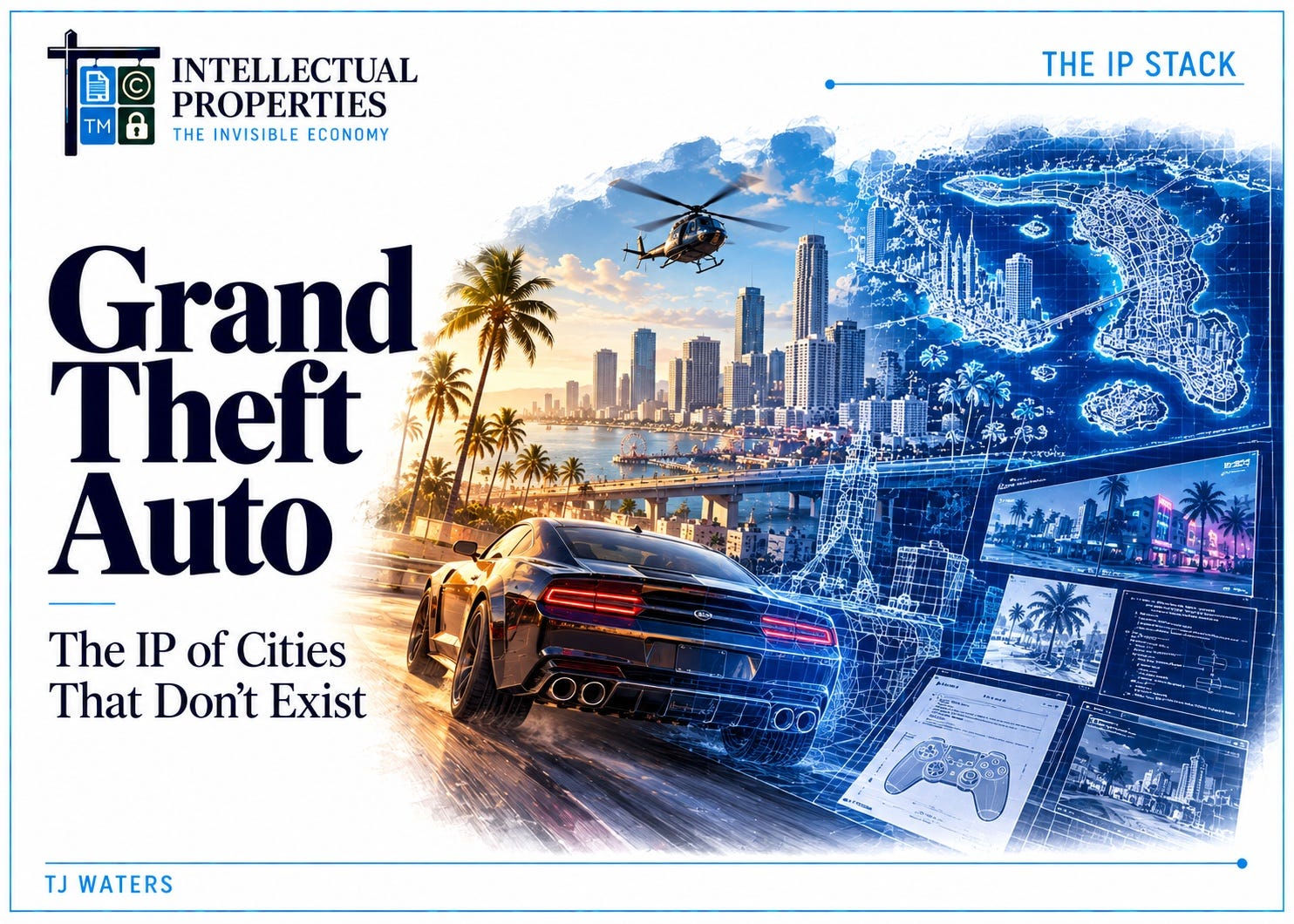

A State of Its Own
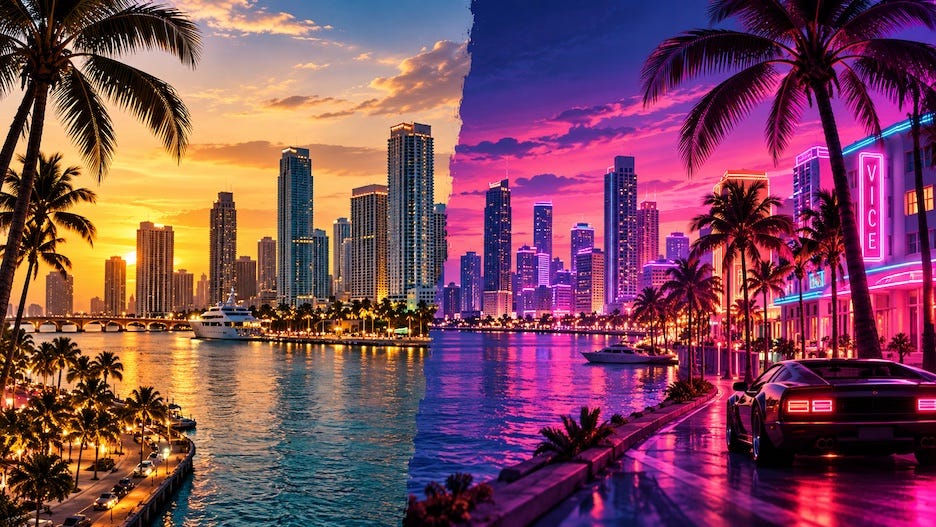
A driver crosses a causeway beneath a Florida sun. Palm trees lean over the water. Somewhere ahead, a nightclub is opening, a radio announcer is talking nonsense, and a billboard is selling something nobody needs. The scenery looks familiar. The city doesn’t exist. Neither does the state.
Welcome to Vice City, inside Leonida, Rockstar Games’ fictional answer to Miami and Florida. In Rockstar’s official introduction, the upcoming Grand Theft Auto VI follows Jason and Lucia through a criminal conspiracy that reaches beyond the city. The company has invented not just another neighborhood for players to explore, but a whole jurisdiction for its stories to inhabit.
That sounds like game design. It is also a remarkably sophisticated way to build intellectual property. Rockstar has spent nearly thirty years making recognizable American places that belong, in their particular expression, to Rockstar.
The City Is the Product
Nobody owns New York. Or Los Angeles. Or Miami. A developer can write a story about those places, photograph their streets and evoke their culture, subject to the rights attached to particular buildings, artworks, brands and other protected material. But the city itself is not somebody’s private franchise.
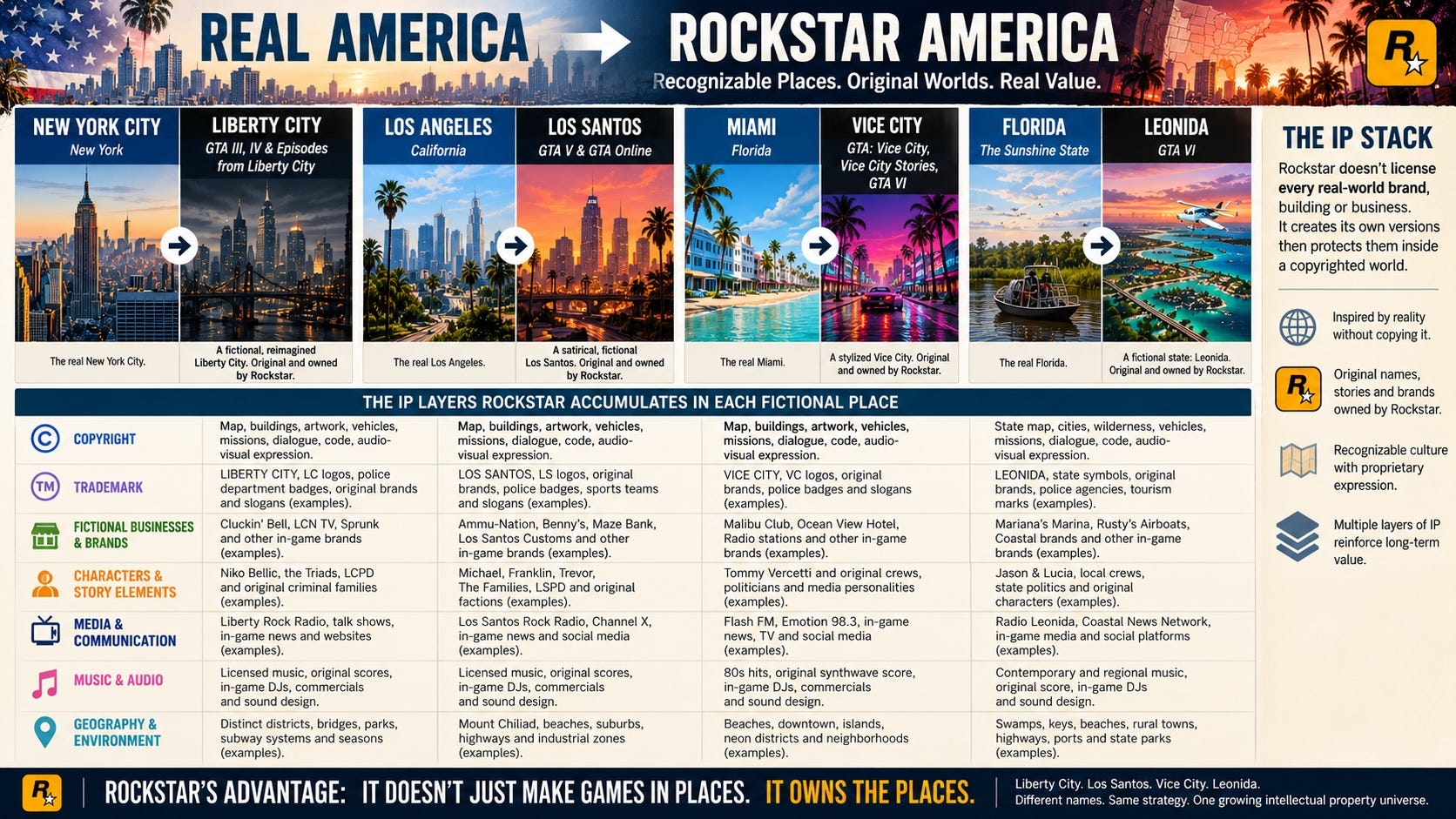
Rockstar approached the problem differently. New York became Liberty City. Los Angeles became Los Santos. Miami became Vice City. Now Florida has become Leonida. The similarities are obvious, and intentionally so. Players recognize the geography without requiring an exact reproduction of it. The game borrows the feeling of a place, then supplies its own people, institutions, advertisements and mythology.
Consider the commercial implications. A real sports league licenses teams and athletes. A racing game may license automobile brands. Rockstar can invent a manufacturer, an airline, a burger chain, a bank or a radio station. The resulting designs, writing, logos and other original expression can become assets in Rockstar’s own portfolio. Not every fictional name is automatically a trademark, and a resemblance to a real business may still invite legal questions. But Rockstar has far greater control over the fictional economy than it would have over a painstaking recreation of the real one.
The fictional city is therefore more than scenery. It is a production system. Streets can host new missions, brands can recur, and characters can move between stories. Players learn the place, and that familiarity makes the next visit more valuable.
The Stack Beneath the Skyline
Start with copyright. Rockstar’s original maps, artwork, scripts, dialogue, characters, animations, music it owns and audiovisual sequences are protectable expression. The code and creative assembly make a city particular rather than generic. Copyright doesn’t confer ownership of palm trees, crime stories or the idea of a Miami inspired metropolis. It protects the original choices through which those ideas take form.
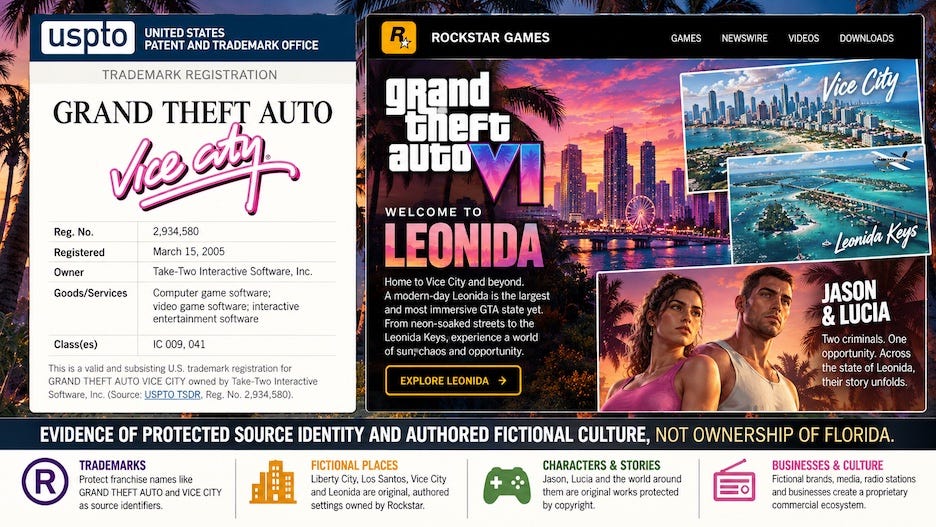
Then come trademarks. Grand Theft Auto and Rockstar identify the commercial source. Fictional locations can become brands as well. The federal trademark registration for GRAND THEFT AUTO VICE CITY and Take Two’s trademark opposition records show the company treating its fictional geography as a recognizable commercial asset. A registration for a game title doesn’t grant exclusive rights to a geographic sounding phrase in every industry. It does provide a basis for protection within the reach of trademark law.
Next are the invented businesses. Los Santos has its own consumer brands, shops, media and corporate personalities. Leonida’s official character profiles introduce a music business around Only Raw Records, alongside nightlife, real estate and the social ambitions of the people who inhabit the state. These are not simply anecdotes pasted onto buildings. They are original narrative and design elements that make the place commercially and culturally coherent.
Music adds a more complicated layer. Grand Theft Auto radio has long mixed licensed recordings with original announcers, advertisements and fictional programming. The licensed songs aren’t necessarily Rockstar’s property. Their permissions may be limited by contract and time. Yet they give the proprietary world emotional authenticity. A familiar song can make a completely invented street feel like a memory.
Behind the visible world sit less obvious assets. Take Two explains that it uses copyright, patent, trademark and trade secret law, along with contracts, to protect software and production techniques. Unreleased game builds, tools, processes, plans and proprietary technical information may be kept confidential. Employee agreements, performer contracts, music licenses and distribution arrangements bring many contributors into one commercial product. Patents can protect selected technical inventions, but the city itself is not patented as a place.
Finally, there is the living economy. Grand Theft Auto Online turns a fictional location into somewhere players return, socialize and spend. As the company describes its strategy, Rockstar favors durable titles that support additional content and purchases over time. The intellectual property earns not only when a copy is sold, but when a player continues participating inside the world.
The Economics of an Imaginary America
This approach has worked on an extraordinary scale. Take Two reports more than 470 million units sold into distribution across the Grand Theft Auto franchise, with nearly 230 million for Grand Theft Auto V alone in its 2026 investor materials. GTA V has crossed three console generations. GTA Online has continued to receive updates, and GTA+ introduced another recurring commercial relationship. These figures measure a franchise, not the independent market value of Liberty City or Vice City. Still, they demonstrate the value of a setting that can outlast a single release.
The next test arrives November 19, 2026, the announced release date for GTA VI. Rockstar’s expansion from Vice City to Leonida is significant because a state can contain many more stories than a city. Keys, wetlands, highways, small towns, recording studios and tourist economies can coexist inside the same invented jurisdiction. The company is creating room for more characters, products, media and future experiences.
The opportunities are no longer confined to a screen. Rockstar has already advertised new collectible merchandise inspired by a fictional Leonida television show. A made up program inside a made up state can become a real product sold to real customers. That is intellectual property moving from the story world into the marketplace.
A Place Competitors Can’t Simply Copy
A rival developer can create another crime game. It can invent a coastal city, fast cars and unruly police. It can even parody Florida. What it can’t readily reproduce is the specific combination of characters, places, visual expression, brands and audience recognition accumulated over decades around Vice City and the larger Grand Theft Auto universe.
That is the central lesson of the IP Stack. The copyright protects the expression. The trademarks protect source identity. Contracts secure contributions and licenses. Trade secrets protect what hasn’t been revealed. Technical rights and production know how help build the world. Online relationships keep the audience returning. None of those layers alone explains the franchise. Together, they create a competitive advantage that grows with every memorable visit.
Rockstar didn’t merely build a game set in America. It built another America, one in which it can own much of the commercial culture. The most valuable thing about Vice City may not be what happens there. It may be that millions of people already know how to get around a place that has never existed.