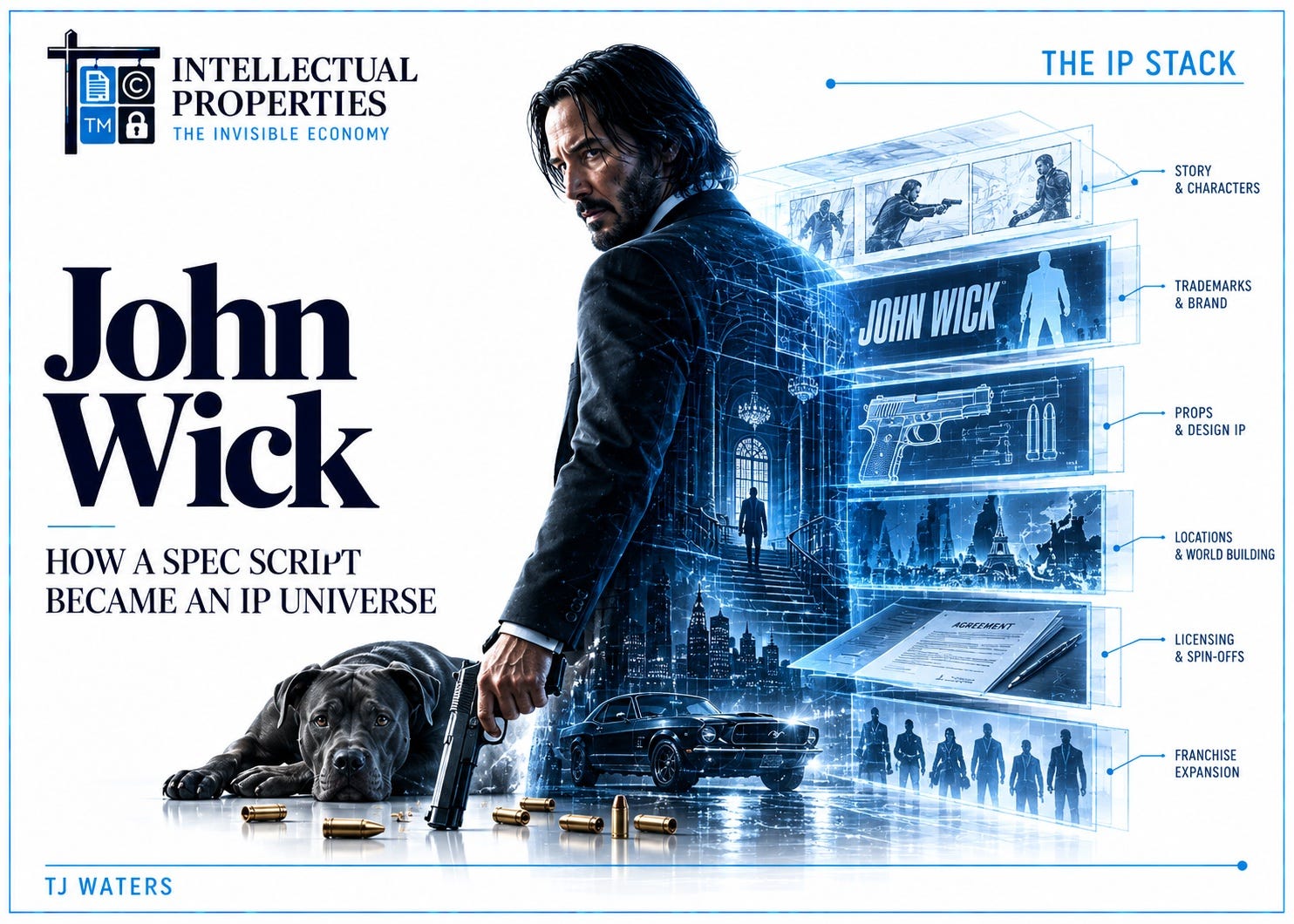

John Wick began with a dead puppy, a stolen car, and a screenplay nobody could have known was a billion-dollar franchise. In 2012, screenwriter Derek Kolstad wrote a revenge thriller called Scorn. The hero was not conceived as Keanu Reeves. He was an older, retired killer — a man whose reputation arrived in the room before he did. Kolstad has described the script as a kind of long-delayed overnight success: he had spent roughly fifteen years trying to make it in Hollywood before this one finally moved.
The premise was almost aggressively simple. Someone hurts the wrong man. The wrong man turns out to be the worst possible man to hurt. But buried inside that familiar revenge story was the beginning of something far more valuable than a plot: a world. There was a mysterious hotel called the Continental. There were gold coins. There were rules. There was an unseen criminal order operating beneath ordinary society. The original screenplay was reportedly far more grounded than the movie that followed, but those little pieces of mythology were already there. They were the seeds of the IP.
Producer Basil Iwanyk and Thunder Road Pictures saw enough in Scorn to move quickly. Then Keanu Reeves read it. Reeves liked the character, but he also seems to have understood something important about the property: John Wick was more interesting than Scorn. In fact, Reeves kept referring to the project by the character’s name until everyone eventually surrendered. The title changed. A screenplay named for an emotion became a franchise named for a person.
Then the Stuntmen Got the Keys
The next transformation may have been even more important. Reeves took the script to Chad Stahelski and David Leitch, stunt veterans he knew from The Matrix. They were not merely interested in staging the action. They saw a mythology hiding behind it. Stahelski has described imagining the Continental as part of an underworld with the scale of Dante, secret societies, ritual, consequence, and rules. The gunfights would not simply interrupt the story. They would become part of the storytelling.
That distinction matters. Plenty of movies have assassins. Plenty have revenge. Plenty have expensive cars, tailored suits, martial arts and firearms. John Wick assembled those ingredients into a recognizable system. The choreography became a signature. The Continental became a place audiences wanted to visit. The coins became objects fans wanted to own. The High Table became an institution capable of generating stories without John Wick even being in the room. In IP terms, the movie stopped being a character plus a plot and became a platform.
It was not an obvious blockbuster. The first film cost roughly $20–30 million and earned about $86 million worldwide. Respectable, certainly. But the economics got better with every trip back to the Continental. Chapter 2 reached roughly $171 million worldwide. Chapter 3 climbed above $327 million. Chapter 4 became the franchise’s theatrical high-water mark at about $440 million according to Lionsgate. Four John Wick films crossed $1 billion in worldwide box office.
The Real Asset Was the World
The clever part is what happened around the movies. Lionsgate did not have to keep asking the same question — how many more times can John Wick shoot his way through another room? — because the filmmakers had accidentally built a universe with detachable parts. The Continental could become a television prequel. The Ruska Roma could support Ballerina. Caine, the blind assassin introduced in Chapter 4, could walk into his own story. Even a gold coin could leave the screen and become merchandise.
That is where the John Wick story becomes especially interesting as intellectual property. The valuable thing is no longer only copyright in four movies. It is the stack: copyrighted characters and stories; trademarks around the franchise and its branding; licensing rights for games, apparel and collectibles; recognizable trade dress and iconography; and a growing body of fictional institutions, customs and lore that can be recombined into new products. Lionsgate’s merchandising program has stretched into figures, apparel, statues and replicas. The franchise even entered gaming early through a Payday 2 collaboration and later John Wick Hex.
There is also a useful warning hidden in Hex. The game was removed from digital storefronts after its license expired. That is IP in its least romantic form. A fictional assassin may be immortal. A license agreement is not. The ability to keep selling someone else’s universe lasts exactly as long as the contract says it does.
So What Comes Next?
The obvious answer is, more John Wick. But the more interesting answer is that Lionsgate no longer needs every John Wick product to be about John Wick. In 2024 the studio announced a Caine feature starring Donnie Yen, continuing the character’s story after Chapter 4. Lionsgate has also said another film following the events of Chapter 4 is in development. The franchise is becoming less like a film series and more like a fictional platform.
The strongest evidence may be the next video game. In February 2026, Lionsgate and Saber Interactive announced a new AAA John Wick game for PlayStation 5, Xbox Series X|S and PC. Keanu Reeves and Chad Stahelski are involved, and the game is not simply replaying one of the films. It is being built as an original story set years before Wick’s ‘Impossible Task.’ That matters because it treats the franchise’s timeline itself as licensable creative territory.
And that may be the future of John Wick, not Chapters 5, 6 and 7 until Reeves needs a walker with a gun rack. The more durable strategy is to keep opening doors inside the world: the High Table, the Continental network, the adjudicators, the Ruska Roma, Caine, earlier chapters in Wick’s career, perhaps stories in cities where John Wick never appears at all. The IP can expand sideways instead of merely forward.
There is a nice irony in all of this. John Wick is a story about a man desperately trying to get out. The intellectual property built around him keeps finding ways to pull him back in. Derek Kolstad started with a revenge script called Scorn, Reeves gave it a better name, then Stahelski and Leitch gave it a visual language. Thunder Road and Lionsgate gave it scale. Audiences gave it value. Somewhere along the way, the deadliest man in the room became something even harder to kill: A franchise!