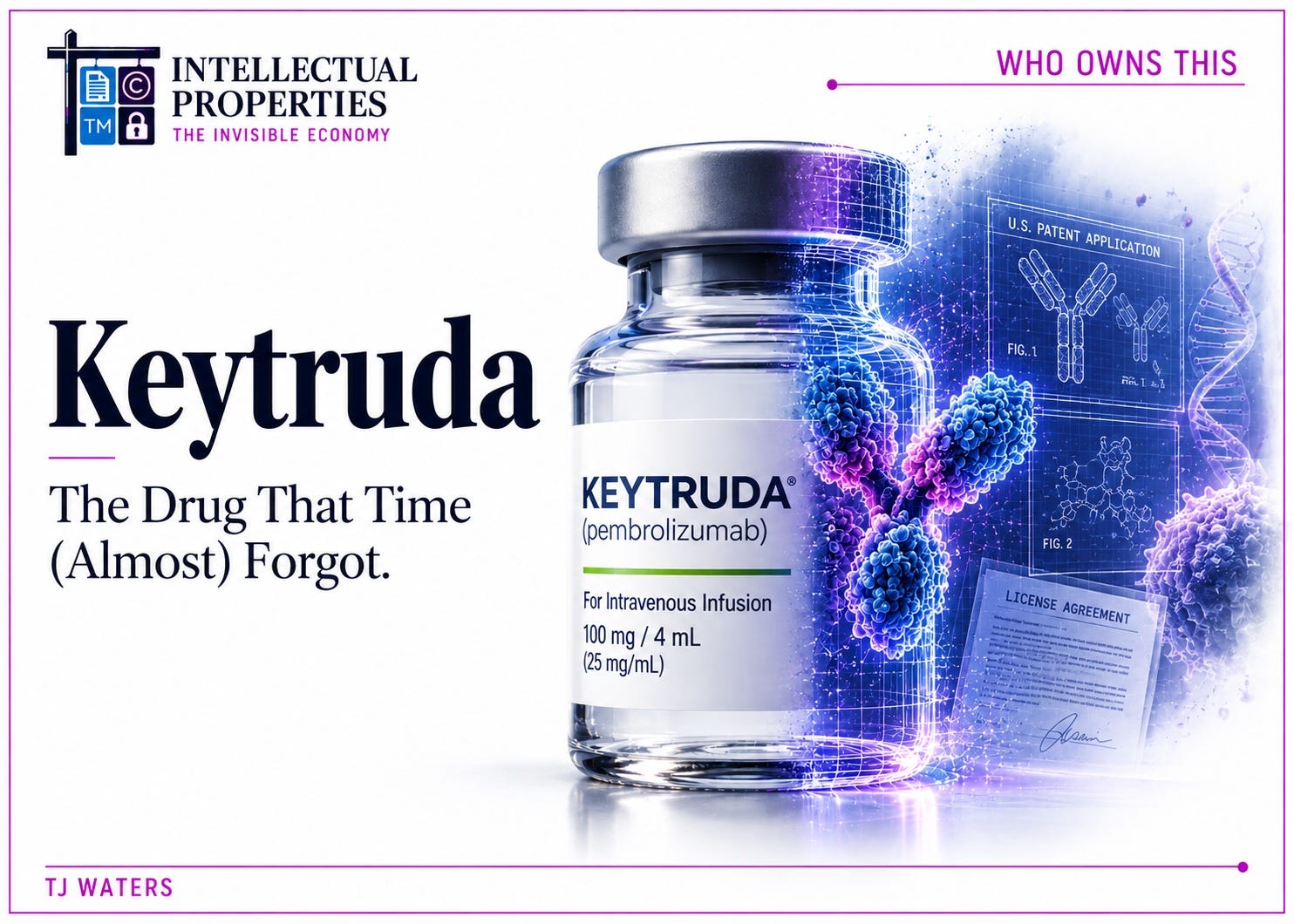

Somewhere inside Merck in 2010 sat an experimental antibody with no sales, no FDA approval, and no obvious place in the company’s strategy.
Merck had not invented it. Merck had acquired a company, that had acquired a company, that invented it! The molecule had changed corporate parents, changed internal identification numbers, and nearly changed owners again. Today, we know it as Keytruda. That makes the beginning difficult to reconcile with the ending. Because it’s origin story begins with a brake.
The immune system is remarkably good at finding things that do not belong; viruses, bacteria, and other abnormal cells. But an immune system that attacks everything would be almost as bad as the threats it is designed to stop. So the body also has mechanisms that tell immune cells when to stand down. One of those mechanisms involves a protein called PD-1.
PD-1 sits on certain immune cells, including T cells. When it receives the proper signal from proteins such as PD-L1, the T cell reduces its activity. Think of a security guard at a locked door. Someone approaches and so the guard prepares to intervene. When a visitor produces the correct credential, the guard steps aside. Cancer figured out how to manufacture that credential.
Many tumors exploit this checkpoint, effectively telling the immune system, “Nothing to see here.” Pembrolizumab (the molecule that became Keytruda) blocks PD-1 and interrupts that conversation. It does not attack the tumor in the way legacy chemotherapies do. It removes one of the brakes that prevents the immune system from attacking it. The science behind that idea came from years of basic research.
Tasuku Honjo and his colleagues identified PD-1 in the early 1990s, and helped establish its role as an immune regulator. James Allison pursued another checkpoint, CTLA-4. Their work on negative immune regulation ultimately earned Honjo and Allison the 2018 Nobel Prize in Physiology or Medicine. What began as basic research into how the immune system regulates itself was becoming an entirely new way to treat cancer.
But the antibody that became Keytruda did not begin at Merck. It originated at Organon, a Dutch pharmaceutical company, where Gregory Carven, Hans van Eenennaam, Gradus Dulos and colleagues worked to create antibodies capable of binding to human PD-1. That IP trail is unusually clear: the Organon patent family identifies Carven, van Eenennaam and Dulos as inventors on antibodies directed to the human PD-1 receptor. Their work produced the antibody that would eventually become pembrolizumab. But then the ownership of it started moving.
Schering-Plough acquired Organon BioSciences in 2007. Pembrolizumab came with the portfolio. In 2009, Merck completed its roughly $41 billion merger with Schering-Plough and inherited the antibody. (Nobody spent $41 billion to buy Keytruda. That is the fascinating IP lesson. More on that in a bit.)
Acquisitions are usually valued around things everyone can see: Revenue, products, market share, manufacturing, distribution, and promising late-stage pipeline assets. But intellectual property can hide inside a transaction like a mineral deposit beneath a farm. Yes, the buyer purchases it. But the buyer doesn’t always understand what it now owns.
After the merger, Merck had to understand its much larger research portfolio. Experimental drugs compete for money, scientists, clinical resources, and years of development. Pembrolizumab was still largely a promise. The program fell to low priority and came close to being licensed away before Merck reactivated it and shifted toward human testing.
The first-in-human study, KEYNOTE-001, began in 2011. Competition also helped change the context. Bristol Myers Squibb was moving aggressively into immune checkpoints with drugs that became Yervoy and Opdivo. Suddenly, Merck was not evaluating an obscure inherited antibody in isolation. A competitor was spending serious money to validate the category. The molecule had not changed, but the market had.
KEYNOTE-001 became far larger than a conventional Phase I study as researchers kept finding reasons to ask additional questions. More patients were enrolled. More cancers were tested. Dosing, biomarkers, previous treatments, and responses were explored. The study also produced important evidence in non-small-cell lung cancer; the 2015 New England Journal of Medicine report described pembrolizumab activity and the relationship between PD-L1 expression and treatment response.
Merck’s attention to PD-L1 as a biomarker was strategically important. Rather than pretending the drug would work equally well for everyone, researchers tried to identify tumors more likely to respond to PD-1 blockade. A smaller target population could produce clearer evidence, stronger results, and a faster regulatory path. Then the results began turning an inherited research asset into a franchise.
In January 2013, pembrolizumab received FDA Breakthrough Therapy designation. On September 4, 2014, the FDA granted accelerated approval to Keytruda for certain patients with unresectable or metastatic melanoma whose disease had progressed after prior therapy. It was the first FDA-approved anti-PD-1 therapy in the United States. Melanoma proved the concept, but lung cancer changed the scale.
Keytruda moved into non-small-cell lung cancer, then into first-line treatment and combinations with chemotherapy. Merck expanded development across cancers, treatment stages, biomarkers, and drug combinations. At that point, it morphed from a single drug and started behaving like a platform.
Its reach now is remarkable. The current FDA prescribing information spans melanoma, non-small-cell lung cancer, head and neck cancer, classical Hodgkin lymphoma, urothelial cancer, colorectal cancer, gastric and gastroesophageal cancers, cervical cancer, renal-cell carcinoma, endometrial carcinoma, triple-negative breast cancer, esophageal cancer, cutaneous squamous-cell carcinoma and other settings with specific biomarkers, treatment combinations, or stages of disease.
Perhaps the clearest sign that something had changed came in 2017. The FDA approved pembrolizumab for certain tumors where the cells cannot correctly fix DNA copying errors, (leading to a high number of mutations). The National Cancer Institute described it as the first FDA approval of a cancer treatment based on a tumor’s genetic characteristics regardless of where in the body the cancer originated. For generations, oncology organized cancer by anatomy: Lung, colon, breast, or skin. Keytruda helped present a different idea; that the mechanism meant more than its mailing address on the body.
Keytruda’s IP story was equally complicated. Merck owned the antibody, but it did not own every important right surrounding PD-1 cancer treatment. Bristol Myers Squibb and Ono Pharmaceutical asserted patents involving the use of anti-PD-1 antibodies to treat cancer. In 2017, Merck settled the worldwide patent litigation, paying $625 million upfront and agreeing to royalties of 6.5 percent through 2023 and 2.5 percent from 2024 through 2026.
That is what real commercialization often looks like. A blockbuster does not always emerge from a perfectly fenced estate of patents owned by one company. Valuable technologies can sit inside overlapping rights. Sometimes the objective is not to own everything. It is to own enough, (and secure access to the rest), to build the business.
By 2025, Keytruda and Keytruda Qlex generated approximately $31.7 billion in worldwide sales. Merck’s SEC filing shows how extraordinary the transformation had become: one molecule inherited through an acquisition had grown into the company’s dominant oncology franchise. And then the story approaches another IP turn.
Keytruda’s exclusivity won’t last forever. Merck has told investors that biosimilar competition in the United States could begin in December 2028, when the primary compound patent expires. Two related composition-of-matter patents extend into 2029, and litigation could affect the exact timing. But 2028 is when Merck expects the U.S. franchise could begin facing biosimilar competition.
That creates an almost perfect closing chapter to the IP story. A molecule that began as a piece of Organon intellectual property, traveled through two acquisitions, nearly lost its place in a corporate portfolio, survived a major patent dispute, and became one of the world’s most commercially important medicines is now approaching the bargain built into the patent system itself.
Patents are temporary, but the knowledge they contain is not. Keytruda began as scientific insight into an immune-system brake. Organon turned that insight into an antibody, Schering-Plough acquired Organon, and then Merck acquired Schering-Plough. The molecule survived long enough for clinical evidence to catch up with the idea, and then accumulated uses one cancer at a time.
One indication became several. A drug became a platform. An inherited piece of intellectual property became a $30-billion-a-year franchise. And in 2028, the protection that helped make that investment possible begins giving way to the next stage of the story. Success makes history look inevitable. But Keytruda was anything but inevitable. Merck didn’t simply commercialize a remarkable drug. It learned, (just in time), what it owned.
This story has a particular resonance for me. My father missed out on Keytruda by only a few months, his small cell lung cancer getting diagnosed in April 2015 and he was gone in July . I miss him every day, but I take comfort that many other patients now have a treatment option he never had.