
A Fortress Full of Competitors
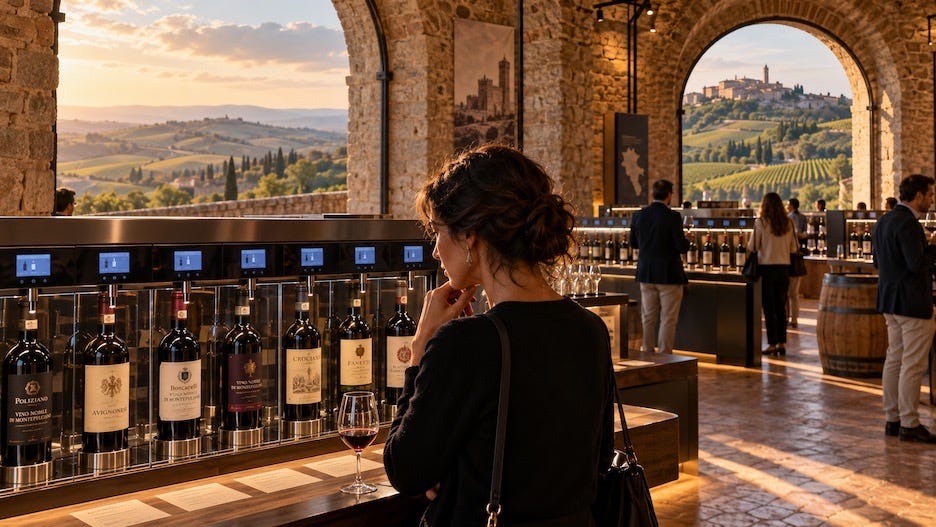
At the top of a Tuscan hill town, inside an ancient fortress, an unusual business arrangement awaits anyone with a glass and a little curiosity. Wines from competing producers sit within reach of the same customer. Visitors can select their own pours from automated dispensers, using rechargeable cards, or seek advice from the people who know the wines. Through the windows, the countryside that gave those bottles their identity stretches toward the horizon. The competitors have agreed to share the stage.
There is no mystery about why an individual vineyard wants customers to recognize its label. The surprise is why dozens of vineyards want those same customers to recognize somebody else’s label, too. Montepulciano has an answer. Before a winery can sell its own story, someone must persuade the world that the place itself is worth remembering.
The Name Everybody Needs
The first business problem is that the region’s most valuable commercial identifier is a name that any one producer can’t simply claim as its private property. Vino Nobile di Montepulciano refers to a defined wine from a defined place, produced under specific rules. The Tuscan town of Montepulciano isn’t the Montepulciano grape associated with Montepulciano d’Abruzzo. One name points to a Tuscan place and the other, in that context, to a grape grown in Abruzzo. For shoppers, the similarity can be confusing. For producers, educating customers is part of the cost of doing business.
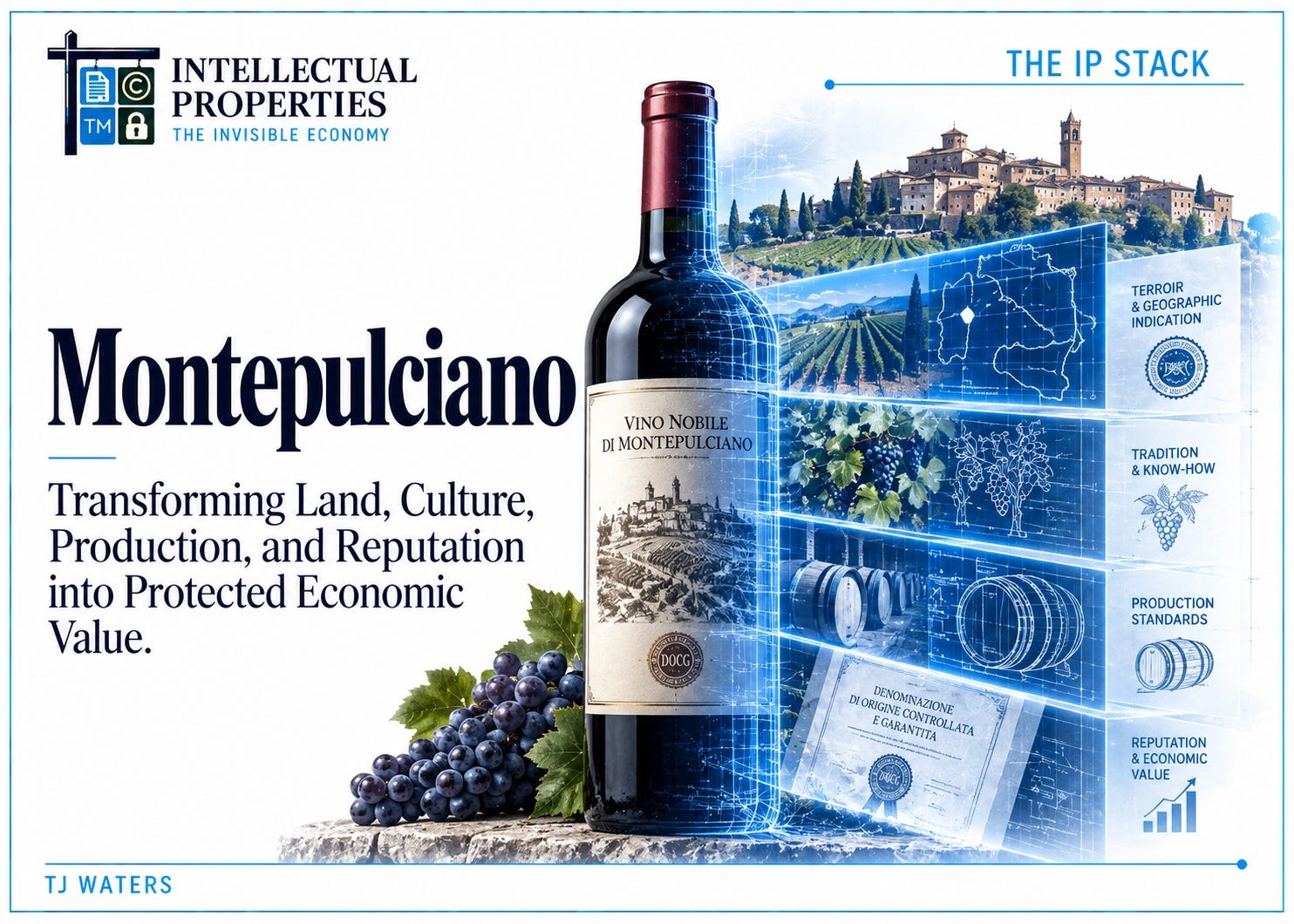
The Consorzio del Vino Nobile di Montepulciano was founded in 1965 to defend and promote the wine’s reputation. The designation received Denominazione di Origine Controllata (DOC) recognition (enforcing strict regional and production rules) in 1966. The highest quality tier, Denominazione di Origine Controllata e Garantita (DOCG), adding mandatory government taste tests and numbered neck seals, was reached in 1980. What had long been a regional reputation acquired a formal, enforceable structure, as it became the first Italian wine to carry the nation’s DOCG seal.
That structure is also a constraint. The familiar Vino Nobile rules require at least 70 percent Sangiovese, known locally as Prugnolo Gentile, together with limits on the other grapes and methods of production. A producer can’t simply borrow the celebrated name for wine made anywhere, in any way. Participation requires compliance. The collective reputation is valuable partly because the rules make it difficult to imitate.
The Stack Beneath the Bottle
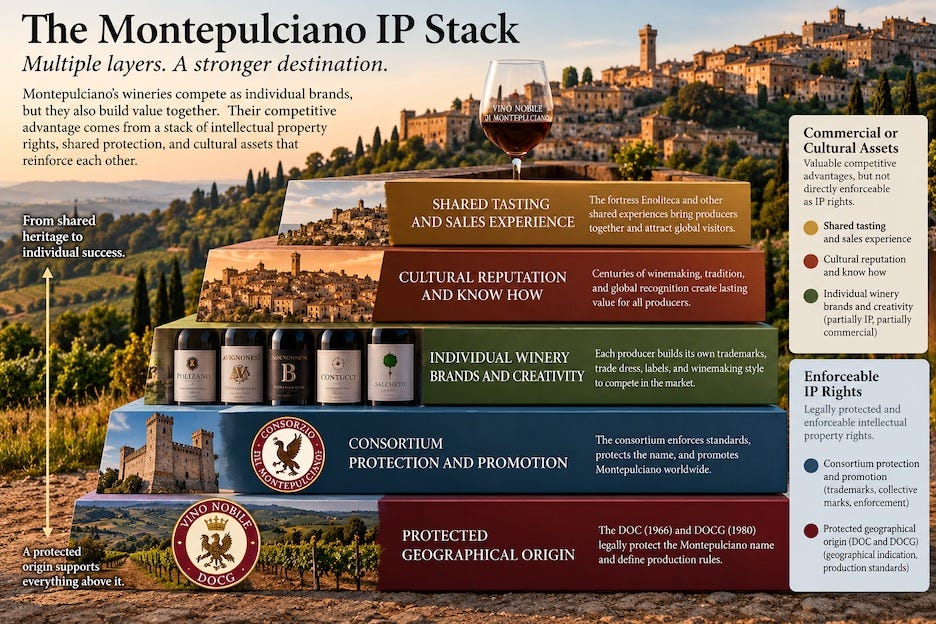
The foundation is geographical indication protection. Under the European Union’s system, a protected designation of originlinks a product’s identity to its territory and required production practices. It is an intellectual property right, but it doesn’t operate like a winery’s ordinary brand trademark. Qualified producers may use the protected designation when their wines meet the specifications. No single winery gets to exclude the others merely because it used the name first. The protected name belongs to a regulated collective system rather than to a favored bottle.
The next layer is the consortium itself. It coordinates promotion, protects the shared identity, and helps producers speak with a recognizable voice outside Tuscany. The consortium reports trademark registrations in more than 50 countries as part of its work against counterfeiting. Those registrations complement geographical indication protections, but they shouldn’t be mistaken for ownership of every winery’s brand or unrestricted private ownership of the designation. The legal rights differ by jurisdiction and by registration.
Above the collective identity sit the individual wine estates. Their house names, label designs, bottle presentation, domain names and distinctive marketing materials can help buyers choose one producer over another. Trademark rights can protect appropriate names and symbols. Copyright may protect original label artwork and photography. Particular vineyard practices, blending decisions, customer knowledge and cellar methods may generate know how, and some confidential methods or commercial information may qualify for trade secret protection. None of those rights gives an estate a monopoly on winemaking itself. Nor does a picturesque vineyard become copyrighted simply because tourists photograph it.
Then comes the cultural layer. Montepulciano’s architecture, landscape, cellars and historical associations make the location itself part of the product experience. This is powerful brand equity, but scenery and centuries of history aren’t automatically exclusive IP. Their value is made more commercially useful by protected names, owned creative materials, authentic experiences and businesses that convert a visit into a continuing customer relationship.
Finally there is the distribution and experience layer. The consortium’s Enoliteca, opened in the fortress setting that also became the consortium’s headquarters in 2016, brings together wines from participating producers. Its public description advertises more than 100 appellation labels and self directed tasting through wine dispensers. The physical space, retail operation and relationships with visitors aren’t themselves a new statutory IP category. They are the machinery that turns the other layers into recognition, trial purchases and potential loyalty.
The Next Layer Is Smaller
In 2025, the region added another chapter. The ‘Pieve’ classification recognizes twelve smaller geographical areas within the designation. Its development drew on geological, geographic and historical research, including names associated with older parish territories. The rules are more demanding than the broader designation. They require at least 85 percent Sangiovese, vineyards at least fifteen years old and a longer maturation period. The first commercial Pieve wines came from the 2021 vintage.
Think about what that does to the competitive system. The principal designation tells buyers where the wine comes from and what standards it meets. Pieve offers another level of origin information and production discipline. Producers who qualify can explain a more specific place within the region. They haven’t invented another grape or a different category of legal ownership. They have made the existing regional identity more detailed, more verifiable and potentially more valuable.
What the Numbers Reveal
This is more than an attractive cooperative story. In February 2026 the consortium reported that 6.4 million bottles of Vino Nobile and 2.5 million bottles of Rosso di Montepulciano entered the market in 2025. It reported that 64.5 percent of Vino Nobile sales went to international markets, along with approximately €65 million in average annual wine production value. These are consortium figures, not a valuation of the geographical indication or of the region’s IP. But they make the commercial stakes clear. A shared identity can serve an export business at a scale few individual producers could easily build alone.
There is an unavoidable tension in this arrangement. Stronger regional recognition may bring more buyers to Montepulciano, but it may also help rival wineries. Tighter specifications can reinforce trust while increasing production costs or limiting what producers can make. A common tasting room invites customers to compare labels in the same sitting. The consortium’s achievement isn’t eliminating competition. It is arranging for cooperation at the level where everybody needs it and competition at the level where customers can still choose.
The Asset Nobody Can Buy
A winery can purchase land, build a cellar, register a distinctive trademark and hire a talented winemaker. What it can’t buy, by itself, is the accumulated credibility of a place whose reputation has been built by generations of unrelated competitors. That reputation isn’t a single transferable patent or a logo held in a drawer. It is supported by a stack of legal protections, common rules, individual brands, histories and experiences that reinforce one another.
The lesson from Montepulciano extends well beyond wine. Some businesses must compete harder together before they can compete successfully apart. In those markets, the most valuable asset may be the one nobody is permitted to own alone.