

A Rocket Engine With Two Owners?
At a test site in Briggs, Texas, a rocket engine roars to life. Its exhaust turns the evening sky into a sheet of fire. The Miranda engine is powerful enough to help lift an enormous spacecraft, but the most interesting thing about it can’t be seen in the flame. It’s buried in the engineering drawings, manufacturing processes, patent rights and contractual permissions that make the engine possible.
Now imagine buying that engine. Better yet, imagine paying for the right to manufacture your own copies. Would the invention become yours? Would you own the design, the technology, the patents? Or would you merely have permission to use someone else’s intellectual property?
On November 6, 2026, Firefly Aerospace and AST SpaceMobile announced a transaction valued at more than $1.3 billion. The company announcement explains that Firefly will deliver 36 engines, provide engineering assistance and license AST to manufacture the engines itself. Firefly, however, keeps ownership of the engine IP.
The Business Problem Behind the Flames
AST SpaceMobile is building a satellite communications network intended to connect ordinary mobile phones from space. Satellites are only useful once they reach orbit and getting them there means depending on launch providers whose schedules and priorities may not match your own. AST wants to build a heavy rocket called Blacklift, with a first launch targeted for 2028.
The obstacle is the engine. A rocket engine is not a component you casually order from Amazon, much less a technology you can recreate over a long weekend. It demands years of testing, specialized materials, manufacturing precision and expertise in controlling extreme temperatures and pressures. A mistake can destroy the rocket, the payload and a considerable amount of money.
Firefly has already invested in that capability. Its Miranda engine has completed more than 175 hot fire tests according to the November company release. The company says its engines draw upon its patented tap off cycle technology and earlier propulsion designs. AST can therefore obtain a head start on its own rocket program without first recreating the entire research and development journey.
But Firefly has a problem of its own. Building rockets requires factories, test facilities, engineers and capital. Demand for launch capacity may be growing, but growth consumes cash long before any rocket reaches a paying customer. So Firefly has something more interesting to sell than a shipment of engines. It has accumulated technical knowledge that another company desperately needs.
Who Owns What?
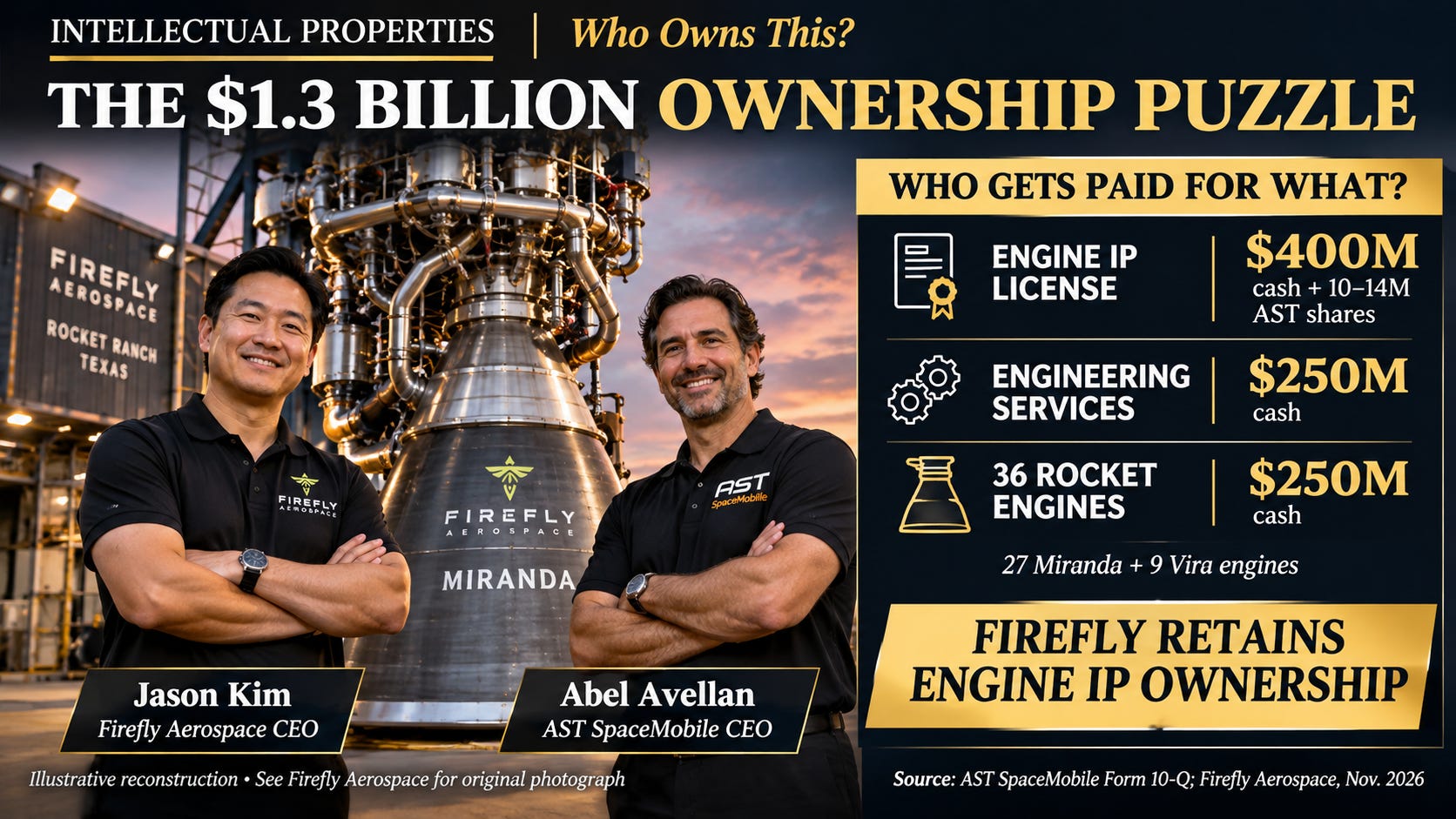
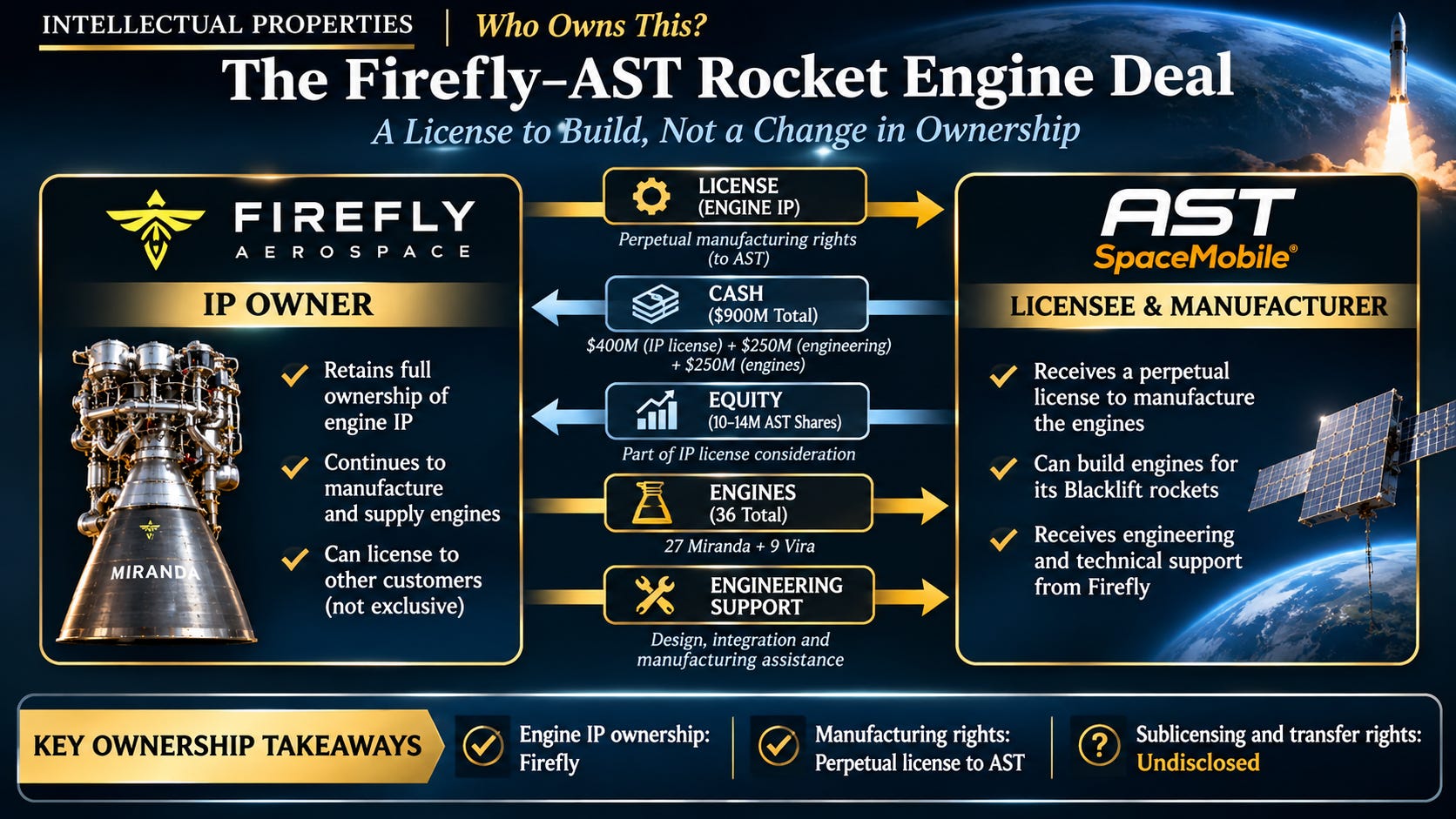
The public filings reveal a carefully separated deal. Under the AST quarterly filing, they are to receive a perpetual license to manufacture Miranda and Vira engines. In return for the license, AST will pay $400 million in cash plus an estimated 10 million to 14 million shares of its Class A common stock. That is the part of the transaction most directly associated with the IP.
Separate agreements call for $250 million in engineering and support services over three years and another $250 million for engines for the first three Blacklift rockets. Those engines comprise 27 Miranda units and nine Vira units. Add the license cash, services and hardware, and the stated cash consideration totals $900 million. The shares supply additional value, explaining the overall deal exceeding $1.3 billion. That figure is the estimated value of the overall package, not a $1.3 billion patent royalty.
The distinction is fundamental to the ownership question. Firefly owns the underlying engine IP. AST receives a contractual right to manufacture engines using specified Firefly technology. AST will also own the physical engines it purchases, subject to ordinary contractual terms. Neither buying the hardware nor acquiring a manufacturing license transfers the underlying patents or the entire body of associated know how.
There is another important aspect. A perpetual license describes duration, not unlimited freedom. It doesn’t, by itself, tell us whether AST may sublicense the technology, sell engines to unrelated customers, transfer the license or modify a protected design. Those details depend on provisions that haven’t been disclosed publicly. Firefly’s investor presentation confirms that it retains full ownership of its engine IP and expects to keep serving the wider launch market.
The license and the supply arrangement also provide different forms of control. In the early launches, AST relies on Firefly for finished engines and engineering support. Over time, manufacturing rights may allow AST to bring more of that production under its own roof. Firefly gives up some exclusivity in manufacturing, but it hasn’t sold the invention itself.
The Competitive Consequences
For AST, the prize is control of its launch schedule. It is attempting to reduce a strategic dependency without spending years inventing a rocket engine from scratch. Its engineers can focus on integrating propulsion into Blacklift and delivering satellites to orbit. That is a business advantage even if the patents remain on someone else’s balance sheet.
For Firefly, the same agreement could fund faster hiring, more testing capacity and expanded production of its own launch vehicles. The company says it plans additional test bays at its Texas facility. Rather than wait for each future launch contract to finance growth, Firefly can monetize technology it already developed and use the proceeds to strengthen its primary business.
This doesn’t mean the deal is risk free. Firefly must deliver engines and technical support, and the agreement depends on meeting conditions and milestones. AST’s SEC disclosure specifies that closing was expected during the fourth quarter of 2026, subject to customary conditions. The share component exposes Firefly to market volatility and liquidity considerations. And a licensed manufacturer may eventually develop capabilities that change the balance between supplier and customer.
Yet the two companies describe their businesses as complementary rather than directly competitive. Firefly intends to keep selling launch services and propulsion expertise. AST wants dependable access to orbit for its satellite network. That difference in business models is what makes licensing a powerful option rather than an perceived surrender.
The Invention Stays Home
There is an old assumption that the best way to profit from an invention is to build the product yourself and prevent everyone else from doing the same. Sometimes that is right. But patents and trade secrets can also create value by giving other companies access to technology they could never afford to develop independently. We see this quite a bit in university licensed technologies, which allow companies to jumpstart commercialization.
Firefly found a way to sell the engines, sell the expertise and sell the permission to manufacture more engines. AST gets a shortcut toward its own launch capability. Neither company needs to pretend that permission and ownership are the same thing.
The lesson for anyone managing IP, from a university laboratory to a global manufacturer, is wonderfully simple. You don’t always have to sell an invention to get paid for it. Sometimes the smartest move is to keep the invention and sell someone else the right to put it to work.