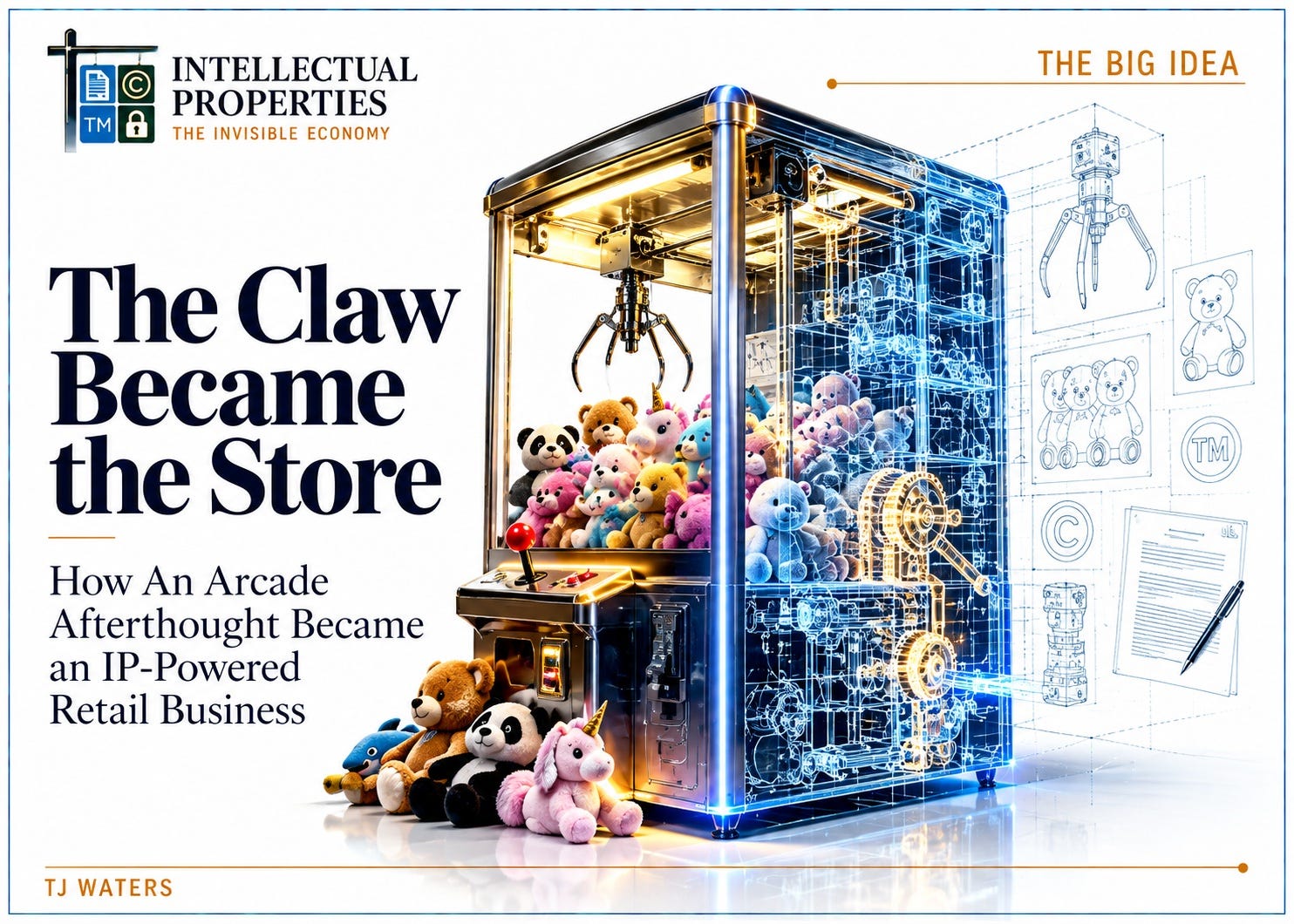

For most of its life, the claw machine was where quarters went to die.
You know the machine. A stuffed animal sits six inches from the prize chute. You line up the claw perfectly. You press the button. The metal fingers descend, close around the toy, lift it toward freedom, and then, (almost insultingly), let go.
The bear falls back into the pile and you walk away. That was the business model. Or at least it seemed to be. The claw machine was a little box of frustration wedged between skee-ball and the exit. Nobody built a Saturday night around it.
They do now.
The Wall Street Journal recently chronicled the rise of dedicated “clawcades”, storefronts filled almost entirely with claw machines, glowing under neon lights and stocked not with anonymous stuffed animals but instead with recognizable characters, collectibles and, (occasionally), luxury goods. CoStar reports these businesses are moving out of niche Asian shopping districts and into mainstream American malls and shopping centers.
The strange part is that nothing about the machine itself is new; but the business model around it is.
Winning Changed
The old claw-machine operator had a simple precept; make the prize difficult to win. Every toy that stayed inside the cabinet protected the margin. The new operators discovered something more valuable than the toy - the return visit.
CommonWealth Magazine documented this transformation in Taiwan, where large claw arcades started replacing cheap plush with snacks, drinks and even household goods. More importantly, operators made the machines easier. The goal shifted from squeezing maximum margin from a single prize to creating high turnover, visible winners and an atmosphere in which people believed they could actually succeed.
The old model monetized failure, the new one monetizes return. That sounds like a small adjustment, but it’s not. It many ways it is borrowing some of concepts that built Las Vegas.
A customer who loses ten times and leaves angry may have produced a profitable transaction. A customer who wins twice, posts the third attempt to TikTok, then trades two prizes toward a larger one and comes back next weekend is an asset.
The Prize Changed, Too
And this is where the invisible economy starts to appear.
A generic teddy bear has manufacturing cost, shipping cost and retail value. Pikachu has all of those things plus intellectual property. So does an anime figure, a designer toy, or a character that somebody has spent years turning into a tiny emotional shortcut.
Bandai Spirits does not treat crane-game merchandise as leftover inventory. Its Banpresto operation plans prizes specifically for amusement facilities, emphasizes the “worlds” of the underlying IP, and commercializes more than 1,800 figures and premium products annually. In a separate history of its World Collectable Figure line, Bandai Spirits describes a deliberate effort to make the prize itself the reason people came to the arcade.
That is an amazing reversal. The game used to make the prize interesting; now the prize makes the game interesting. And because licensed characters arrive with built-in fandom, the operator no longer has to create desire from scratch. The character did that years ago. The clawcade simply places a game between desire and possession.
The IP Is Not in the Claw
Anyone can buy machines, lease a storefront, and fill a room with LED lights. If the category keeps growing, all three will become commodities. The defensible business sits outside the cabinet.
It is the trademark on the door. The visual identity of the room. The licensed characters inside the machines. The exclusive prize arrangements competitors cannot duplicate. The operating know-how governing prize cost and win frequency. The customer data showing which machine gets played, which prize moves, how long someone stays and what makes them return. It is the trade-up system, the loyalty program, the vendor relationships and eventually, the franchise manual.
And perhaps, one day, it is a character the clawcade owns itself.
Pop Mart’s filings show what ownership can look like at scale. In 2025, 99.1% of its revenue came from proprietary products, with artist IPs including THE MONSTERS, MOLLY, SKULLPANDA and CRYBABY driving the overwhelming majority. Labubu did not become valuable because plastic suddenly improved. It became valuable because a character became a world, and the world became demand.
A smart clawcade operator should understand that.
The Customer Became the Advertising
There is another reason this works today that would have been nearly useless twenty years ago; the transaction is camera-ready.
A claw attempt has suspense, movement, a near-miss and a reveal, usually in less than thirty seconds. It requires no explanation. The viewer knows exactly what is supposed to happen. So the customer does something unusual - they record the purchase.
Nobody films themselves taking a sweater to the register at Macy’s. People absolutely film a claw hovering over the one plush they have been chasing for the past twenty minutes. That turns the store into a studio, the prize into a prop and the customer into a media channel. The better operators are not simply designing for foot traffic. They are designing for the phone pointed through the glass.
What Comes Next
Round1’s 2025 integrated report says demand for crane games has grown in both Japan and the United States, helped in America by larger prize lineups, large-format machines, popular Japanese characters and a growing embrace of Japanese culture. The interesting question is no longer whether the claw can support a store as much as what the store becomes next.
Imagine a clawcade with memberships. Limited-edition drops. Exclusive character collaborations. Inter-store tournaments. Now throw in QR or NFC-authenticated prizes., digital collections tied to physical wins, and special creator nights. A loyalty app that knows what you collect. Trade-ups across locations. A house mascot that begins as a plush prize, moves into animation and apparel, and eventually gets licensed to somebody else.
At that point, the company is no longer operating claw machines. It is using claw machines as a distribution system for IP (their own as well as other creators). The entrepreneur who owns forty machines owns forty depreciating assets. The entrepreneur who builds a recognizable clawcade brand owns something better. The entrepreneur who eventually creates the character everybody comes in to win may own something better still.
The machine is visible, as is the prize. But the real business is what you cannot see through the glass.