


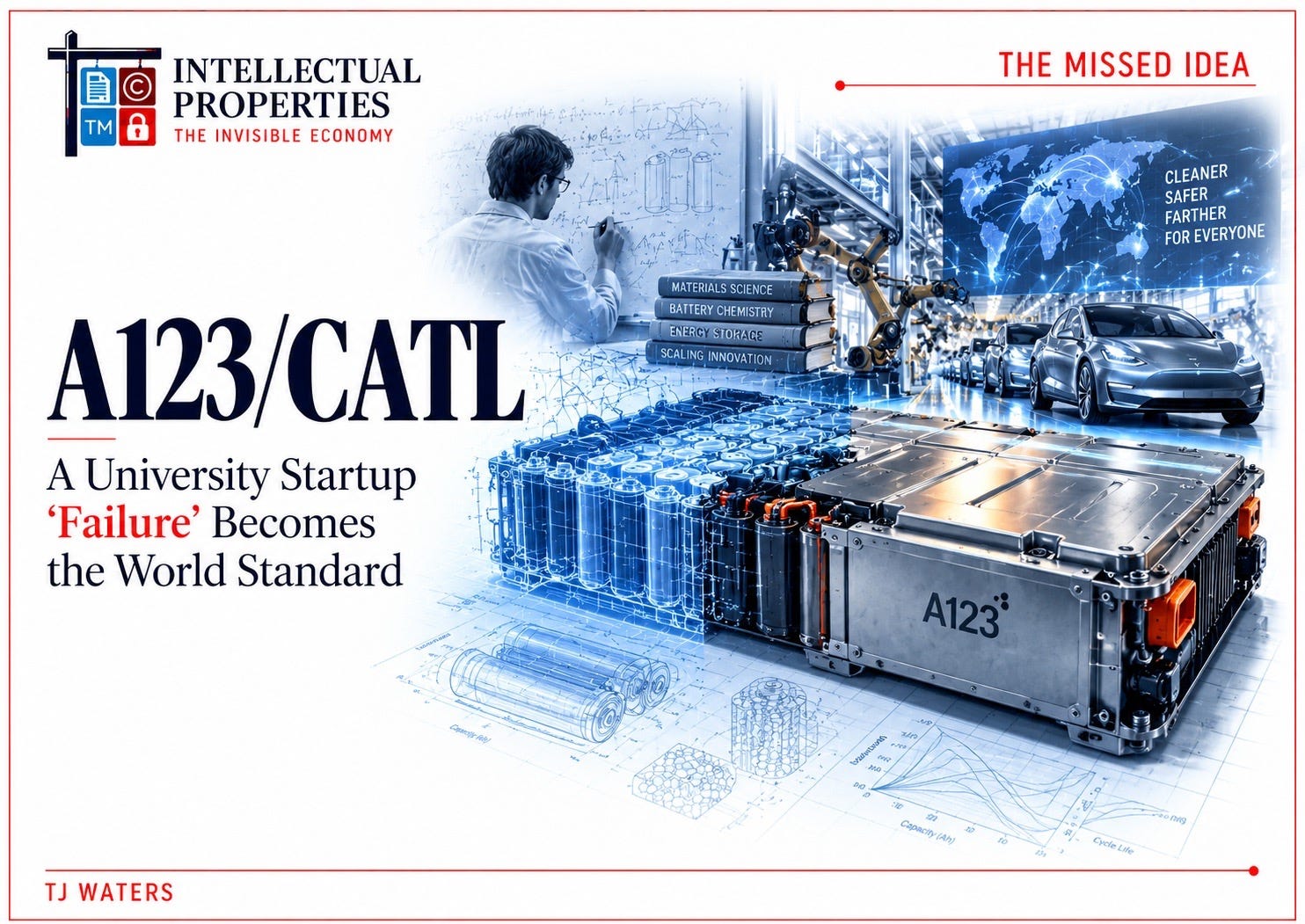
In October 2012, A123 Systems walked into bankruptcy court with the sort of assets that normally make a university technology transfer office proud. It had factories, engineers, customers, hundreds of millions of dollars in investment, and a battery technology born at MIT. The company had done what university spinouts are supposed to do. It delivered laboratory science to the real world.
Then it ran out of money.
A few months later, China’s Wanxiang Group acquired most of A123’s commercial battery business. The factories, employees, customers, intellectual property, and operating machinery moved forward under new ownership. So did something less visible: A123’s exclusive license to MIT battery patents.
That seems strange. If the licensee failed, shouldn’t the technology have returned to MIT?
Not necessarily. And buried inside the answer is one of the most useful lessons in intellectual property: Sometimes the missed idea is not the invention; it is the contract written around it.
MIT never sold A123 its patents. MIT owned the underlying patent rights and gave A123 an exclusive, worldwide, royalty-bearing license covering batteries and power supplies. The 2001 agreement was hardly casual. A123 promised a “thorough, vigorous and diligent” commercialization program. It had to raise capital, spend money on research, report its progress, pay royalties, and bring products to market. Products used or sold in the United States were generally required to be substantially manufactured here.
On paper, MIT had protected almost everything one would expect a university to protect. But a startup license has to solve two problems at once: The university wants control and investors want an exit.
Venture capitalists are understandably reluctant to pour money into a company whose most important asset disappears when the company is acquired. (Imagine buying a hotel only to discover that the deed to the lobby returns to the architect at closing.) So, technology licenses commonly contain assignment provisions allowing the agreement to move with the business. A123’s did.
Section 10 first says the agreement is specific to A123 and cannot be assigned without MIT’s written consent. Then comes the sentence that matters. A123 could assign the agreement in connection with a sale or transfer of all or substantially all of the business related to the licensed products, including through a merger, consolidation, or asset sale, provided the buyer assumed the agreement and a confidential valuation requirement was satisfied.
That is not sloppy drafting. It is commercially sensible drafting. But it also opened the door. The distinction becomes even more interesting when we ask what “failure” actually means. A123 failed financially but it did not fail to commercialize MIT’s technology. Quite the opposite.
It raised enormous amounts of capital. It built manufacturing facilities. It sold batteries, attracted automotive customers, and went public. The U.S. Department of Energy supported plans for automotive-class lithium-ion battery manufacturing near Detroit. A123 fulfilled the part of the university bargain that said ‘do something with this invention’. A123 played the game but simply lost.
University reversion provisions are normally designed to prevent a licensee from parking an invention on a shelf, (a tactic to prevent competitors from acquiring it). If a company never raises money, misses development milestones, stops paying royalties, or abandons the technology, the university needs a way to recover the rights and find someone else.
A123 was the opposite problem. It had commercialized so aggressively that the MIT invention was now surrounded by something much larger: Factories, engineers, manufacturing recipes, and testing data. There were new patents, process improvements, and trade secrets. A decade of learning what worked and, (often more valuable), what did not. MIT owned the recipe but not the restaurant.
Taking the original patent rights back would not magically reconstruct A123.
Bankruptcy law added another wrinkle. Chapter 11 is designed to preserve valuable businesses long enough to reorganize or sell them. Federal law generally prevents an executory contract from terminating solely because a company became insolvent or filed bankruptcy. Otherwise, the moment a company entered Chapter 11, its most valuable contracts could evaporate. That would leave creditors fighting over furniture.
So, the question was not simply whether A123 had filed bankruptcy. The question was whether it had breached the MIT agreement in a way that allowed termination, ceased the licensed business, or attempted an assignment the contract did not permit. Wanxiang was buying the business to continue it; MIT’s agreement had contemplated that possibility.
There is an uncomfortable economic logic here. Even if MIT could have recovered exclusivity, what exactly would it have recovered? Just the patents.
A new licensee would still need battery scientists, production equipment, suppliers, customers, safety data, quality systems, manufacturing know-how, and access to the improvements A123 had created. Wanxiang was offering to buy the operating platform and keep it alive. From a licensing perspective, the buyer looked like a solution rather than a problem.
That is where the missed idea appears.
The MIT agreement asked whether the technology would be commercialized. It asked whether A123 would invest. It asked whether MIT would be paid. It asked whether a future buyer would be substantial enough to assume the agreement. Those were all logical business questions.
It apparently did not ask another one: What happens if this technology becomes critically important and the company that successfully commercializes it is acquired by a foreign company?
That is a very different problem.
Government officials learn early that the value of information is rarely limited to the document sitting on the desk. There is the source who obtained it, the method used to collect it, the network that made access possible, and the ability to collect the next piece of information tomorrow. Technology works the same way. The patent is the document, but the factory is the collection system.
Manufacturing generates knowledge every day. Every defective cell teaches something. Every production run sharpens tolerances. Every warranty claim becomes data. Every supplier problem produces another workaround. The company that manufactures at scale is not merely producing things like batteries, it is conducting thousands of experiments. That learning does not expire with the patent. It is a separate asset all by itself.
This is why university licensing for strategic technologies may need another layer. Not an absolute prohibition on foreign ownership. That could make startups impossible to finance. Something more subtle is needed.
A foreign acquisition might convert U.S. exclusivity to nonexclusivity. The university might retain the right to license a second domestic manufacturer. A change of control could trigger review of where critical manufacturing and R&D will remain. Minimum domestic capacity could become a milestone just like first commercial sale. The goal would not be to lock the technology in a vault; it would be to create (and keep) another key.
A123 is easy to describe as a failed American battery company acquired by China. That misses the more important lesson. MIT protected the invention, A123 commercialized it, and bankruptcy preserved the operating business. Wanxiang acquired the remaining system.
Every step made sense on its own. That is precisely why the outcome matters. The missed idea was never the battery. It was recognizing that one day the system around the patents might become more valuable than the patents themselves. We’ve learned that lesson the hard way.
CATL now supplies American-invented battery technologies to Tesla, Ford, VW, Mercedes, GM, BMW, Hyundai, Toyota, Honda, and Volvo. Pretty impressive for a bankrupt university startup!