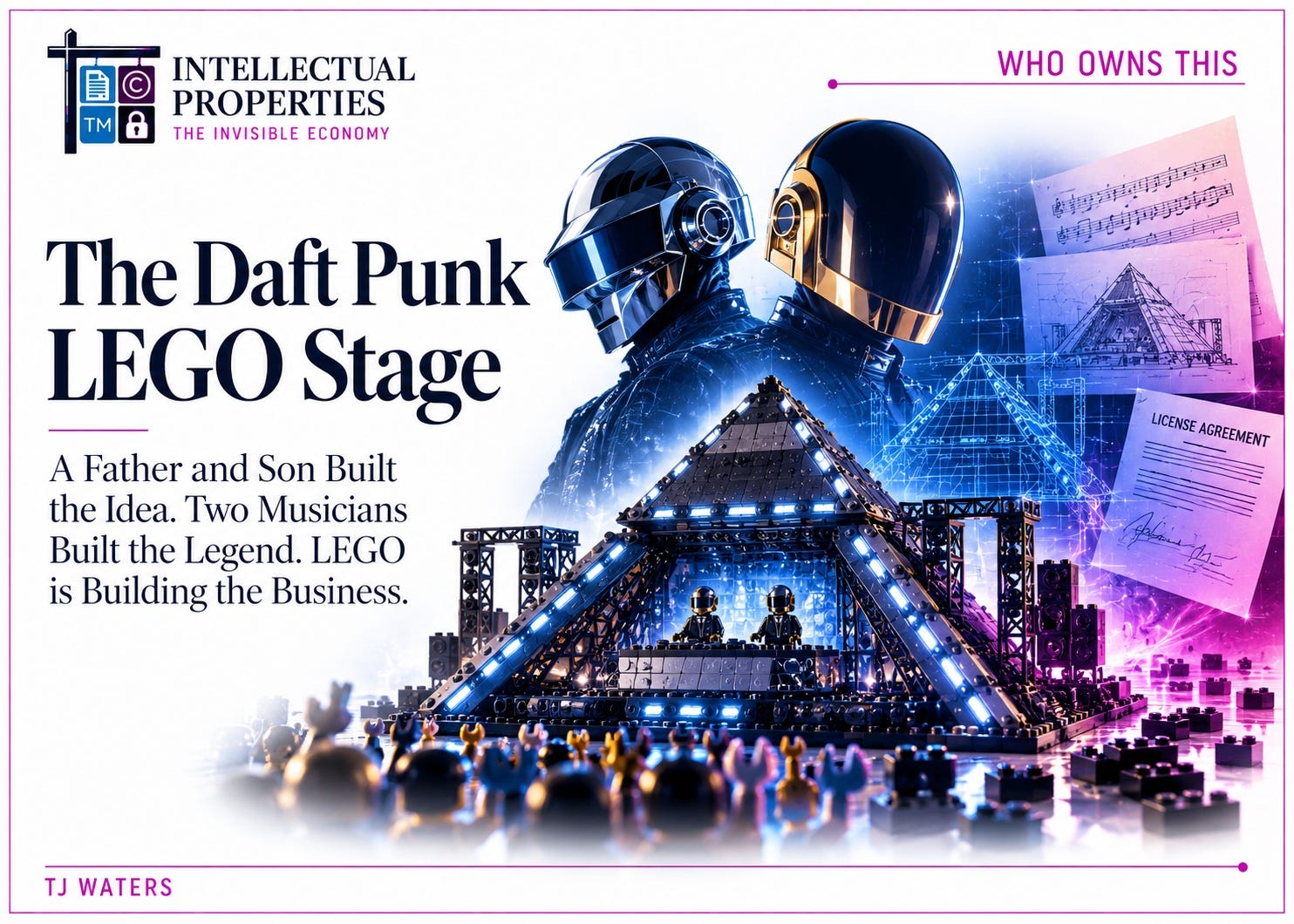

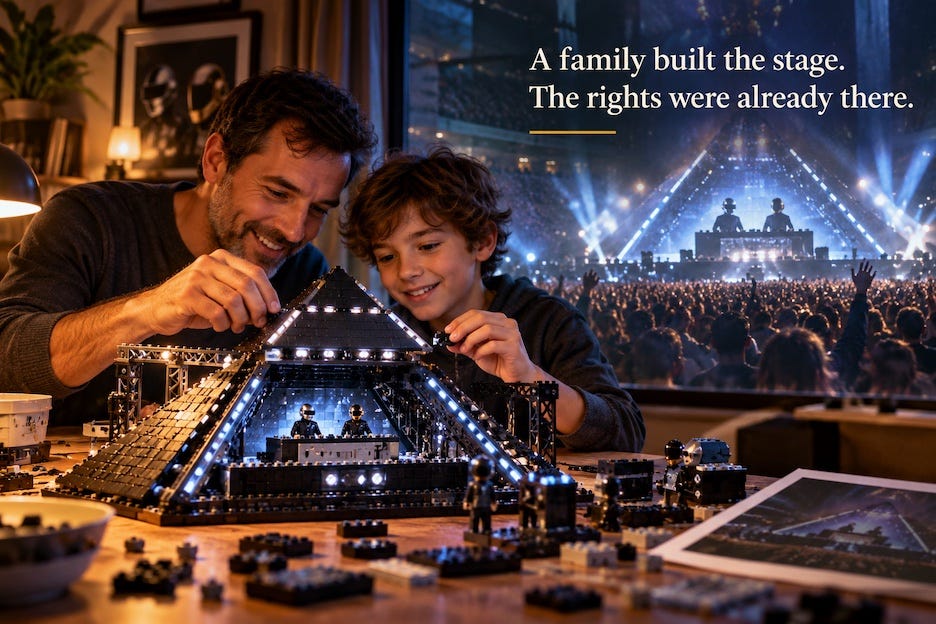
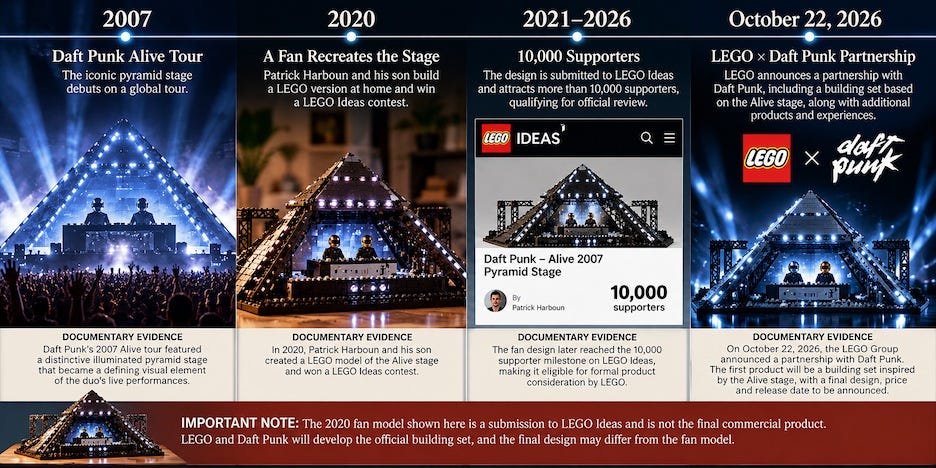
Somewhere in Luxembourg, a father and his eight year old son were spending the pandemic doing what millions of families were doing. They were building something with LEGO bricks. Only their project wasn’t a castle, a spaceship or a miniature city. It was a concert stage. More specifically, the illuminated pyramid from Daft Punk’s 2007 Alive tour, complete with the futuristic atmosphere that made two French musicians look as though they had arrived from another planet.
Patrick Harboun and his son weren’t launching a toy company. They were celebrating the music they loved. Their model won a LEGO Ideas competition in 2020, later attracted 10,000 supporters, and this October received an extraordinary endorsement. LEGO and Daft Punk announced an official partnership, with the family’s pyramid concept moving into product development. The announcement calls it a fan created foundation for a broader collaboration. Suddenly, a family pastime had become a commercial opportunity.
So who owns the stage? The people who built the model? The musicians whose stage inspired it? Or the company that will put it in a box? The answer is more interesting than any one of them.
A Pyramid With More Than One Owner
Daft Punk’s Thomas Bangalter and Guy Manuel de Homem Christo ended their musical partnership in 2021. The brand, however, never really left the stage. Their robot helmets, recordings, concert imagery and visual world continue to attract an audience. Their 2007 pyramid is recognizable even without a note of music. That recognition is commercially useful, but it isn’t a single property right sitting in a drawer somewhere.
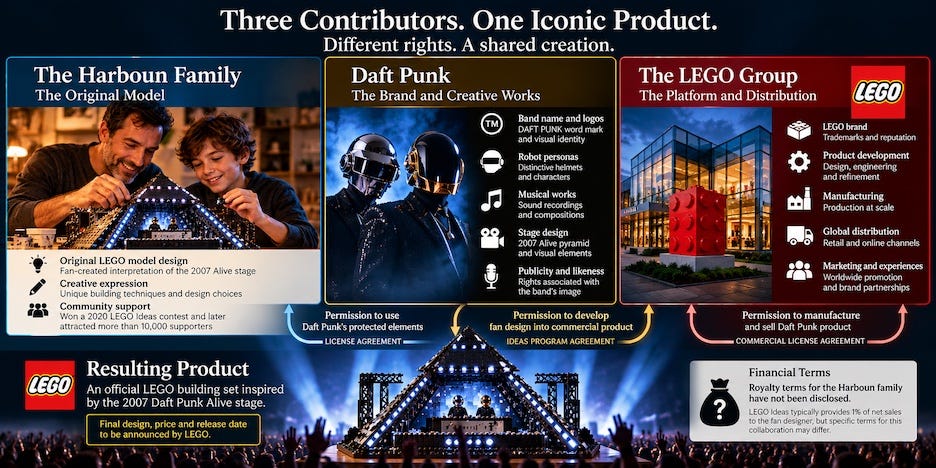
The group’s name and associated branding involve trademark rights. Original concert visuals, artwork, recordings and filmed performances can invoke specific copyrights. Their likenesses as robot personas raise additional contractual rights questions depending on how they are used. And the distinctive stage design contains protectable creative expression.
The family contributed something else. They translated an elaborate concert environment into a buildable miniature. That requires original choices about proportions, construction, detail and the arrangement of bricks. Yet originality in a fan model doesn’t mean the fan can independently market a licensed Daft Punk product. Nor does the band’s ownership or control of its identity automatically make it the owner of the family’s original contributions.
Then there’s LEGO. The Danish company owns a valuable brand, product expertise, manufacturing processes, distribution relationships and an established way of turning fan ideas into finished merchandise. It can test whether a proposed model is safe, stable, practical and fun to assemble. A brilliant concept that falls apart when a child picks it up isn’t much of a toy business.
Three participants brought three different kinds of value. The fans supplied the spark. The artists supplied the cultural meaning. LEGO supplied the commercial machinery. The finished product needs all three.
The Contract Nobody Sees
The most revealing part of this story isn’t the copyright law. It’s the LEGO Ideas agreement. Under the platform’s published terms, contributors assign LEGO System A/S the intellectual property interests arising from their submitted content, subject to the terms and provisions governing submissions and possible reversions. That is much more than simply granting LEGO permission to look at a photograph of a model.
The agreement also describes compensation if a submitted product idea is commercialized. LEGO’s published program materials describe a standard award of 1 percent of total net sales, ten complimentary sets and recognition of the fan designer. (But the exact compensation and allocation for this father and son haven’t been publicly confirmed.)
Still, that one percent royalty illustrates an unusual bargain. Suppose, purely for illustration, a licensed set generated $10 million in qualifying net sales. One percent would equal $100,000. The fan doesn’t have to finance molds, inventory, packaging, marketing or distribution. LEGO would carry those responsibilities and the corresponding risks. The calculation is hypothetical, not a sales forecast or a statement of what the Harbouns will receive.
There is a second contract behind the first. LEGO must have suitable permission to commercialize the Daft Punk elements it uses. Its October announcement confirms a partnership with the band’s representatives, but it doesn’t disclose licensing fees, royalties, exclusivity or the precise allocation of rights. Nor does it establish that LEGO owns the underlying music or concert imagery. The new promotional film uses the songs “Voyager” and “Human After All,” an especially vivid reminder that the sound recording, musical composition, characters and product are not necessarily covered by one agreement.
This is how a fan sees one product while the business manager sees several separate transactions. A physical set can sit on a shelf only after rights and responsibilities have been assembled as carefully as the bricks themselves.
The Fans Who Did the Market Research
The family’s contribution went beyond design. Their model won the Music to Our Ears challenge in 2020. When they later put the idea before the LEGO Ideas community, at least 10,000 people supported it. That didn’t guarantee production, but it did reveal an audience willing to raise its hand for a very specific product. LEGO gained an unusually useful signal about demand before committing to manufacturing.
This is an ingenious business model. Instead of inventing every licensed product internally, LEGO invites its customers to propose products, identify enthusiasm and help surface valuable relationships with outside rights holders. The platform becomes a source of ideas, a form of early market testing and a mechanism for finding creative talent. None of that eliminates the cost of licensing or product development, but it does change where opportunities originate.
It also explains why Daft Punk remains valuable five years after the duo separated. A band can stop touring while its catalog, imagery and reputation continue generating opportunities. A familiar stage can become a toy. A toy can introduce the music to a younger generation. The music, in turn, can make the toy more desirable. Each participant adds value to the others without surrendering everything it owns.
LEGO has promised more information in 2027. The final set, its price and its release date have not been announced. Neither have the economics of the wider partnership. But the underlying business is already visible. Intellectual property doesn’t have to change hands completely for a new market to emerge.
Ask who owns the Daft Punk LEGO stage and you’ll discover that ownership is only half the question. The other half is who has the rights, the relationships and the ability to turn everyone’s contribution into something people will buy. The Harbouns could build the pyramid. Daft Punk could make it famous. LEGO could make it a product. The contracts are what allow all three achievements to occupy the same box.
That may be the most surprising lesson in the invisible economy. Sometimes the thing worth owning isn’t one more brick. It’s the right to connect the bricks that belong to everybody else.