
The Opening Scene
Imagine a neighborhood newspaper publisher checking Facebook on a Monday morning. She has spent years paying reporters, photographing local events, and building an audience that expects her to know what is happening before anyone else does. Facebook helps her reach that audience. It also controls how much of that audience she can reach on any given day.
Now imagine an update to the platform’s business terms. The publisher can keep posting stories, selling subscriptions, and promoting advertisers. But the proposed agreement also appears to give the platform broad permission to crawl material on websites associated with her business. Suddenly, the price of admission may be something considerably more valuable than an advertising budget.
That was the question raised by a quiet revision to Meta’s commercial terms in October 2026. It wasn’t a hypothetical dispute about whether an AI company could scrape the public internet. It was a proposed contract between a company that controls access to customers and businesses that depend on that access.
When Free Isn’t Free
For years, businesses have treated Facebook and Instagram as inexpensive distribution channels. A restaurant posts photographs of tonight’s special. A clothing boutique shows off a new collection. A newspaper shares a headline. A university promotes a research breakthrough. The platform provides visibility and a convenient way to find customers, while the business provides a steady supply of content that makes the platform worth visiting.
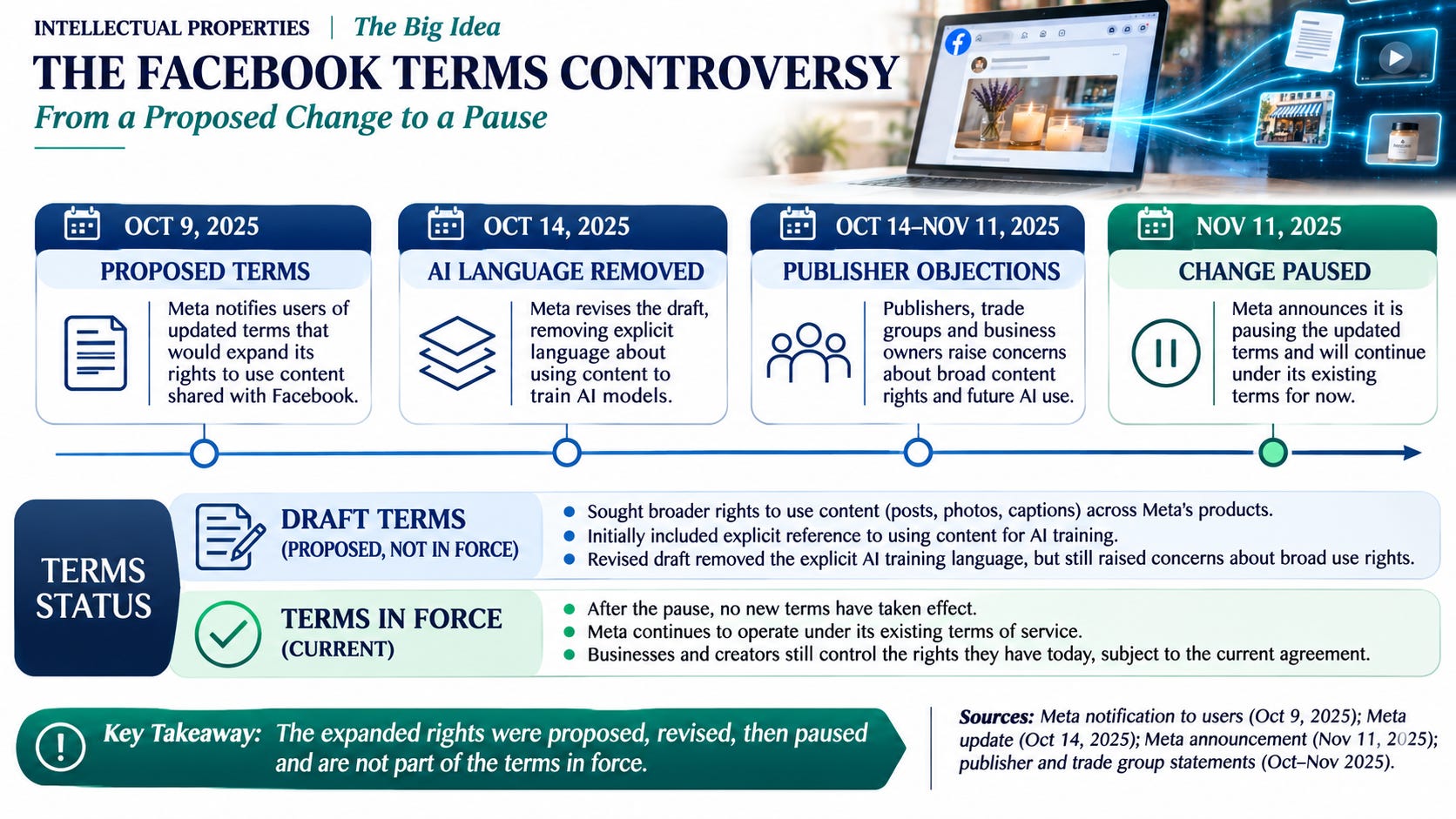
In October, Meta proposed changes to the terms governing commercial users. Early language expressly referred to using material collected from associated websites to train Meta products. Following criticism, Meta revised the language and removed that explicit reference, while retaining broad website crawling provisions tied to its advertising and business products. Legal experts warned that Meta revised the language, but still left important questions about permissible uses unanswered.
Meta maintained that the changes were intended to support advertising and business services, such as accurate product information, and said its crawler practices and respect for website controls weren’t changing. Critics saw a very different possibility. A company that needs Facebook to reach its customers might be asked to consent to the collection and development use of content it created elsewhere.
Consider the economics. A publisher pays journalists to produce reporting. The publisher places links on Facebook because that is where readers spend time. The proposed terms raised the prospect that the very act of maintaining that commercial relationship could strengthen Meta’s claim to use material from the publisher’s own website. If those materials also help build AI services that answer readers’ questions without sending them back to the publisher, the relationship starts looking less like distribution and more like involuntary technology transfer.
The copyright owners objected through industry organizations, and news publishers challenged the proposed arrangement. Meta ultimately paused the changes in early November. Its existing terms remained in effect. That means the broad new terms shouldn’t be described as an operative grant of rights. The proposed exchange, however, revealed a business model worth examining.
The Invisible IP
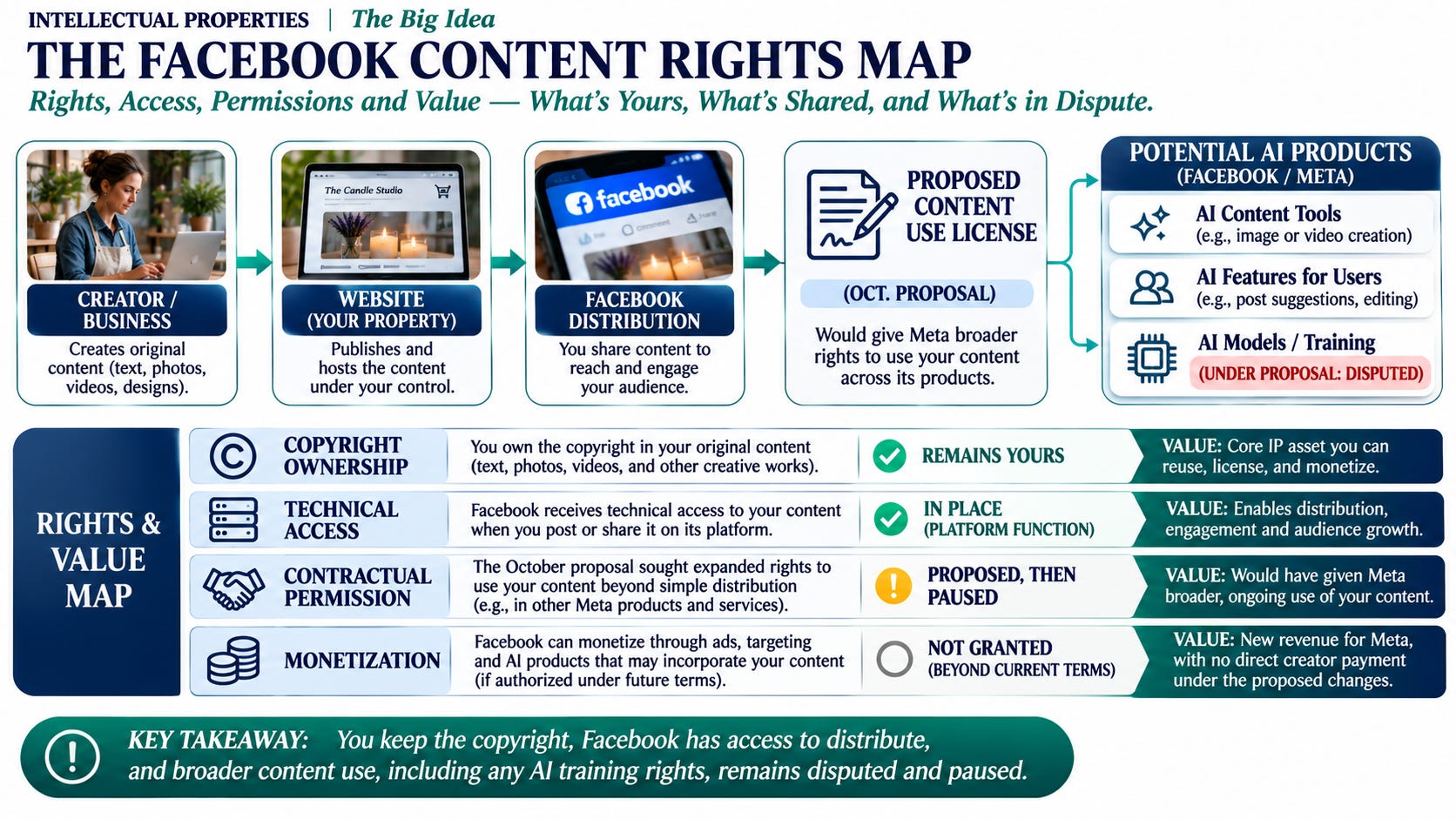
Copyright protects original expression. A company’s photographs, articles, videos, product descriptions, illustrations, and certain other creative works may qualify. But copyright ownership and permission to use a work aren’t the same thing. A creator can own the copyright while granting someone else a license to reproduce, analyze, display, or otherwise use that work within contractual limits.
This is where a routine terms of service update can become a strategic transaction. An individual licensing deal normally identifies the content, the authorized uses, the duration, and the limits on sublicensing or reuse. A platform contract may bundle access to customers with permissions affecting material far beyond the posts uploaded directly to that platform. Whether particular terms would be enforceable, or would actually authorize AI training, depends on their wording and applicable law. Those questions were disputed, not settled, in Meta’s case.
The overlooked asset is consent. It sounds less glamorous than a patent or trademark, yet permission can be the difference between a valuable technology and one that cannot legally be deployed. AI developers need data. Businesses need audiences. Whoever can connect those two needs through a contract may gain negotiating leverage that neither side fully appreciated when the account was opened.
There are several layers to that leverage. First is the copyright in the underlying content. Second is access to a website and the technical ability to collect material at scale. Third is the contractual scope of what the collector may do with it. Fourth is the market power created when leaving a platform means losing contact with customers. None of those layers is identical, and ownership of one doesn’t automatically convey the others.
The public controversy also exposed the limits of technical controls. Website owners can use crawler instructions to express preferences about automated access. Those signals are useful, but they aren’t a substitute for a negotiated legal agreement. The debate over Meta’s proposed terms showed how quickly a technical setting can become secondary to the language of a commercial contract.
The most surprising possibility is that content may have two different customers. One customer wants to read the article, watch the video, or buy the product. The other wants to use the same material to improve a machine that can generate answers, recommendations, or advertisements. Businesses have spent decades measuring the first market. Many are only beginning to price the second.
The Competitive Consequences
A business that signs away broad usage rights may not immediately notice the cost. Its Facebook page still works. Customers still click. Sales may even improve. But the value of an intangible asset is often determined by what its owner can prevent others from doing. Granting broad, durable permissions can reduce future licensing opportunities, particularly if the content helps create competing products.
For Meta, the commercial logic is understandable. Better product information can improve advertisements, recommendations, and shopping experiences. Facebook also says it is rewarding original creators, and its own creator payments reached nearly $3 billion in 2025. Those investments and incentives complicate any simplistic claim that the platform is merely taking value. It creates value for businesses, too. The question is how the additional value generated by a business’s creative assets should be shared.
For publishers and other content businesses, the stakes are unusually high because distribution and production are so closely linked. They need traffic to fund the next article, photograph, or video. If an AI service answers the customer’s question before that customer visits the original source, the economics of producing the next work may deteriorate. That outcome is a risk, not a demonstrated result of Meta’s paused proposal.
The public response changed the trajectory. Meta paused the changes after publisher objections, legal scrutiny, and regulatory attention. In the United Kingdom, a competition investigation began on October 30. The Associated Press reported the postponement and opposition from publishers in Europe and the United States. The episode showed that commercial terms are no longer merely administrative documents. They can determine who gets access to the raw material of the AI economy.
The Big Idea
What if the next great intellectual property negotiation isn’t between an inventor and a manufacturer, or a songwriter and a record label? What if it happens when a small business clicks a button to continue using a platform it can’t afford to leave?
The lesson isn’t that every website crawl is unlawful, or that every platform license is unfair. It’s that a business can own its creative work and still surrender valuable control through a contract designed for something that looks unrelated. The content it produces attracts customers today. The rights attached to that content may help determine who builds tomorrow’s AI services.
For business leaders, the first question shouldn’t be whether their social media account is free. It should be what they are paying with. The most expensive asset in a transaction is sometimes the one that never appears on the invoice.