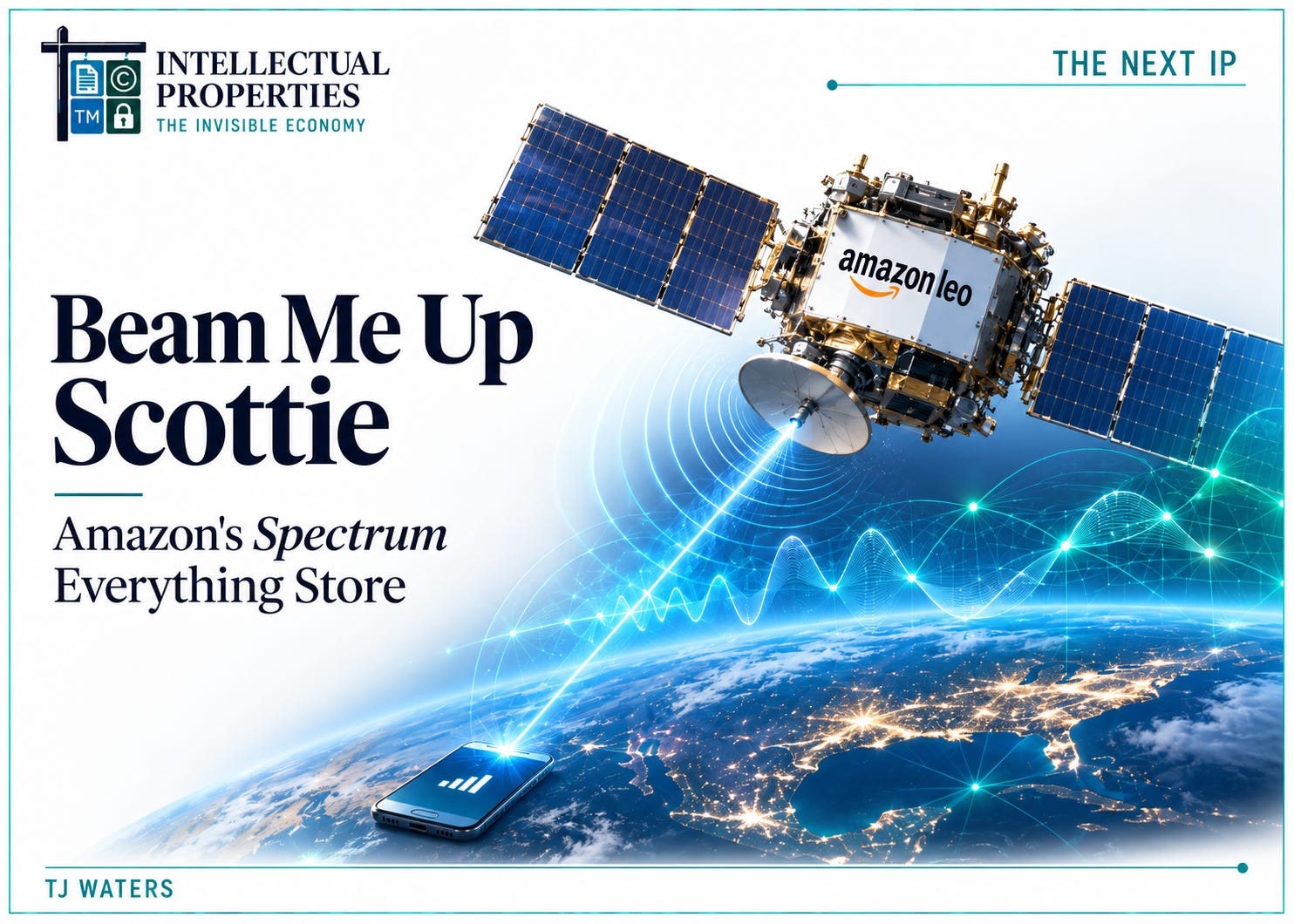

The Missing Ingredient
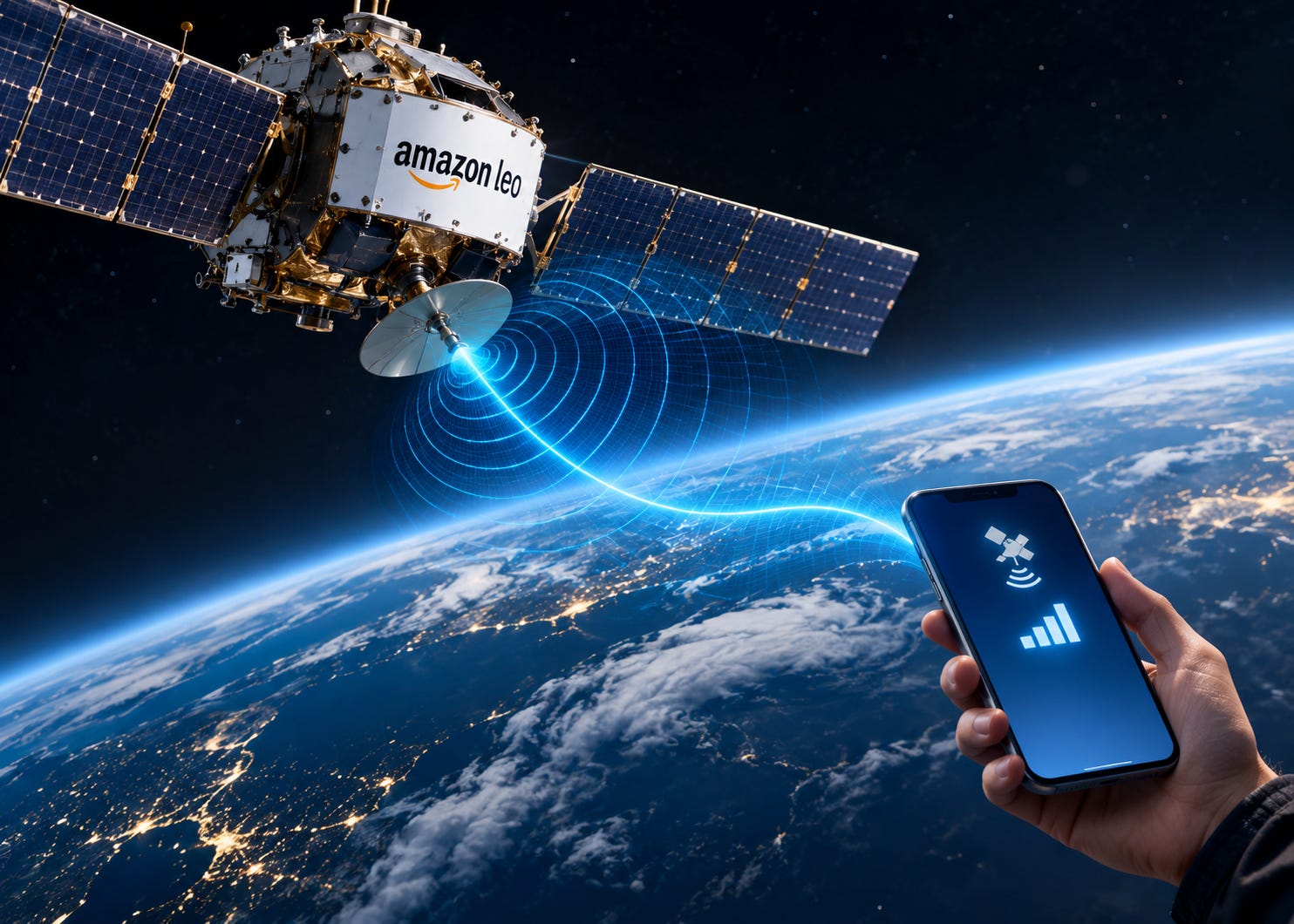
Imagine spending billions to build the world’s most sophisticated fleet of communications satellites. Your engineers design the spacecraft. Your factories assemble them. Rockets carry them into orbit, where they circle the planet ready to connect people who have never had a reliable signal. There’s only one problem. You can’t talk to their phones.
Not because the satellites don’t work. Not because the antennas are too small. You’re missing permission to use the invisible portion of the electromagnetic spectrum that makes the connection possible. That permission isn’t something an engineer can manufacture, regardless of the budget. It comes from governments, international coordination and decades of investment in a limited resource.
Amazon is discovering just how valuable that permission can be. Its proposed purchase of Globalstar, valued at roughly $11.5 billion, is less a story about buying spacecraft than about acquiring the rights to communicate through them.
A Company That Can Build Almost Anything
Amazon knows how to scale physical infrastructure. It built warehouses, cloud data centers, delivery networks and now a growing satellite constellation called Amazon Leo. Yet its ambition to connect ordinary mobile phones from orbit faced a different kind of bottleneck. The company had broadband satellite capacity, but not comparable mobile satellite spectrum rights suitable for its proposed direct connection service.
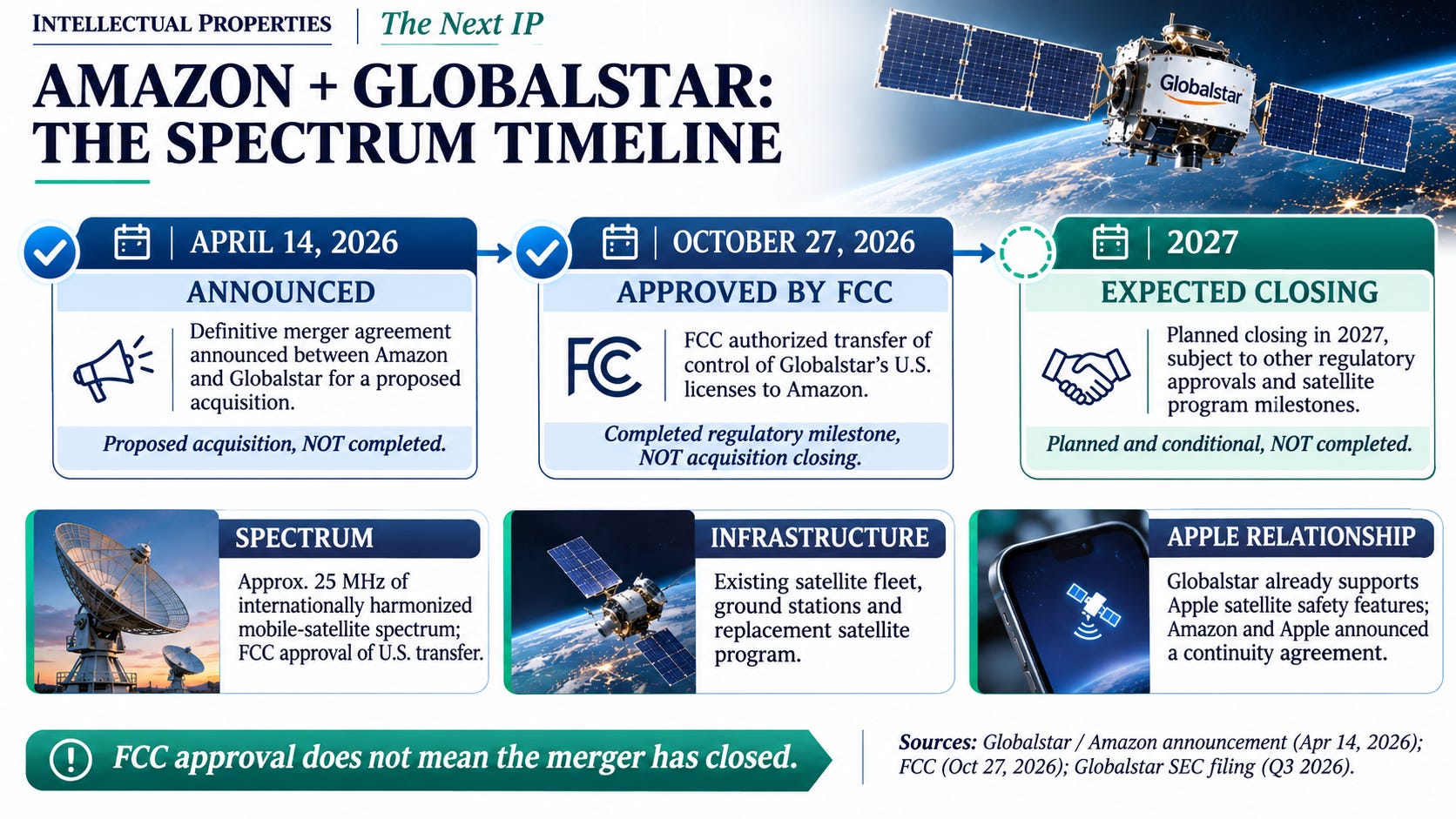
In April 2026, Amazon and Globalstar announced a merger agreement that would combine Amazon’s capital and manufacturing capabilities with Globalstar’s satellites, ground facilities, operating experience and internationally coordinated radio authorizations. The companies also announced arrangements to continue satellite services for supported Apple devices. The proposed combination is expected to close in 2027, subject to remaining conditions and milestones. The announced merger terms show that Amazon is acquiring a business, not simply purchasing an isolated frequency license.
Globalstar already supports emergency and other satellite features on Apple products. That existing relationship adds another dimension. Amazon isn’t just buying a possible future network. It is stepping into a functioning ecosystem of devices, services, infrastructure and customer commitments. Apple’s satellite services must continue, while Amazon hopes to expand what those connections can do.
The Federal Communications Commission approved the transfer of control of Globalstar’s U.S. authorizations in October. Reuters reported the transaction at approximately $11.5 billion and noted that Amazon intends to enter the direct to device market more aggressively. But regulatory approval isn’t the same thing as a completed acquisition, and Amazon still has work to do before the planned network is fully operational.
The Invisible Asset
A patent grants its owner certain rights to exclude others from practicing an invention. Spectrum rights are different. They are regulatory authorizations to operate radio systems under specified frequencies, technical rules, locations and conditions. The airwaves themselves aren’t privately owned in the way a factory or patent might be.
Yet those authorizations can carry extraordinary economic value. Two companies might possess equally capable satellites and comparable engineering talent, but only one may have the necessary permissions to communicate with a particular class of devices in a particular band. Its rival can’t solve that shortage merely by copying the hardware. It must secure lawful access to spectrum, share capacity, obtain approvals or pursue a different technical architecture.
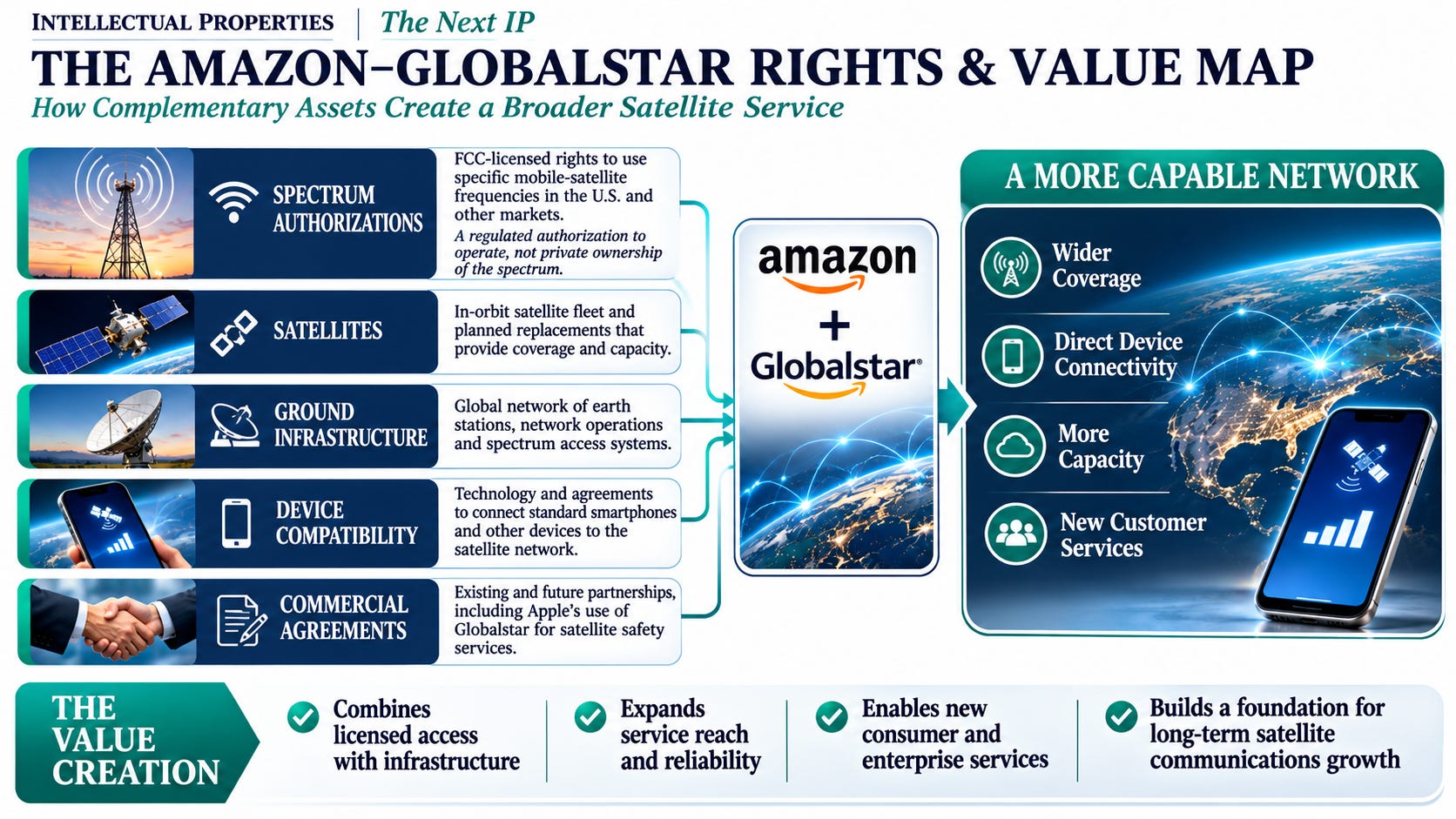
Globalstar’s portfolio includes mobile satellite service authorizations in the L and S bands. The parties’ regulatory application explains that Globalstar operates multiple satellite systems built around these coordinated spectrum resources and that Amazon lacked comparable mobile satellite spectrum. The filings describe how these authorizations, paired with the planned spacecraft, could support a new direct to device network.
The ownership trail also has limits. National regulators authorize spectrum use within their jurisdictions, while international coordination helps manage interference across borders. Buying the company doesn’t give Amazon ownership of radio waves or an unrestricted right to transmit anywhere on Earth. Authorizations carry technical, geographic and regulatory conditions, and future systems may need additional approvals.
Here is the fascinating part. Spectrum rights don’t fit comfortably into traditional intellectual property categories, but they behave like strategic assets. They can be scarce, transferable subject to approval, expensive to obtain and essential to a business model. Their value may depend less on the paper authorization than on the capabilities and market access it unlocks.
What Eleven Billion Dollars Buys
It would be misleading to claim Amazon is paying $11.5 billion solely for spectrum. Globalstar brings spacecraft, terrestrial infrastructure, customers, engineering experience and contractual relationships. The acquisition price is an enterprise transaction, not a published stand alone valuation of its frequencies. But the strategic importance of spectrum is unmistakable. Without the required authorizations, Amazon’s plans for direct connections to ordinary phones face a formidable obstacle.
The FCC described approximately 25 megahertz of internationally harmonized mobile satellite service spectrum in approving the U.S. transfer. That number sounds modest beside the bandwidth associated with terrestrial networks. But in this setting, the right frequencies can be more useful than a far larger amount of capacity in the wrong band. Coverage, propagation characteristics, device compatibility and interference rules all influence what the asset can actually accomplish.
Amazon plans to begin deploying a next generation direct to device satellite system in 2028. Its broader ambition is to combine fixed broadband services with connections to phones, connected vehicles, industrial equipment and devices beyond the reach of terrestrial towers. The payoff, if the technology and commercial executions succeed, could include new customers, partnerships with mobile operators and a stronger position against competing satellite networks.
The competition isn’t merely about who launches the most satellites. It is also about who assembles the strongest combination of regulatory rights, hardware, compatible devices, distribution and commercial relationships. Those pieces reinforce one another. A spectrum authorization without a network may have limited practical value. A network without usable spectrum may have limited commercial purpose.
The Next Intellectual Property
For years, business leaders were taught to inventory patents, trademarks, copyrights and trade secrets. That remains essential. But the next generation of strategic assets includes permissions, access rights, data relationships, network positions and contractual privileges that can determine whether an otherwise impressive technology becomes a business.
Amazon’s deal illustrates a useful question for every executive. What is the one thing your company needs that it cannot simply invent, purchase off a shelf or manufacture at scale? Sometimes it is a dataset. Sometimes a license. Sometimes an exclusive distribution relationship. And sometimes it is permission to use a narrow slice of an invisible resource above our heads.
Amazon can build satellites. It can hire engineers and buy rockets. But to reach the phone in your pocket from space, it first needed something far less tangible. The next great competitive advantage may not be the machine you build. It may be the right that allows the machine to matter.