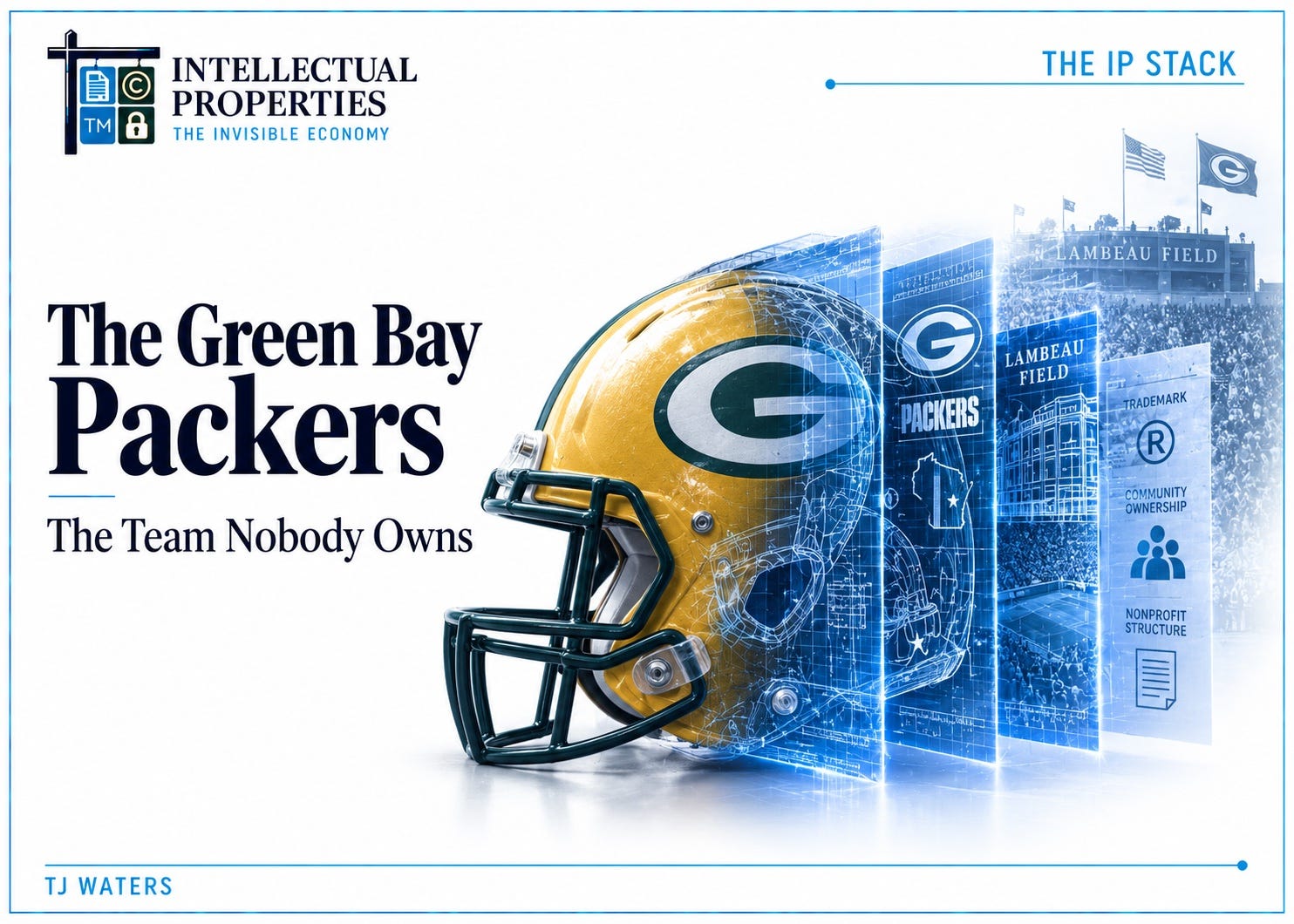

There is something economically absurd about the Green Bay Packers. Start with the geography. Green Bay, Wisconsin, is the smallest home market in major American professional sports. It does not have the population of New York, the corporate base of Chicago, or the wealth of Silicon Valley. There is no billionaire owner capable of writing a check when the organization needs something. There is not even an owner who can sell the franchise and collect the billions of dollars in appreciation created along the way.
Instead, there are more than half a million owners.
And almost none of the things we normally associate with ownership apply to them. Packers shareholders receive no dividends. Their shares are severely restricted in transferability. The certificate may hang proudly on the wall, but it will not finance anyone’s retirement. Which raises an interesting question.
What exactly do these people own?
The Accident That Became a Business Model
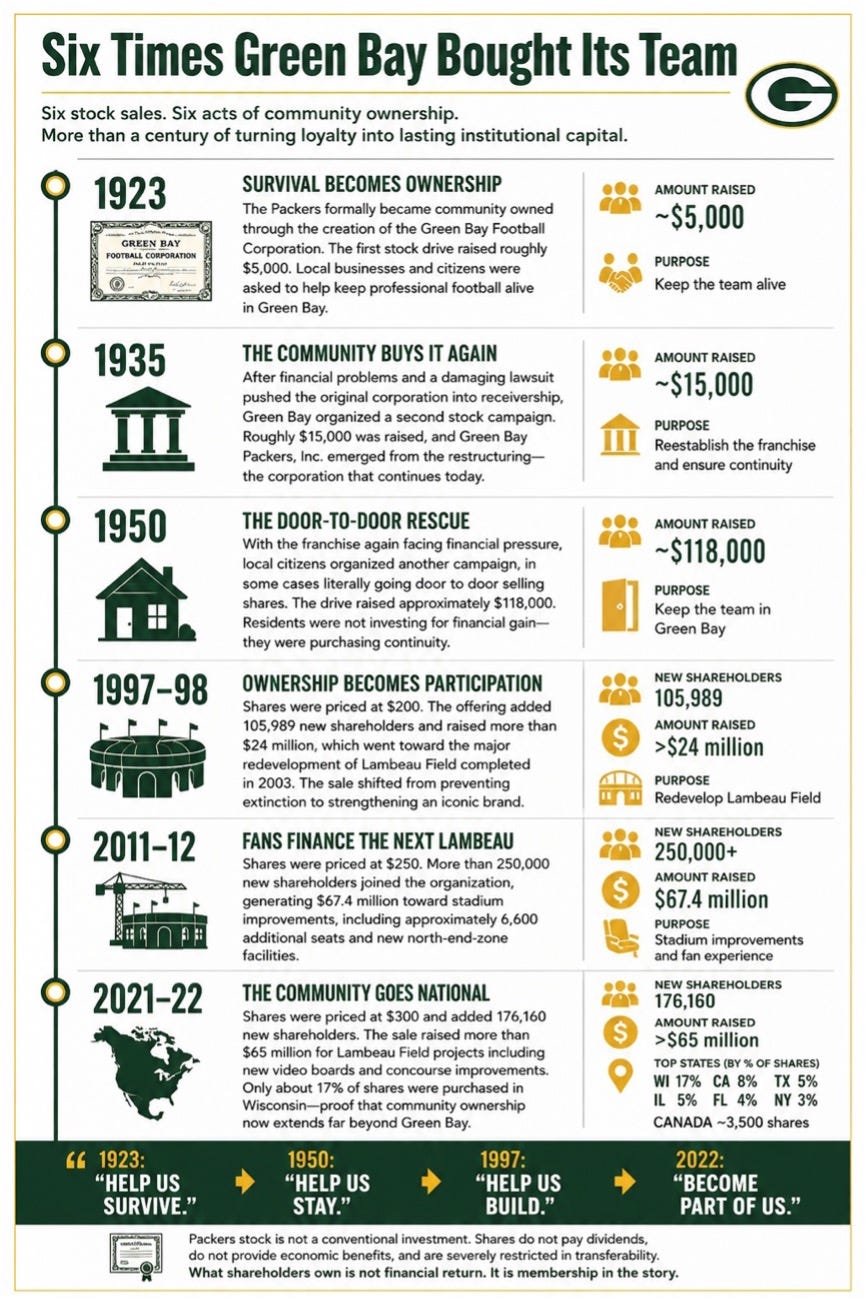
The Packers are community owned because they had to. Professional football in the 1920s was hardly a guaranteed business. Teams appeared, disappeared, moved, and occasionally ran out of money. Green Bay nearly joined them. In 1923, local supporters created the Green Bay Football Corporation and sold stock to keep the team alive. Financial trouble returned during the Depression, and the organization was reconstituted in 1935. Another stock campaign followed in 1950. Later offerings in 1997, 2011, and 2021 again invited fans to provide capital, largely for Lambeau Field improvements.
The early stock drives were exercises in survival. The later ones became exercises in belonging.
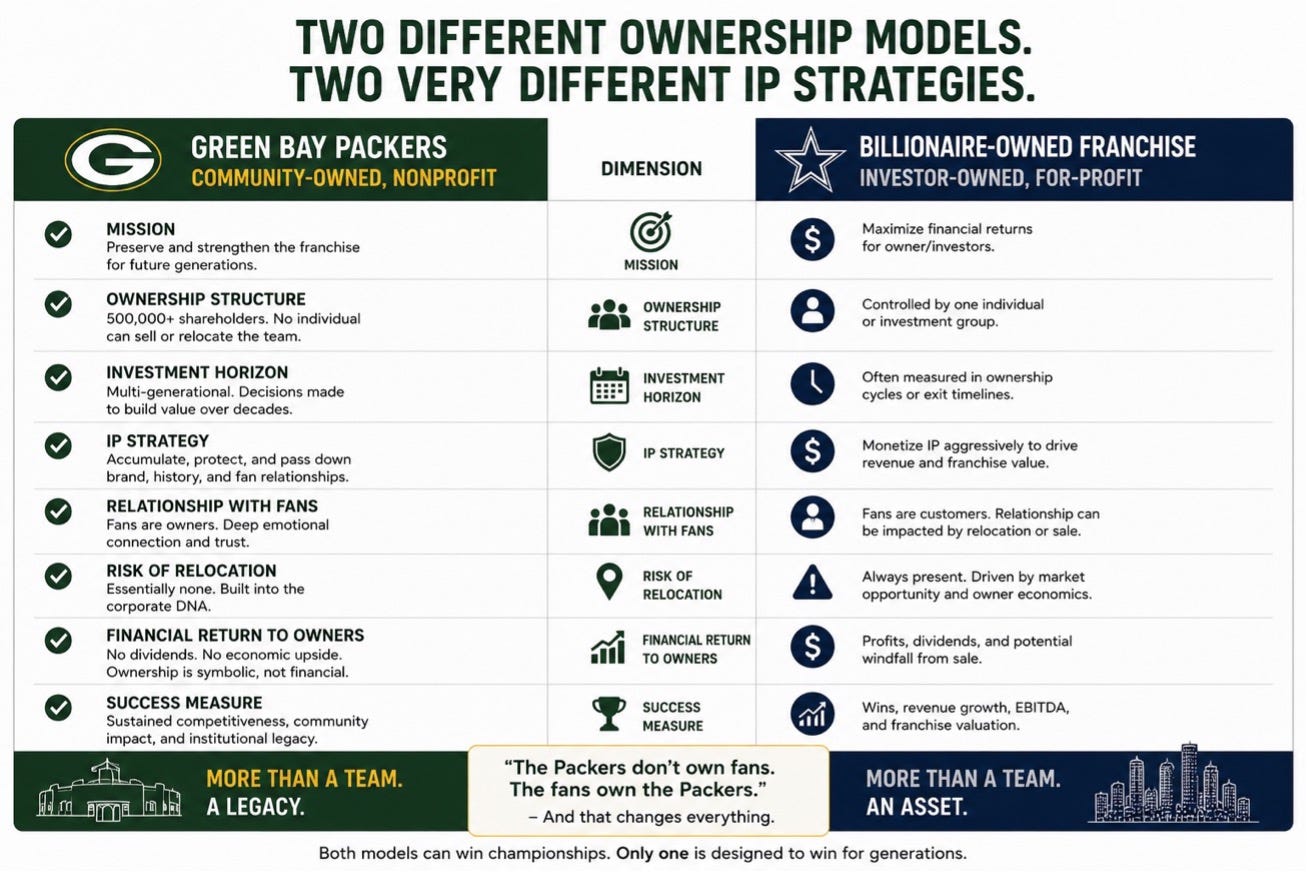
Today, roughly 5.2 million shares are held across about 539,000 shareholder accounts. Shareholders vote for directors and can attend the annual meeting. But there is no Jerry Jones, no Robert Kraft, or even a Stan Kroenke. The Packers have management, directors, and shareholders. What they do not have is an owner in the conventional sense.
Owners Who Cannot Cash Out
That distinction changes the economics. A conventional franchise owner buys a scarce asset, increases revenue, expands sponsorships, develops facilities, and retains the option to sell. That final step quietly influences everything before it.
The Packers effectively removed it.
There is no controlling shareholder waiting for an optimal exit. Packers shareholders cannot capture the franchise’s appreciation. At first glance, that sounds like a weakness. But from an intellectual property perspective, it may be one of the team’s greatest strengths.
The organization has separated ownership from financial extraction. A conventional owner can ask whether an investment will increase franchise value during a particular ownership period. Green Bay can ask whether the same investment will strengthen the institution for the next fifty years.
The IP of Permanence
Walk through Lambeau Field and consider what actually makes the Packers valuable. It is not the concrete; it can be replaced. It is not the seats. They can be replaced too. It is not even the players. Every player eventually leaves, one way or another. The truly valuable assets are largely intangible.
The Packers name. The distinctive G. The green and gold. Lambeau Field. Vince Lombardi. Bart Starr. The Ice Bowl. The Frozen Tundra. Thirteen NFL championships. Decades of photographs, broadcasts, merchandise, archives, customer relationships, sponsorships, digital content, data, and institutional knowledge.
Then there is an asset that does not appear neatly on the balance sheet. Trust.
A Packers fan can reasonably expect that the Green Bay Packers will still be the Green Bay Packers decades from now. Fans elsewhere know that a beloved team can also be a movable financial asset. Green Bay has removed that concern from the relationship. The fan gives the institution loyalty. The institution offers something close to permanence.
That bargain may be one of the most valuable intangible assets in sports.
When Customers Become Owners
Traditional companies spend billions trying to manufacture engagement. The Packers institutionalized it. In the 2011 offering, shares sold for $250 and the sale raised $67.4 million for Lambeau Field projects. A decade later, shares were offered at $300. Buyers knew what they were getting. No dividend. No meaningful resale opportunity. No proportional claim to the franchise’s value. Yet they bought anyway.
From a conventional finance perspective, that is difficult to explain. From an intellectual property perspective, it is almost perfect. The Packers monetized identity. People paid hundreds of dollars for permission to say four words: I am an owner.
That collapses the distance between customer, advocate, financier, and symbolic owner. During the most recent offering, only about 17 percent of shares purchased went to Wisconsin residents. California accounted for about 8 percent. Texas and Illinois each accounted for about 5 percent. Fans in Canada bought thousands more. Green Bay transformed ‘local’ from a geographic idea into an emotional one.
History Is Inventory
Intellectual property travels. A stadium is geographic. A trademark is not. A football game takes place in Wisconsin, but a story can go anywhere. Or everywhere.
The Packers have spent a century converting geographically constrained assets into unconstrained ones. Lambeau becomes an image. The Ice Bowl becomes a story. Lombardi becomes a symbol. Green and gold become identifiers. Community ownership becomes mythology.
A manufacturing company produces a product and sells it. A sports organization produces experiences and retains the intellectual residue. Video becomes documentary material. Players become legends. Games become anniversaries. Championships become merchandise. Stadium moments become stories parents tell their children.
The difference is physical inventory usually depreciates, but sports history can appreciate. The 1967 Ice Bowl is not obsolete because it happened nearly sixty years ago. Its age is part of its value. Every season produces current entertainment and new material for a permanent IP portfolio.
A Perpetual Intellectual Property Trust
Investor ownership is not hostile to intellectual property. Sophisticated owners can build extraordinary brands. But an investor also possesses an option Green Bay does not meaningfully have; the ability to harvest accumulated value through a sale.
The Packers cannot easily cash out a century of goodwill. Their practical alternative is to keep reinvesting in the institution that created it.
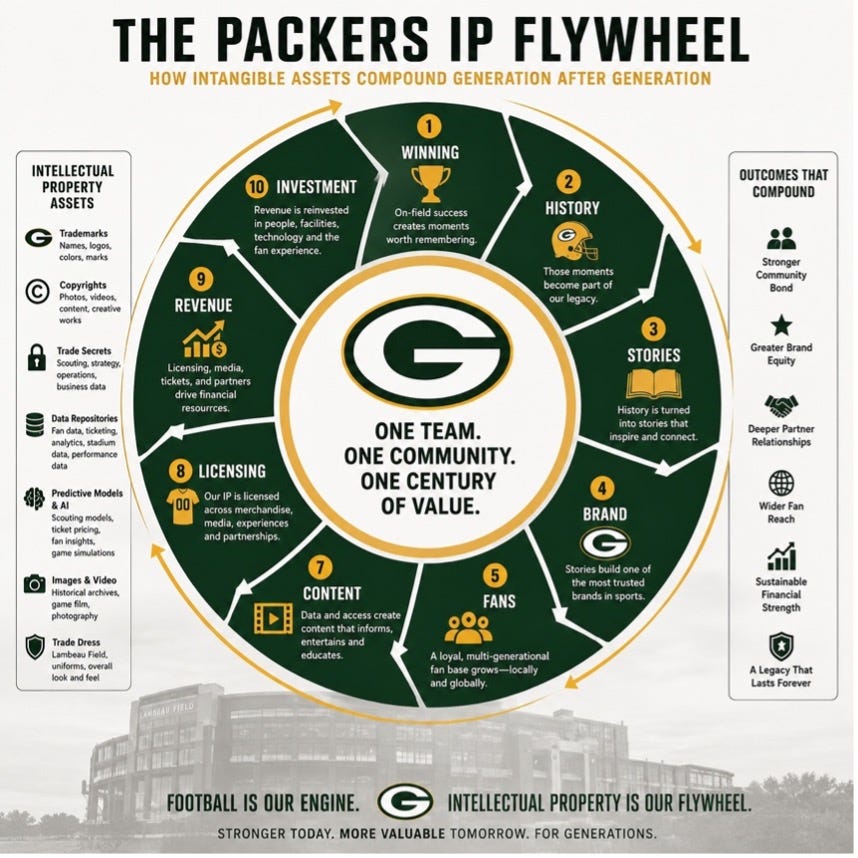
Revenue supports football operations. Success creates stories which strengthen the brand. The brand attracts fans. Fans buy tickets and merchandise, consume media, visit Green Bay, engage digitally, and support sponsors. Those activities create revenue, relationships, and data. The next generation of the franchise gets funded and the process begins again.
The Packers have created something resembling a perpetual intellectual property trust. Their ownership structure helps prevent anyone from selling the flywheel.
The Value of Forever
Most intellectual property strategy begins too late. Executives ask how to patent a technology, register a trademark, protect data, own a copyright, or preserve an algorithm as a trade secret. Those are important questions. But there is another question. What ownership structure gives those assets the greatest opportunity to compound?
Different governance structures create different incentives. Those incentives influence what gets created, what gets preserved, what gets sold, and what gets sacrificed. Green Bay is an extreme example because its ownership horizon is effectively infinite.
So return to the original question. What does a Packers shareholder actually own?
Participation. A vote. An invitation into the governance process. A tangible connection to an intangible institution. More importantly, they own a credible sense of stewardship.
The certificate does not promise to make the shareholder rich. It offers something more unusual. The shareholder becomes a temporary custodian in a story that began before that person arrived and is intended to continue after that person is gone.
Business schools teach students how to create shareholder value. The Packers present a fascinating inversion. Their shareholders receive almost none of the financial value. The institution receives it instead. The Packers have persuaded generations of people to invest in an asset whose principal return is the continued existence of the asset itself.
Belonging, permanence, and identity. Those are intangible assets too.
Companies frequently ask how much their intellectual property is worth. Green Bay suggests a different question: Who should own it if we want it to still matter a hundred years from now?
(Disclosure: I am the proud father of a Packers owner. Our daughter Sarah became a shareholder in 2021 at the ripe old age of seventeen. Lots of green & gold at our house!)