


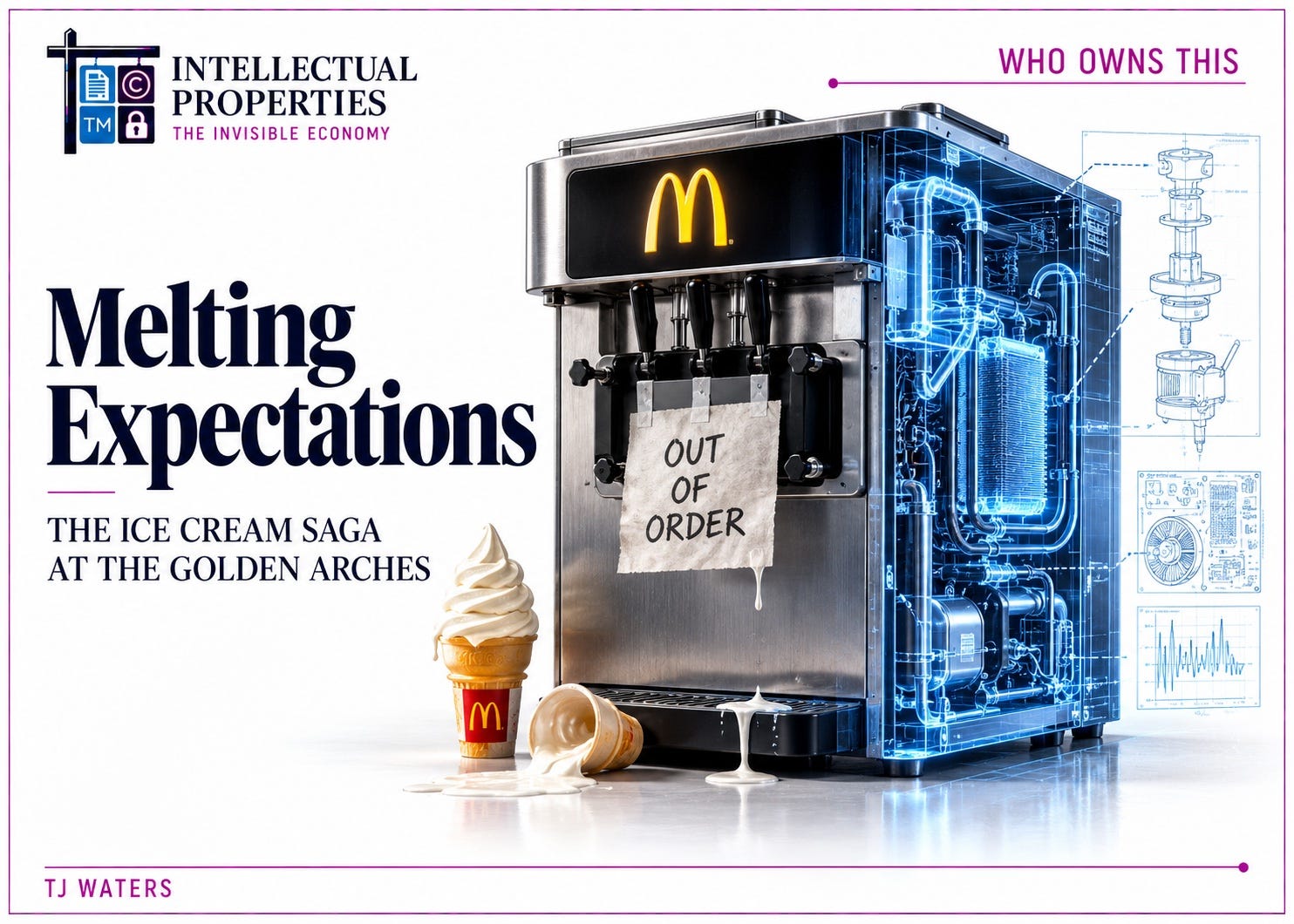
There may be no more famous broken appliance in America than a McDonald’s ice cream machine.
For a company that turned hamburgers into operational precision, it is a strange distinction. McDonald’s can deliver a remarkably consistent meal across thousands of restaurants worldwide. Yet its ice cream machine became famous for doing something else: Not. Working.
The joke inspired McBroken, a website tracking whether McDonald’s ice cream machines near you were operational. But behind the comedy was a serious imbalance: Restaurant operators often lacked the diagnostic information available to authorized service technicians. That is where this stops being an ice cream story and becomes an IP story.
STACK ONE: TAYLOR OWNS THE MACHINE’S LANGUAGE
The Taylor C602 combines refrigeration, heat cycles, sensors, controllers, software, and safety systems. When it displays an opaque fault code, the restaurant may own the appliance without understanding what the appliance is saying. Imagine a car that announces “Problem 41” instead of “oxygen sensor.” The manufacturer understands. Its authorized technicians understand. You do not. The wrench is not the scarce asset. The translation is.
Taylor has legitimate reasons to protect software, engineering know-how, sanitation standards, warranties, and equipment safety. But control over diagnostic access can also sustain an aftermarket in which the purchase is only the beginning of an economic relationship. The machine sells once. But the ecosystem can sell forever.
STACK TWO: KYTCH SELLS THE TRANSLATION
Kytch founders Jeremy O’Sullivan and Melissa Nelson did not manufacture a competing ice cream machine. They created a connected device that read operating information from Taylor’s equipment, translated the diagnostic data, and helped operators understand the failures. Kytch attacked the information bottleneck, not the hardware.
WIRED reported that the device launched in 2019 and reached hundreds of McDonald’s restaurants. Kytch said its tools could reduce downtime and service costs. Its emerging IP stack included software, diagnostic logic, accumulated knowledge, customer relationships, contracts, and asserted trade secrets. Its value was not plastic and circuitry. It was what the circuitry knew.
STACK THREE: McDONALD’S OWNS THE GATE
McDonald’s built neither device. But it controlled the system in which both needed permission to operate. Franchise standards govern equipment, suppliers, food safety, and restaurant procedures.
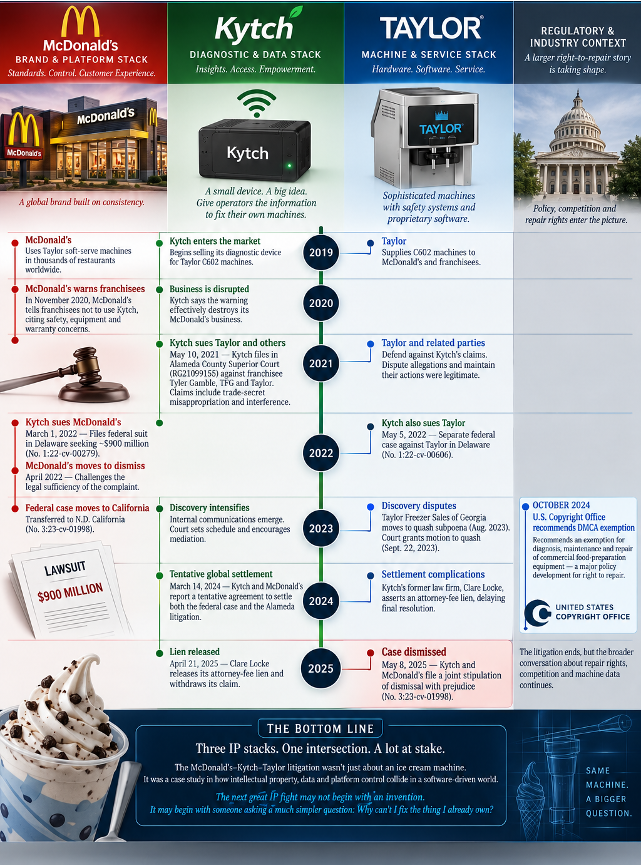
In November 2020, McDonald’s warned franchisees against using Kytch, citing safety, warranty, and proprietary-information concerns. Its position was not frivolous: a global restaurant system has good reasons to vet devices attached to essential equipment.
Kytch alleged another motive: Eliminating a disruptive diagnostic competitor while Taylor developed connected capabilities of its own. Litigation discovery uncovered Taylor communications monitoring Kytch and discussing efforts to obtain and evaluate its device. WIRED reported a Middleby communication referring to an opportunity to “head off this threat.”
Those communications did not establish wrongdoing. Studying a competitor is lawful; McDonald’s and Taylor disputed Kytch’s allegations. But the documents illuminated the business architecture. Taylor controlled the machine layer. Kytch offered an intelligence layer. McDonald’s controlled the gate. Three stacks. One franchisee.
Kytch alleged that a device reached a Taylor distributor despite restrictions on sharing it, and sued Taylor, distributor TFG, and franchisee Tyler Gamble over alleged improper acquisition and examination of its technology.
Reverse engineering is not automatically illegal. Trade-secret law turns on questions of improper acquisition, disclosure, or use, and whether the information was genuinely secret. The issue was how the device was obtained, which contractual terms applied, and what, if anything, was misappropriated. That is the difference between competition and theft of know-how.
In 2022, Kytch sought roughly $900 million from McDonald’s, alleging that its warnings were false and had destroyed Kytch’s business. McDonald’s rejected those claims and defended its equipment standards. The notable feature was not the dollar figure. It was the alleged mechanism; Kytch argued that McDonald’s could use its direct relationship with franchisees to shut out a product without acquiring Kytch’s technology.
Apple controls App Store admission. Amazon sets marketplace rules. McDonald’s defined acceptable franchise equipment. Sometimes the gate is more valuable than the product.
THE FRANCHISEE DILEMMA
The franchisee absorbed machine downtime, service costs, and disappointed customers without any control over the diagnostic software, repair channels, or franchise rules. The party suffering the problem was not the party controlling the solution. Kytch offered the operator something simple: Information. This was a right-to-repair problem hiding inside a McFlurry machine.
The broadest consequence unfolded beyond the courtroom. Section 1201 of the Digital Millennium Copyright Act restricts bypassing technological locks protecting copyrighted works. But what happens when software locks prevent the owner of a physical machine from diagnosing it?
Public Knowledge and iFixit pressed for a repair exemption for commercial food equipment, with competition arguments supported by federal antitrust enforcers. In 2024, the Copyright Office recommended an exemption, incorporated into federal regulations, allowing circumvention of certain software access controls in lawfully acquired retail-level commercial food-preparation equipment for diagnosis, maintenance, or repair, within defined limits.
The exemption did not decide Kytch’s lawsuits. Nor did it invalidate contracts, override safety law, or prove McDonald’s warnings fraudulent. It did however recognize something important: Copyright should not automatically make lawful repair dependent on the manufacturer’s permission. The milkshake machine had become a very public copyright fight.
By 2024, Kytch and McDonald’s had reached a tentative settlement. A dispute over legal fees involving Kytch’s former law firm added another complication. The case moved toward settlement without a public trial verdict deciding its central allegations. The courtroom went quiet while the market kept talking.
Taylor owned the hardware, embedded software, servicing expertise, and maintenance relationships. Kytch provided the diagnostic device, software, operating knowledge, customer relationships, and asserted trade secrets. McDonald’s had the brand, franchise standards, approval authority, and communications network. The franchisee had the bill whenever the equipment failed. Nobody controlledeverylayer. That was the problem.
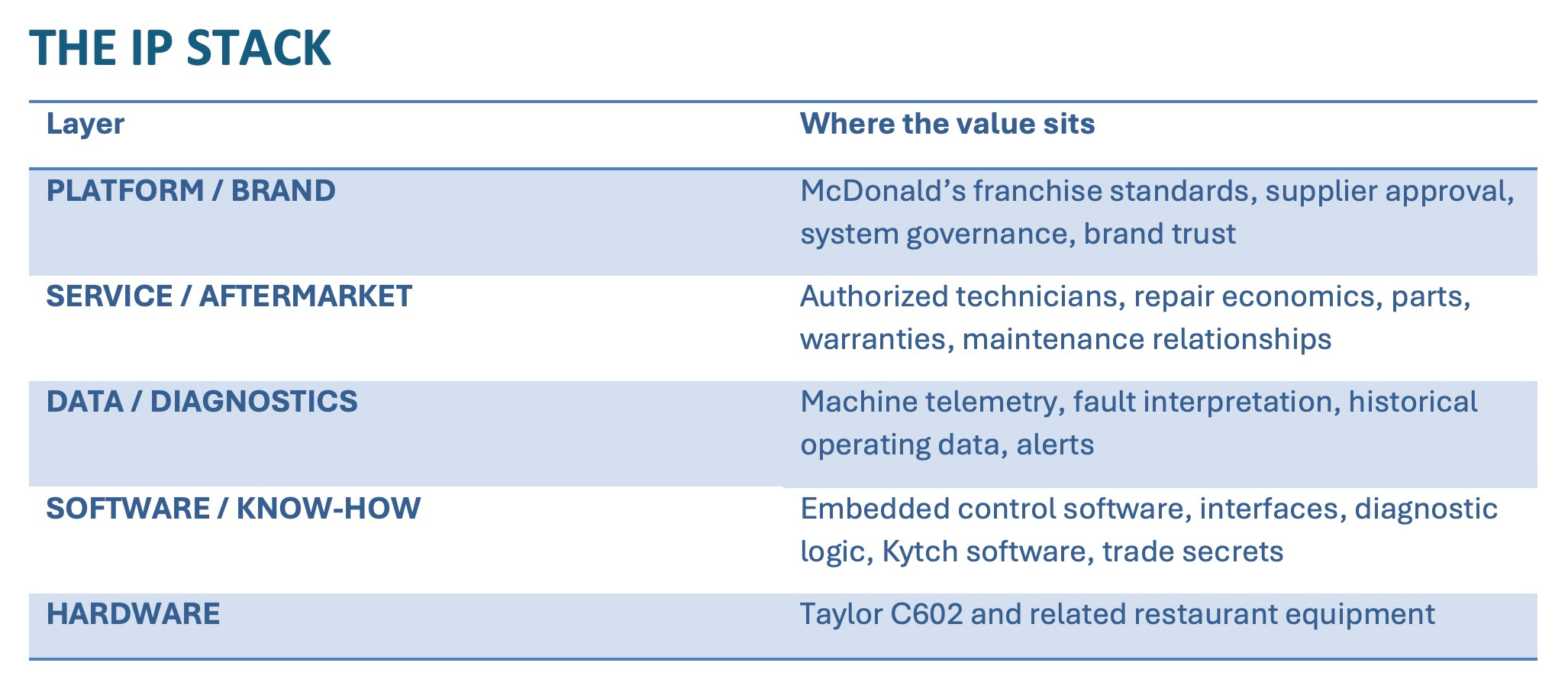
The same architecture surrounds tractors, cars, robots, medical devices, and industrial printers. Each is hardware embedded in a system of software, diagnostic permissions, data, service networks, and contracts. The physical object is often the least complex layer. The competitive advantage lies in who can interpret its information and decide who gets access.
Every product business should ask; after we sell the product, who controls the relationship with the information it generates? Manufacturer control creates an aftermarket. Customer access creates opportunities for interoperability. An independent translator can create a startup. Kytch found that third market. Then it discovered how powerful the others were. The Taylor machine was visible, the McFlurry was visible, and the Kytch box was visible.
The most consequential assets were not: Software, diagnostic access, trade secrets, machine data, repair relationships, contracts, platform authority, and brand trust. They shaped what the machine could do, who could repair it, and which competitor could reach its customer.
Twenty years ago, we might have called the C602 restaurant equipment. Today it is a stack of intellectual property wearing a stainless-steel costume. The fight it started isn’t with the invention. It’s with a simple question:
Why can’t I fix what I already own?