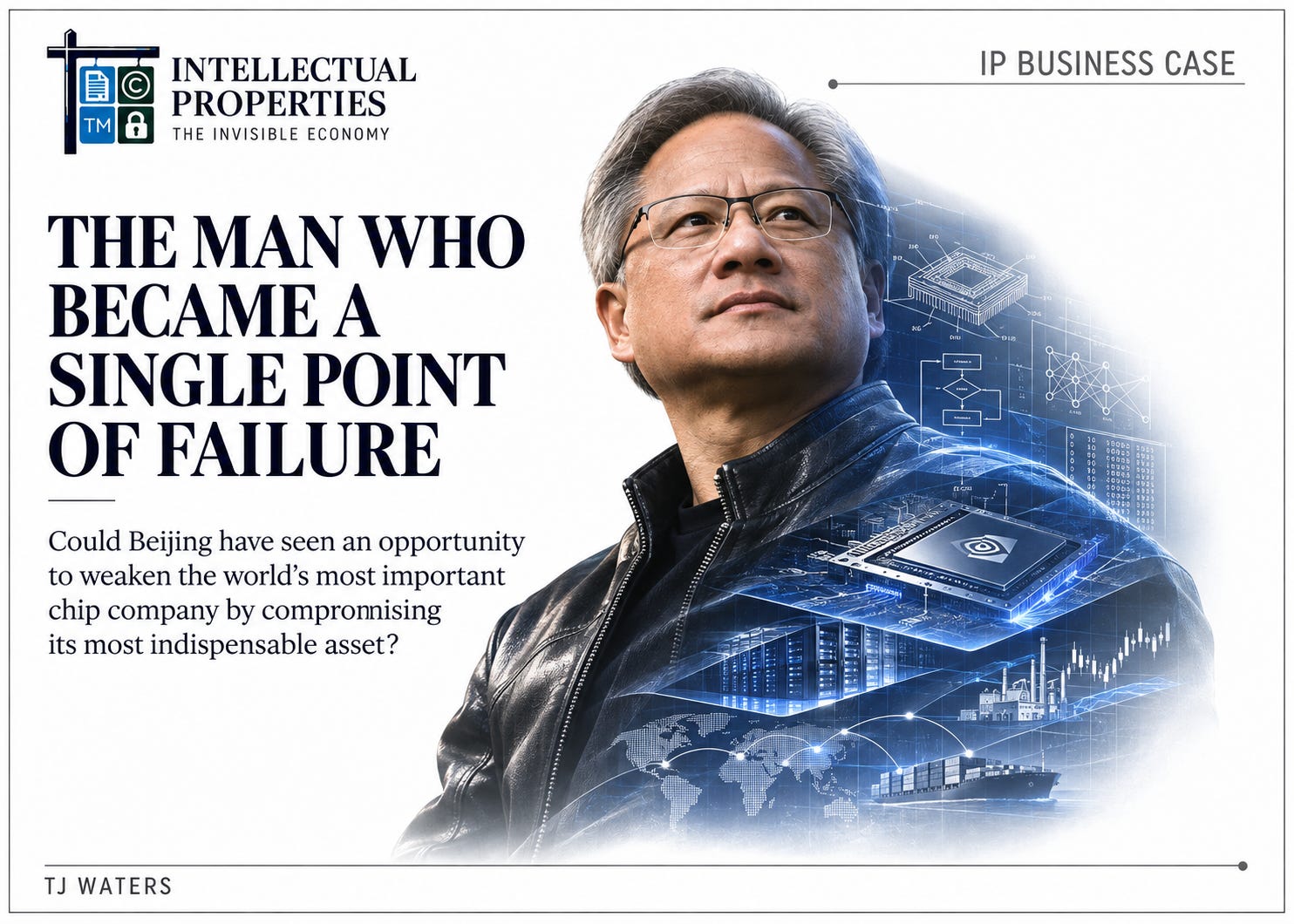


The $600 Billion Question
Imagine spending three decades building one of the world’s most valuable companies. You have thousands of patents, extraordinary engineering talent, sophisticated software, a network of global partners, and a product that has become essential to the AI revolution. Then imagine that the asset whose sudden loss threatens the whole enterprise is not a patent, a fab, or a trade secret. It’s you.
On November 12, 2026, Nvidia announced that co-founder Jensen Huang had resigned as CEO. CFO Colette Kress became interim CEO, and Harvey Jones became Nvidia’s first board chair. This was no simple personnel change. It follows explosive media reporting about Huang’s personal relationships and allegations involving Chinese intelligence.
Here is the uncomfortable business question: What if a foreign government recognized that the easiest way to disrupt a technology giant was not to steal its chips, but to compromise the one human being holding that entire company together?
That is a hypothesis mind you. No public evidence shows Beijing engineered Huang’s relationship or directed the disclosures that preceded his resignation. But the question is serious enough to demand attention by boardrooms everywhere. Particularly with companies involved in national security.
The Invisible Empire Under the Silicon
Nvidia sells accelerated computing, but its durable advantage is a layered economy of chip architectures, engineering know-how, patents, CUDA and associated software tools, developer trust, integrated systems, product roadmaps, supplier relationships, and an exceptionally effective strategy for turning computing bottlenecks into markets.
Huang was more than the face on a keynote stage. He was the coordinating force connecting those assets. Nvidia’s 2026 proxy expressly assigned the CEO primary responsibility for operational leadership and strategic direction. It also defended a governance structure with a lead independent director rather than a board chair. But investors could reasonably ask how much critical coordination had been concentrated in one person.
Nvidia’s November troubles don’t erase its patents or software. It does expose something that conventional IP audits often overlook; the value of a company’s portfolio can depend on relationships and decision-making systems that are not owned, patented, or easily transferred.
A Business Relationship, an Alleged Spy, and a Husband
The reporting follows a business executive named Alice Huang, who had a personal relationship with Jensen Huang and was associated with Singapore-based cloud computing company Megaspeed, a significant Nvidia customer. The Wall Street Journal reports Alice was introduced to Huang by her husband, businessman Kang Wei, who appeared to tolerate the relationship and had substantial business interests tied to AI computing. These reports warrant additional investigation.
The New York Times reported that a classified U.S. memorandum characterized Alice as having been recruited by China’s Ministry of State Security to gather information about Nvidia and potentially influence access to advanced chips. That is a serious accusation. CNN subsequently reported a critical stipulation; officials disagreed about the intelligence and sources said current evidence did not prove she had acted as a spy. The Justice Department has not reached a conclusion.
However, both things could be true; a relationship can pose a grave counterintelligence exposure and public evidence can remain insufficient to establish intentional espionage. Media reporters and government investigators have to keep those possibilities in mind at the same time.
Then there is the peculiar timing. In May 2026, (six months before the scandal), a small short-selling firm called Culper Research raised concerns about Megaspeed’s commercial arrangements and Huang’s evident closeness with Alice. Culper had a financial interest in Nvidia’s decline, so its allegations are not disinterested findings. But its work illustrated how an illicit relationship could be identified through corporate records, social media images, and interviews with former employees.
Why Beijing Might Prefer a Weaker Nvidia
China has a clear strategic interest in reducing dependence on American AI processors. U.S. export controls have constrained access to Nvidia’s highest-performing products; and Beijing has promoted domestic alternatives. IDC figures put Nvidia at 34% of Chinese data-center AI accelerator shipments in the first half of 2026, compared to Huawei’s 28%.
So, let’s consider a possible geopolitical calculation. A nation-state that believes Nvidia’s founder is a vulnerable point of failure could view his removal as a way to buy time for domestic competitors. Not by making a Chinese chip instantly superior, but by introducing uncertainty around Nvidia’s strategy, leadership and customer relationships.
There could also be a second prize. Chinese law obliges organizations and citizens to cooperate with state intelligence work upon demand. Greater dependence on Chinese-controlled technology ecosystems may give the state more opportunities to demand cooperation. This doesn’t prove that Chinese processors contain built-in clandestine access, and hardware market share should not be confused with automatic access to customers’ data. But infrastructure, firmware, software and services matter in the global semiconductor game. The only thing harder than getting a competitive advantage is keeping it.
The counterargument cannot be overlooked. Huang advocated for commercial access to China, and Chinese AI companies still value Nvidia computing. An intelligence service interested in continued collection or influence might prefer to keep such a relationship intact. A deliberate takedown could sacrifice a useful channel. That is why the motive to disrupt cannot by itself prove a sabotage plan.
Four Explanations. One Corporate Vulnerability.
To guard against the temptation to connect every suspicious dot, consider four distinct explanations.
1. A commercial relationship could have developed independently, with intelligence suspicions later overstated.
2. A genuine relationship could have become an opportunity for intelligence recruitment.
3. Commercial connections could have been deliberately used to obtain intelligence access from the beginning.
4. An access operation could have been redirected, (or planned from inception), to expose Huang and weaken Nvidia.
The available facts fit more than one explanation. Kang Wei’s introduction is consistent with commercial facilitation and with a possible access operation. The reported intelligence memo would weigh against the purely independent account, yet CNN’s reporting cautions that the underlying evidence is disputed. Nvidia’s concentrated leadership supports the attractiveness of a disruption scenario, but that alone doesn’t identify Chinese intent.
Two findings would sharply change the picture. Did the alleged intelligence recruitment begin before Alice met Huang? And was there any state direction behind the disclosures that ended his tenure? These are likely the focus of numerous legal (and a few clandestine) collection projects.
Another reported media point is noteworthy. Nvidia’s Singapore geographic revenue reporting changed after the company blocked additional Megaspeed sales in 2025. That complicates transparency into Singapore-billed transactions. Now, this alone does not prove sales vanished or that Beijing began waiting for the U.S. midterms. Chronology is a question to look into, not an indication of causation.
The Business Case: A Board Can Lose More Than Its Trade Secrets
Here is what makes the Nvidia episode relevant beyond semiconductors. Industrial espionage historically conjures up images of stolen blueprints, hacked servers and departing engineers carrying proprietary files. Those risks are certainly real. In 2026, a U.S. jury convicted a former Google engineer of economic espionage and theft of AI trade secrets for the benefit of China. A separate prosecution established that an MSS officer sought aviation technology from GE Aviation, (among other companies). The FBI details on their website how Chinese economic espionage remains its top priority.
But a nation doesn’t have to steal a patent to undermine the value of an IP portfolio. It could exploit an executive’s undisclosed relationships, compromise negotiations, pressure a decision-maker, exploit supply-chain dependencies, or trigger a succession crisis. These are plausible pathways for many adversaries, not proof of a particular strategy against Nvidia.
The most dangerous corporate asset may be one the company has never listed on a balance sheet: An executive’s irreplaceable combination of reputation, personal relationships, knowledge and power. When those assets are excessively concentrated, personal exposure can become enterprise exposure. That is why the phrase ‘key-person risk’ sounds too small. In a strategically critical technology company, it can become national-security risk.
The Board’s Fiduciary Exposure: When Private Conduct Becomes Enterprise Risk
A board is not a morality tribunal. An executive’s consensual private relationship does not automatically constitute a breach of fiduciary duty. But the analysis changes when the relationship involves a direct report, a major customer or intermediary, potential conflicts of interest, or access that could invite coercion. Then the question is no longer simply what the CEO did. It is what the directors knew, what reporting systems existed, and what reasonable oversight steps they took.
Nvidia is incorporated in Delaware. Under Delaware oversight doctrine, directors may face “Caremark” claims when they make no good-faith attempt to establish adequate monitoring systems or consciously disregard sufficiently significant warning signs. These claims are notoriously difficult for plaintiffs to win. A damaging scandal, an embarrassing affair, or a falling stock price does not by itself establish liability.
But the company’s own 2026 proxy assigned its board oversight of legal and compliance risks, intellectual property, reputation, business continuity, management development and related-party transactions. That makes the pertinent inquiry concrete. If directors had credible notice of a CEO–subordinate relationship or a sensitive customer connection, did the board independently assess conflicts, reporting lines, retaliation or harassment concerns, export-control exposure, access to nonpublic information, and a sudden-succession scenario?
Reuters reported on November 11 that shareholders had already proposed securities and derivative claims. A derivative plaintiff would need particularized grounds to show an oversight failure or conscious disregard of red flags; not simply assert that directors heard office rumors. Securities claims raise different questions about material misstatements and omissions, including knowledge and materiality. Directors may also face demands for company records, regulatory inquiries, litigation costs and reputational consequences even without a final finding of liability.
There is an important defense-side fact: Nvidia’s independent directors announced an investigation and retained outside counsel, and its board subsequently accepted Huang’s resignation. Those steps may demonstrate oversight response rather than indifference. Media reports don’t establish what individual directors knew years earlier, whether any relationship violated company policies, or what confidential reviews took place.
The fiduciary lesson is not “monitor the CEO’s bedroom.” It is “when a personal relationship becomes a potential route into sensitive decisions, commercial conflicts, regulated technology or executive continuity, the board must have an independent, documented way to examine the enterprise risk”.
Five Moves for the Modern Board
A Board of Directors has two functions: Hire and fire the CEO and set the overall company strategy. Given Nvidia’s stock price fall today there are going to be inquiries into what the Board knew and when they knew it. So, here’s something every Board should consider for its own protection:
1. Map the invisible crown jewels. Inventory not only patents, code and trade secrets, but also decision rights, key relationships, privileged access, and the individuals connecting them. Identify where the loss or coercion of one individual could disable several assets at once.
2. Make succession serious, not ceremonial. Boards should rehearse a sudden CEO departure just as they rehearse cyber incidents. Assign temporary decision authority, key-account coverage, security handoffs and public communications before a crisis.
3. Treat close access as a counterintelligence issue when warranted. Apply proportionate, lawful screening and escalation to sensitive business intermediaries and high-stakes external relationships. Focus on access, conduct and conflicts—not nationality or private life as such.
4. Separate commercial opportunity from intelligence exposure. A customer with legitimate orders, financing and personal ties can still present information-security risks. Verify ultimate end users, financing relationships and permissions, particularly where export restrictions apply.
5. Protect people without building a surveillance state. A credible disclosure channel, independent legal advice, a well-defined conflicts policy, privacy protections and a nonpunitive process for reporting coercion can reduce leverage.
Executives need a route to seek help before private vulnerability becomes public crisis. Otherwise, more companies are likely to follow Nvidia’s sudden and rapid fall from grace.
The Final Move
Maybe Beijing recognized Huang’s vulnerability and decided that weakening Nvidia was worth more than keeping him in place. That deserves investigating. Maybe an intelligence service sought access and the resulting scandal destroyed its own asset. Maybe the relationship began without state planning and the fallout came from journalism, investigations and corporate decisions. The public record does not yet show which explanation is correct.
What it does tell us is that one of the world’s most consequential technology companies experienced an abrupt founder transition amid a counterintelligence controversy and that the company had built much of its success around an unusually influential individual. The old question was: Who owns the intellectual property? The new question may be more urgent: Who (or what) can make it worthless?
For Western executives, the lesson is not to assume that everyone is a spy. It is to recognize that in a contest over technology, markets and national power, the most valuable target may be the person who makes the entire business work.