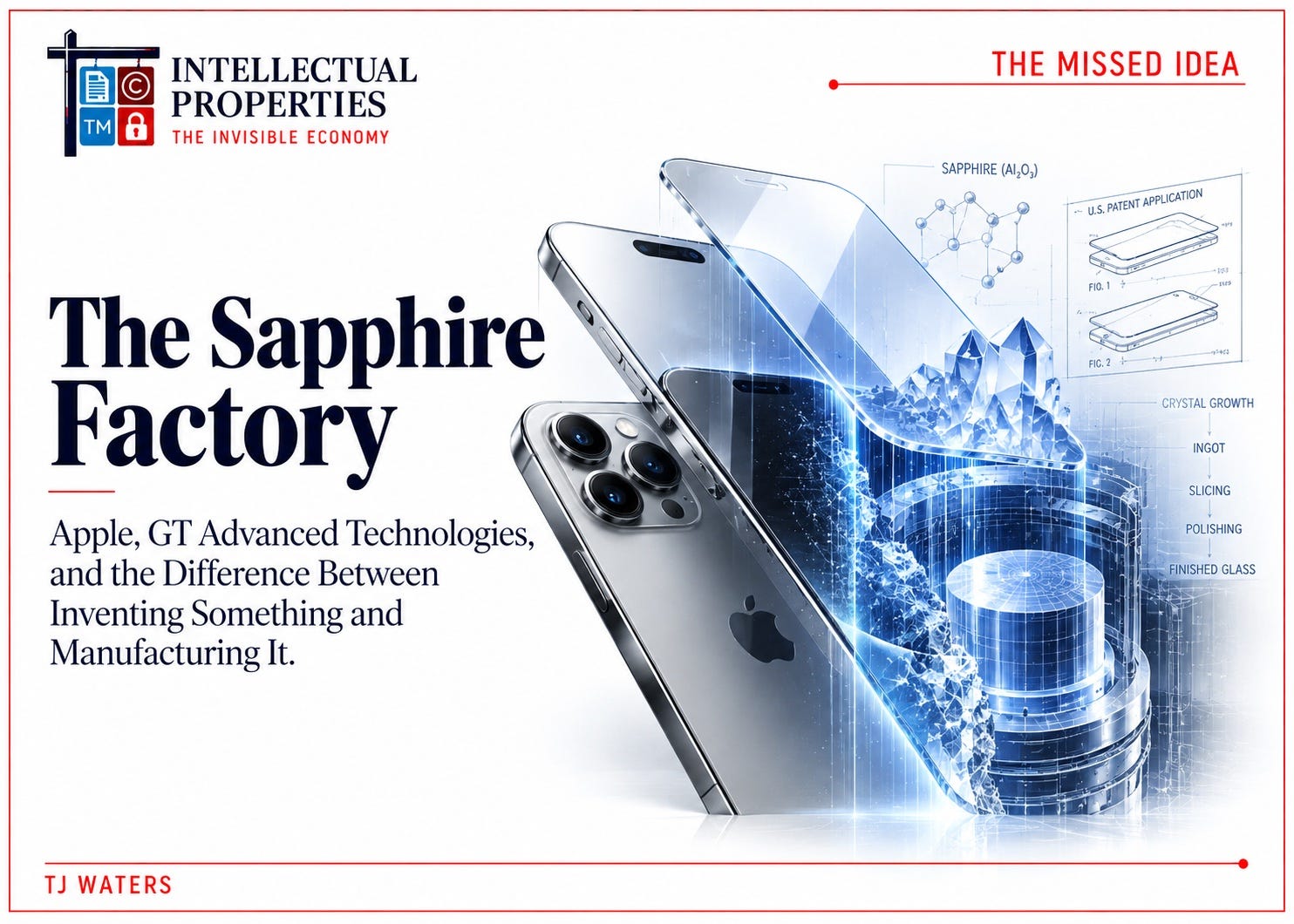

In 2013, Apple had a wonderful idea. The iPhone had become one of the most valuable consumer products on Earth, but it’s important interface was still a piece of glass that could scratch, crack, and ruin your afternoon with one bad drop on a sidewalk. Apple already knew a harder material: synthetic sapphire. The iPhone 5s used sapphire over its Touch ID sensor, and the material was hard, clear, and decidedly premium. So the next leap seemed almost obvious. Why not make the screen out of it?
There was only one problem. Making a small sapphire cover for a fingerprint sensor and making millions of smartphone-sized pieces of sapphire are not the same thing. That difference, (between proving an innovation can work and proving it can work at scale), is where this story gets interesting.
Apple reached out to GT Advanced Technologies, a New Hampshire company with expertise in sapphire-growing equipment. GTAT’s Advanced Sapphire Furnace business had historically centered on selling equipment and technology to sapphire producers. GTAT’s historical strength was building and selling the ovens, but Apple was asking it to become the bakery. Then asking the bakery to feed one of the largest consumer-electronics production systems in the world.
The deal announced in late 2013 was enormous. Apple agreed to provide GTAT up to $578 million in four milestone-based prepayments. GT would use that money to build sapphire-growth capacity at a massive Apple-owned facility in Mesa, Arizona. The program ultimately contemplated 2,036 sapphire furnaces. The catch was hiding in plain sight: Apple’s money was an advance that GT had to repay, while the supply arrangement did not give GTAT the kind of guaranteed purchase volume that might normally protect a supplier making such a concentrated bet.
That matters because GTAT was not merely expanding an existing production line. It was trying to invent the production line while operating it.
The economics depended heavily on growing much larger sapphire boules than GTAT had previously demonstrated at commercial scale. Accounts of the bankruptcy record described the push toward roughly 262-kilogram boules and the difficulty of producing enough Apple-acceptable material from them. Bigger boules promised better economics because more usable sapphire could come from each furnace cycle. On a spreadsheet, that is the kind of improvement that makes a factory look brilliant. But physics doesn’t always follow spreadsheets.
A crystal can emerge from a furnace and still be economically useless. Cracks, defects, contamination, or inconsistent crystallization can turn hours of furnace time, electricity, raw material, and labor into scrap. GTAT’s own 2014 SEC filing reported significant sapphire ramp-up costs, inventory losses, and production inefficiencies while equipment and processes were still being qualified.
Read that sentence again. GTAT was establishing production processes inside a factory being built for volume production. Apple needed manufacturing, but GTAT was still doing development. Those two activities can look remarkably similar right up until the invoices arrive.
And growing the crystal was only half the problem. A sapphire boule still had to be sliced, ground, polished, finished, inspected, and converted into something Apple could actually install in a device. Bankruptcy-era accounts described serious fabrication and cost problems in addition to the crystal-growth difficulties. So GTAT had problems at both ends: growing enough acceptable sapphire and economically turning it into acceptable components.
But the most useful lesson is not about who was the villain. It is about scale.
Companies love the phrase “proof of concept.” It sounds reassuring. Something worked in the lab, the prototype performed, the patent was filed, and everyone starts talking about markets. But between a successful prototype and a successful product sits an entire second innovation system: manufacturing. Equipment reliability, cycle time, scrap, and supply chains. Then there is training, quality control, and Maintenance. Finally, there is finishing, inspection, and yield.
A prototype answers one question: Can we make it? A production line answers another: Can we make it profitably? A profitable production line answers the question that eventually matters most: Can we make it repeatedly, at specification, on schedule, at a cost somebody will pay? Those are different accomplishments. Apple and GTAT were trying to achieve all three almost at once.
Mesa magnified every uncertainty. The facility was roughly 1.3 million square feet. Furnaces were arriving. Employees were being hired. Fabrication equipment had to work. Power had to be reliable. Apple’s specifications had to be met. Cash was tied to milestones. Meanwhile, the manufacturing process itself was still moving underneath everyone’s feet.
By April 2014, the engineering problem became a financing problem. GTAT failed to satisfy technical requirements associated with Apple’s fourth prepayment; Apple withheld the final $139 million and obtained rights connected to repayment of earlier advances. That created the ugliest loop in advanced manufacturing: the factory needed cash to solve its technical problems, while the technical problems were preventing the factory from getting the cash.
In September, Apple introduced the iPhone 6 and iPhone 6 Plus without the anticipated GT sapphire display covers. On October 6, 2014, GT Advanced Technologies filed for Chapter 11 bankruptcy protection. Media reports described a stock collapse of more than 90 percent after the filing. Less than a year had passed since the Apple agreements were signed.
Bankruptcy then exposed how differently the two companies viewed what had happened. GTAT’s chief operating officer, Daniel Squiller, portrayed the Apple relationship as extraordinarily demanding and economically lopsided. Apple pushed back, emphasizing that GTAT was a sophisticated company that had negotiated and signed the agreements. Both points are worth keeping in the frame. Apple had extraordinary leverage. GTAT still chose to take the bet.
But the most useful lesson is not about who was the villain. It is about scale.
Companies love the phrase “proof of concept.” It sounds reassuring. Something worked in the lab, the prototype performed, the patent was filed, and everyone starts talking about markets. But between a successful prototype and a successful product sits an entire second innovation system: Manufacturing, equipment reliability, and cycle time. Then there’s scrap, supply chains, and training. Finally, there’s quality control, maintenance, and yield. Any one of which could the magic bullet that kills the entire thing.
Mesa tried to cross too many of those bridges at the same time. New boule size. New production operation. New fabrication process. New factory, workforce, and customer relationship. Huge volume. Aggressive schedule. And financing directly tied to technical milestones. Any one of those risks might have been manageable. Together they created a system with almost no room for failure.
The better path is much less glamorous. Build the pilot before the cathedral. Run 20 furnaces before 2,000. Learn what actually breaks. Measure first-pass yield instead of theoretical capacity. Calculate cost per acceptable finished component, not cost per furnace cycle. Create kill gates before everyone becomes emotionally and financially committed to the project. And when a supplier is being asked to carry frontier technical risk, structure the contract so the customer carries some of that uncertainty too.
That last point is important for university inventors and startups. A large customer can feel like validation, (and, sometimes, it is). But that one customer can become so important that it stops being a customer and becomes the business model. At that point, every technical delay is a financing issue, every specification change pushes your timeline out farther, and walking away becomes harder precisely when it may be necessary.
Sapphire itself was never a foolish idea. Apple had already demonstrated that sapphire made sense in smaller iPhone applications. The failure was assuming that because the material worked, the manufacturing system was ready to follow. It wasn’t.
That is the enduring image from Mesa; more than a million square feet of factory space, thousands of sophisticated furnaces, hundreds of millions of dollars, smart engineers, and one of the world’s most capable technology companies. All waiting for a manufacturing process to become something it had not yet become.
In 2018 Tesla went through what CEO Elon Musk called ‘production hell’, trying to scale production to where they could manufacture cars economically. When he announced the Model Y in 2019, he described “building the factory as a hundred times harder than building the car“.
There is a tendency to treat manufacturing as the boring part that happens after invention. Mesa teaches the opposite lesson. Sometimes manufacturing is the invention. Until you have invented that, you do not really have a product. You have a prototype and a very expensive plan.