
Picture a concert hall at Christmas. The audience recognizes the melody before the saxophonist has completed his first phrase. People smile, lean toward one another and remember a holiday from years ago. Some might even mouth the words. Dave Koz doesn’t have to sing a syllable. The audience supplies the lyrics for him. What looks like a musical trick is really a rather sophisticated business strategy. He has found a way to make an instrument perform the emotional work of a human voice.
A singer can sell a story with words. An instrumentalist has to make listeners remember a sound, recognize the person behind it and decide that hearing it again is worth paying for. Koz has spent more than three decades solving that problem. Along the way, he has created something considerably larger than a catalog of saxophone recordings. He has built a repeatable experience that travels from radio to theaters, from Christmas celebrations to cruise ships.
The Problem With a Hit That Has No Words
Koz began as a sideman, touring with Bobby Caldwell, Jeff Lorber and Richard Marx before releasing his first solo album in 1990. His records succeeded in a format that commercial radio executives called smooth jazz. There was a benefit to belonging to a recognizable category. Stations needed songs, concert promoters needed artists and listeners learned where to find both. There was also a trap. If the format disappeared, the audience might disappear with it.
That danger became real. As major market smooth jazz stations changed formats, the radio infrastructure that had introduced audiences to musicians like Koz contracted. In a JazzTimes examination of the genre’s decline, Koz described the unsettling experience of trying to find new footing while remembering how the business once worked. His recordings hadn’t suddenly lost their appeal. The means of getting those recordings to customers had changed.
Koz responded in ways that look less like a typical musician’s career and more like a lesson in customer relationships. He became a radio host, placing his personality alongside the music. His nationally syndicated program and later SiriusXM presence let him introduce other musicians while reinforcing his own identity as a trusted guide. For an artist without lyrics to quote, a speaking voice could become another source of recognition. Radio also provided access to the wider musical community. That is valuable, although it shouldn’t be mistaken for ownership of the stations or their listeners.
He also made himself a reliable seasonal destination. The Dave Koz & Friends Christmas tour turned familiar songs into a recurring occasion. A ticket no longer depended exclusively on whether the customer had heard the latest album. Christmas itself provided the reminder. In an interview, Koz explained that familiar holiday melodies reach listeners emotionally even without sung lyrics. Here, the instrumentalist’s presumed weakness becomes a strength. The audience arrives already knowing the songs, and the musician sells his interpretation of them.
The Invisible Property Behind the Saxophone
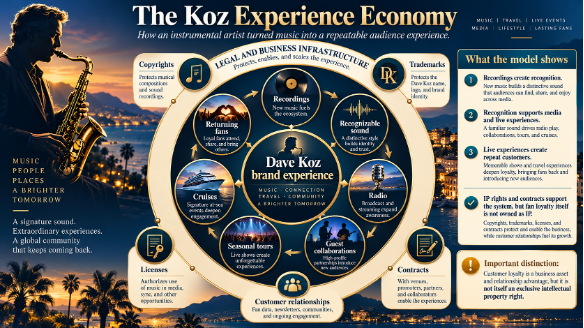
A saxophone tone by itself is not an exclusive legal monopoly. Copyright protects qualifying compositions and sound recordings, not an artist’s general musical style. A particular composition may earn publishing income. A particular master recording may generate royalties for its owners. The musician’s name and associated branding can function as trademarks identifying performances, recordings or services. And contracts determine who receives what portion of the value. Those rights are related, but they aren’t interchangeable.
Consider his signature song, “You Make Me Smile.” Fans can remember its melody and the warm sound associated with Koz, even though no one needs a chorus to join. The composition, recording and Dave Koz name can each carry different rights and commercial functions. The real economic power emerges when they reinforce one another. The record introduces the person, the person sells the concert, and the concert renews interest in the record. His song “Faces of the Heart” also served as a long running theme for General Hospital, bringing a recognizable musical identity into homes far beyond jazz radio.
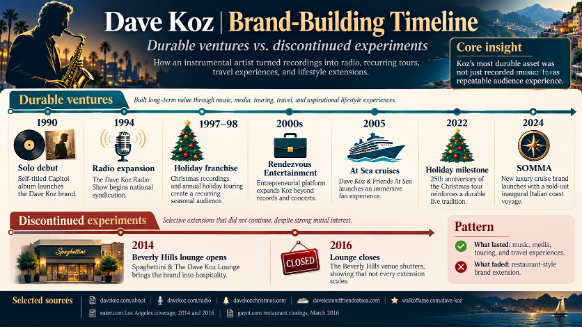
Koz tried working on the ownership side of the music industry, too. He helped establish Rendezvous Entertainment, moving beyond performance into a business that could develop and release music. Owning or controlling recording rights and artist relationships can create value that outlives any one tour, although the precise economics depend on the deals. That effort deserves attention not because every venture must succeed forever, but because it shows an artist attempting to participate in the infrastructure surrounding his work.
He has also relied on a less obvious asset, borrowed familiarity. Collections built around movie themes and holiday standards offer listeners melodies they already know. But familiarity can come with a price. Recording an existing composition involves copyright permissions and royalties, and pairing music with films or advertisements can require additional licenses. An artist doesn’t acquire ownership of a song merely by recording a memorable version of it. Koz’s 2007 At the Movies topped the contemporary jazz album chart for 12 weeks, evidence that reinterpretation can be commercially compelling without requiring original lyrics.
Collaboration provided another way out of the niche. Koz has worked with artists from different generations and genres, including Ray Charles, Stevie Wonder and the Foo Fighters. More recently, his work with Cory Wong brought him into a different audience network, while his album Just Us with Bob James earned a 2026 Grammy nomination. Each partnership joins audiences as well as musicians. But the rights must be negotiated, credits allocated and any promised uses of names, recordings and performances properly cleared. The goodwill is shared even when the underlying intellectual property is not.
When the Experience Became the Product
The most revealing extension of the Koz brand may be the cruise. A concert sells a seat for an evening. Dave Koz & Friends at Sea sells a week with musicians, other fans and a carefully arranged social world. Koz’s official website advertises sold out voyages for 2027, evidence of demand for that particular offering, though not proof of its profit margin. The concept turned an audience into a community, and community is harder for a competing saxophonist to reproduce than a set list.
Koz has described a revealing change in the cruise operation. He first participated through another producer, then brought production in house in 2011 and later developed travel support around the customer experience. That means more control over the touchpoints, from the first inquiry to the trip itself. The cruise name and event presentation are brand assets. The relationships with guests, talent, travel partners and suppliers are business assets. None guarantees success, but together they produce an experience with fewer easy substitutes.
His luxury cruise concept SOMMA takes the idea another step, adding speakers, wellness, cuisine and destinations to the musical programming. The proposition is no longer simply to hear Dave Koz. It is to belong, temporarily, to a world he has curated. That is brand extension with a logical bridge back to the original customer promise.
Not every extension held. Spaghettini & The Dave Koz Lounge, a Beverly Hills dining and live music venture, closed in March2016 after roughly 18 months, with the property reworked into a different restaurant concept. Contemporary reporting established the closure, not the venture’s private financial results or Koz’s personal loss. Still, the outcome supplies a useful warning. A touring audience can follow an artist to a concert. A restaurant needs sufficient customers on ordinary Tuesdays, whether the famous musician is there or not. Brand recognition won’t pay the rent by itself.
A Career Bigger Than a Category
There were other experiments. KOZ Wines placed his name on bottles while directing his proceeds to the Starlight Children’s Foundation. This was closer to philanthropic brand licensing than a demonstrated major profit engine. It reinforced affection for the artist, but available sources don’t establish that it became a lasting standalone wine business. Likewise, his willingness to perform outside strict smooth jazz conventions opened doors but invited criticism from jazz purists. Koz acknowledged that tension in a 2025 interview, emphasizing expression over critical approval.
His endurance isn’t proof that every strategy was deliberate from the start. Nor can we calculate the financial contribution of individual ventures without contracts, revenue and cost records. It does suggest something more useful. He didn’t make his career wholly dependent on the success of his next single, the health of one radio format or the continued patronage of a record company. He developed several ways for people to encounter him and several reasons for them to return.
The Big Idea is that intellectual property is most powerful when it anchors a relationship rather than merely protecting a product. Koz owns or participates in particular rights, but his durable advantage is the association fans make between a sound, a person and a welcoming experience. They may not be able to sing the saxophone solo, but they can recognize it. More importantly, they know where they want to be when he plays it again.