

The Archive Nobody Wanted
Picture a company that has been in business for thirty years. Somewhere on its servers are millions of emails, forgotten project folders, sales presentations, customer complaints, meeting notes and arguments about products that never made it to market. The IT department calls it storage. The lawyers call it a retention problem. The employees call it a mess.
An artificial intelligence developer might call it something else. Training material.
Not because every message is brilliant. Most aren’t. But buried in those conversations is a remarkable record of how people actually work. How a sales manager rescues a troubled account. How an engineer diagnoses a failure. How a product team rejects three ideas before discovering a fourth. A corporate archive can reveal the decisions behind the decisions, which is exactly the kind of context tomorrow’s AI assistants may need.
And now there are buyers interested in getting their hands on it.
A Market for Yesterday’s Conversations
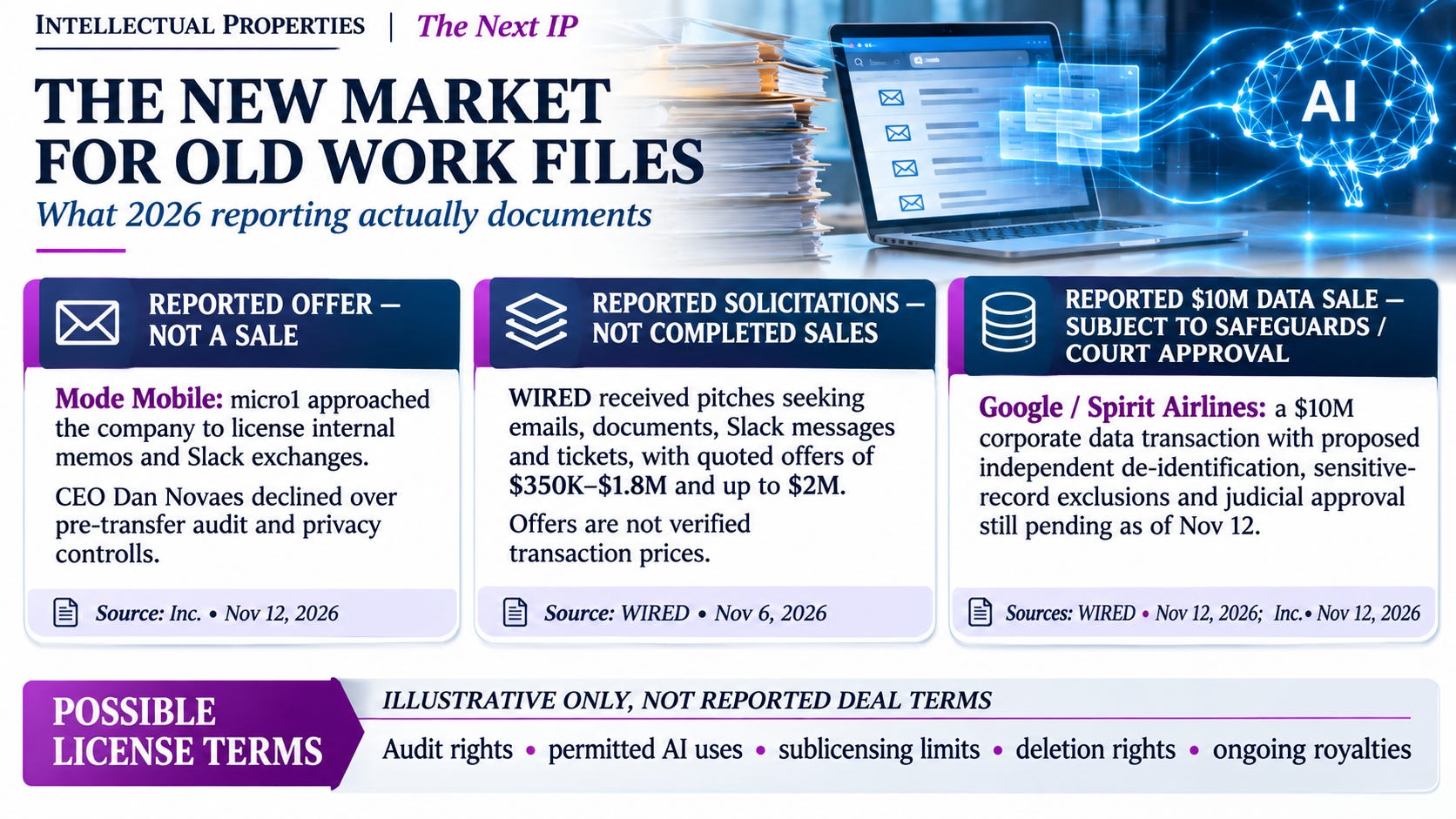
In November 2026, WIRED reported that AI companies and intermediaries were seeking access to workplace files and emails for model training. Days later, Inc. described a growing business in acquiring or licensing internal company records, including communications and operational material. This isn’t the familiar story of an AI company scraping the public internet. It’s a market for information that was never intended to leave the building.
Why would anyone pay for yesterday’s sales meeting? Because the next generation of AI is expected to do more than answer questions. It will be asked to perform work. A useful sales agent needs to understand how deals stall, which exceptions require approval and what makes a customer nervous. A useful engineering agent needs to know how a team investigates a defect, not merely the definition of a defective part.
Public information can teach a model the vocabulary of business. Internal records may teach it the behavior of business. Those are very different things.
Inc. reported that Mode Mobile CEO Dan Novaes rejected an approach from data intermediary micro1, concerned about control over removing sensitive material, and subsequently pursued a venture emphasizing more auditable data protection. His reaction illustrates the dilemma. A business may discover that its historical records have market value at precisely the moment it realizes how much damage their disclosure could cause.
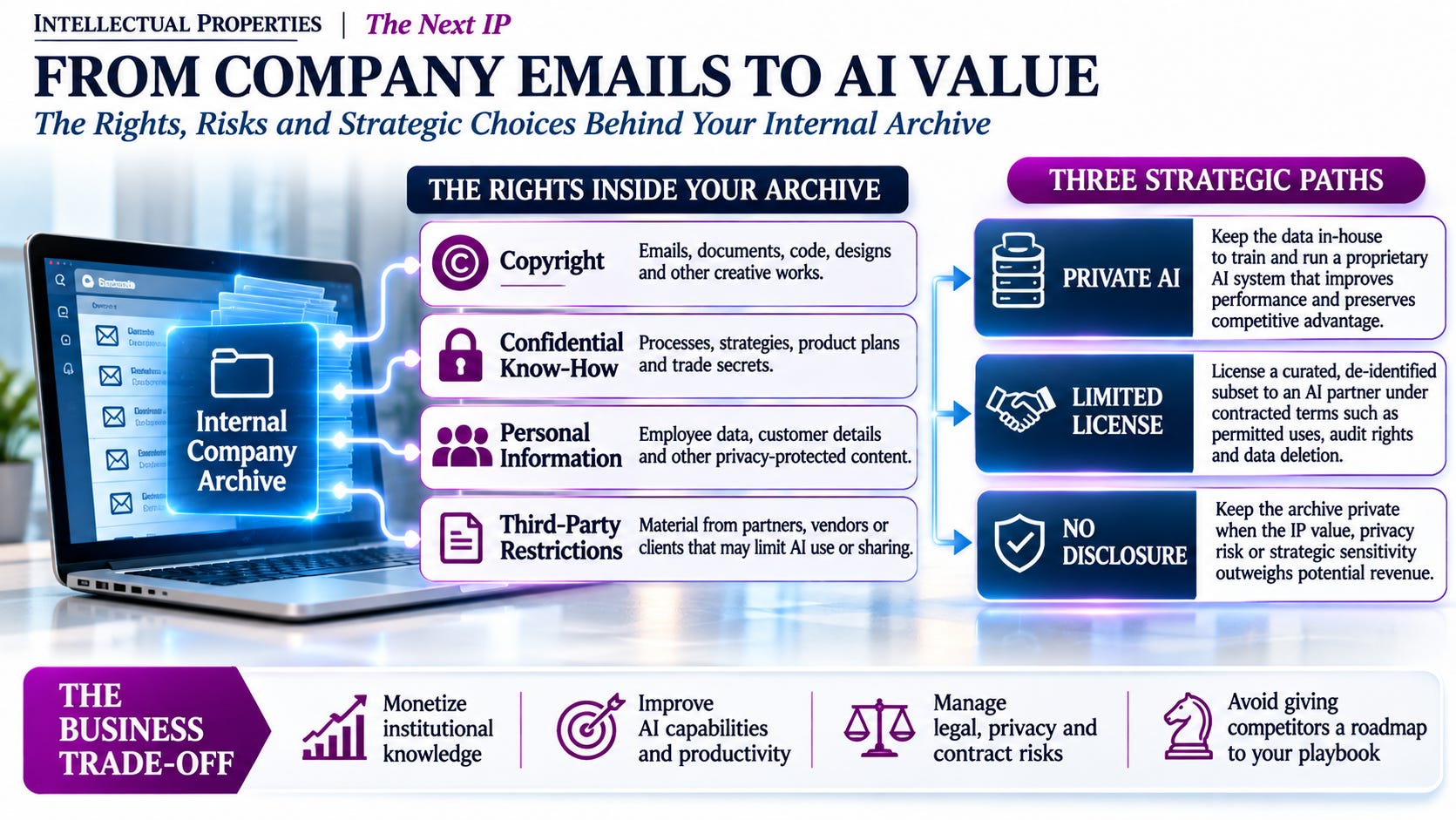
There’s another possibility, of course. Instead of selling those records to someone else, the company could use them to build an AI system that understands its own operations better than any general purpose model. The same archive might support two competing strategies, licensing income today or competitive advantage tomorrow.
The Intellectual Property Nobody Catalogued
Here’s where the story becomes more interesting than a simple data sale. A company may possess the servers, maintain the email accounts and pay the people who wrote the messages. None of those facts automatically means it can license every piece of information in the archive for any purpose it chooses.
A single project folder may contain employee authored material, customer confidential information, licensed third party content, personal data, patented concepts, trade secrets and routine facts that no one owns exclusively. The folder looks like one asset on a computer screen. Legally, it may be a stack of very different rights and obligations.
Copyright may protect original expression in some documents, but not the underlying facts or general business methods. Trade secret law can protect valuable confidential know how, provided the company takes reasonable measures to keep it secret. Contracts may limit what can be disclosed to a customer, supplier or data partner. Privacy laws may impose separate duties concerning personal information. And an AI training license can create contractual permissions without transferring ownership of any underlying intellectual property.
That last point is easy to miss. A company can authorize an AI developer to use specified records for a specified purpose without selling the records outright. It can also negotiate limits on retention, model improvement, subcontractors, sublicensing, geographic access and whether trained systems may be offered to competitors. Whether those restrictions are technically enforceable, commercially acceptable and adequately audited is another question entirely.
The most valuable rights may not involve copyright at all. They may involve the ability to control access to a unique body of institutional experience. The archive becomes commercially valuable not because each message is an invention, but because the collection captures patterns that would be expensive, perhaps impossible, for an outsider to recreate.
Consider a manufacturer that has spent twenty years learning why its machinery fails under unusual conditions. Its repair emails may contain clues that never appeared in a patent application or technical manual. Licensing that archive might generate a payment. Training its own diagnostic AI on the same material might help it repair equipment faster, protect customer relationships and outperform competitors for years.
Which is more valuable? The answer depends on whether the information is scarce, whether competitors can reproduce it, how safely it can be used and how much control the company keeps after an AI model has learned from it.
The Price of Teaching a Machine
There’s a reason this emerging market should make executives nervous. A conventional licensing agreement can specify which documents a customer receives and when the license ends. Model training complicates the picture. Once information has influenced a model, deleting the original files doesn’t necessarily erase every effect of that training. A promise to delete source records is therefore not the same thing as a promise to reverse what a model learned.
A sensible licensing negotiation would begin with questions that sound more like a trade secret audit than a software sale. Which records are genuinely owned or licensable? Which contain personal information or customer secrets? Can the buyer use the material to train a general model? Can that model serve the seller’s competitors? Are derivative datasets permitted? What happens if the license ends? How will compliance be tested?
The economics are just as important. A one time fee may look attractive for records that otherwise sit idle. But if the buyer uses those records to create a durable capability, the seller could be exchanging a unique competitive advantage for a relatively small check. Usage based fees, limited fields of use, exclusivity premiums or a private deployment may better reflect the value at stake. None of those structures is automatically best. The point is to negotiate the asset you actually possess, not the pile of files you happen to store.
Businesses already conduct inventories of patents, trademarks, software and physical equipment. Few have a useful inventory of the operational intelligence embedded in their communications. That may change quickly. The first step won’t be calling a broker. It will be identifying what the company knows, who has rights in it and which parts should never leave.
What Comes After the Patent Portfolio?
For generations, companies learned to recognize valuable intangible assets by looking for familiar labels. Patent. Trademark. Copyright. Trade secret. Those labels still matter. But they don’t fully describe the value in a company’s accumulated experience.
The next important asset may be a carefully governed collection of decisions, exceptions, experiments and lessons learned. It won’t necessarily have a registration number. It may never appear on a balance sheet at anything close to its economic value. Yet it could become the foundation of an AI system that knows how a business works, including the things its people have never bothered to write into a manual.
That makes the old email archive a rather unlikely strategic resource. Yesterday it was a storage expense. Today it might be a licensing opportunity. Tomorrow it could be the knowledge base that makes a company’s AI impossible to imitate.
Before selling it, executives might want to ask one simple question. Are we monetizing our institutional memory, or are we teaching someone else how to compete with us?