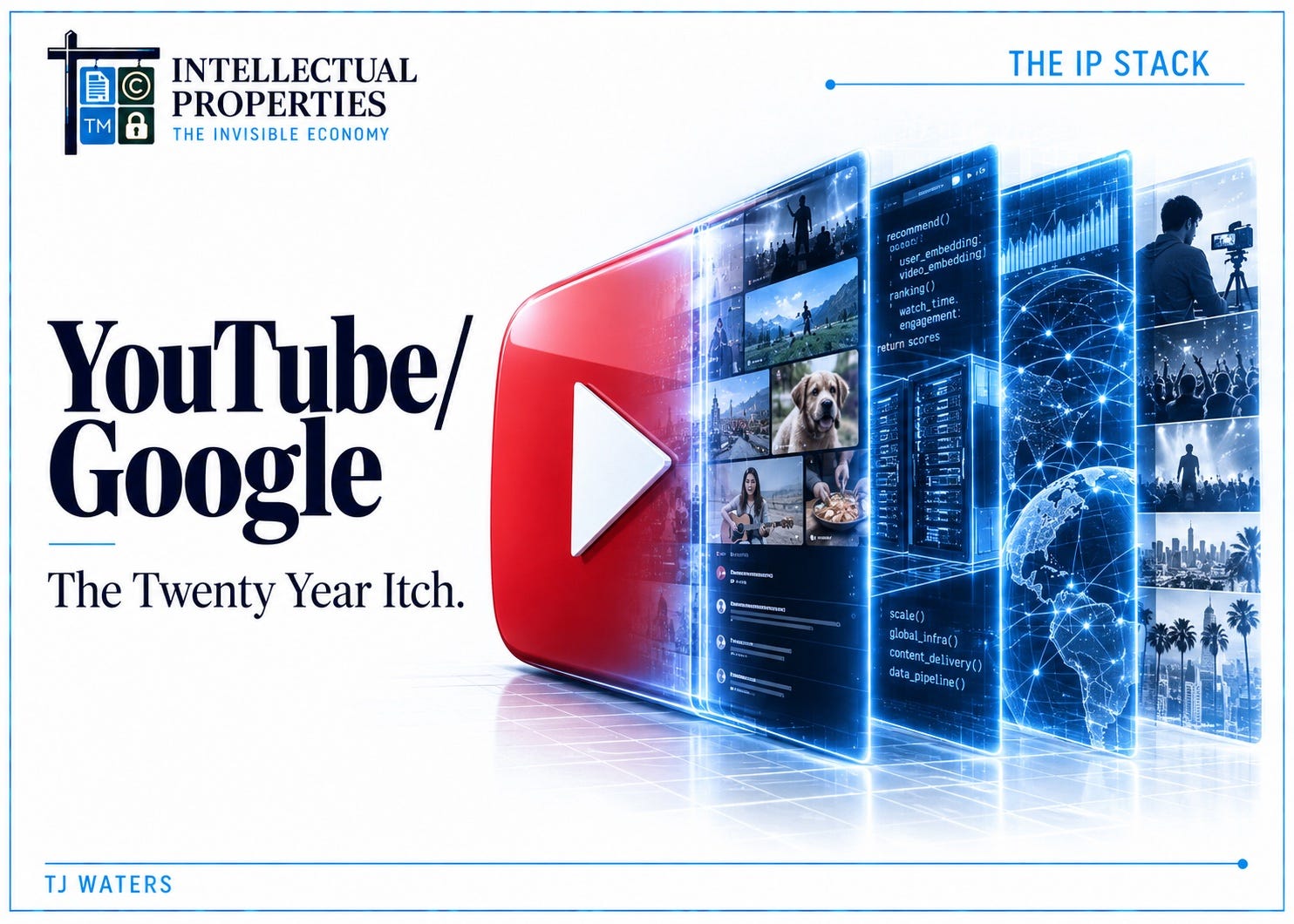

In October 2006, Google agreed to pay $1.65 billion in stock for YouTube. At the time, that sounded less like an acquisition than a dare. YouTube was not yet two years old. It had little revenue, enormous bandwidth costs, and a growing library of television clips, music videos, and other material uploaded by people who often did not own the copyrights. To plenty of observers, Google had paid an extravagant price for a lawsuit attached to a website.
But Google saw something else. YouTube had made online video behave differently. Uploading no longer required technical knowledge. Watching no longer required special software. A video could be emailed, linked, or embedded on someone else’s webpage. YouTube hosted the file, but the file could travel everywhere. “Broadcast Yourself” was not merely a slogan. It was a change in who was allowed to broadcast.
Google already knew video mattered. It had Google Video. It also had better engineers, more money, more computing capacity, and one of the most powerful brands on the internet. And it still lost. Google approached video largely as an information problem. YouTube approached it as a participation problem. Google could copy an upload button. It could not easily copy the community, habits, creators, embeds, expectations, and cultural momentum already gathering around the YouTube name.
That distinction is the beginning of the IP Stack. Google did not buy one magnificent patent. It bought overlapping layers of intangible assets that became far more valuable together than they were separately.
At the bottom was conventional intellectual property. YouTube had copyrights in its software, interface, graphics, documentation, and original code. It had technical know-how and trade secrets involving encoding, streaming, storage, ranking, fraud detection, and site operations. It controlled the YouTube trademark, domain name, logos, and goodwill. Over time, the platform and Google also accumulated patents around embedded video players, recommendation systems, personalized content streams, segmentation, and collaborative streaming.
But the next layer was more interesting: Contracts and licenses. YouTube did not need to own most of the videos on YouTube. Creators generally retained their copyrights while granting the platform the rights necessary to host, reproduce, display, distribute, recommend, and monetize their work under the service’s terms. That arrangement allowed YouTube to assemble an enormous accessible video library without purchasing every video individually.
Then came the layer that almost killed the company; copyright risk. The same frictionless upload system that made YouTube irresistible also made infringement easy. In 2007, Viacom sued Google and YouTube for $1 billion, arguing that unauthorized copies of its programming were being distributed at enormous scale. The litigation tested how the Digital Millennium Copyright Act’s safe-harbor rules applied to a platform built around user uploads. Google had something the independent YouTube desperately needed: enough money, lawyers, infrastructure, and patience to survive the fight. The case eventually settled in 2014.
What happened next is the most interesting part of the stack. Google did not merely defend against the copyright problem. It turned the problem into infrastructure.
Content ID allowed participating rights owners to provide reference files that YouTube could compare against uploaded material. When the system found a match, the owner could choose among outcomes that included blocking the video, tracking its performance, or monetizing it. That third choice changed the economics. A fan-uploaded clip no longer had to be viewed only as something to tolerate or remove. It could become a revenue event.
That made Content ID more than a compliance tool. It became a moat. A startup can build a video player. It can rent servers. It can even design a better interface. What it cannot quickly reproduce is a mature rights-management ecosystem containing reference files, ownership relationships, matching systems, territorial rules, claims procedures, payment infrastructure, dispute processes, and years of institutional trust. Copyright, (the weakness that once made YouTube look dangerous), became part of what made it difficult to challenge.
Above that sat the brand and community. The YouTube trademark became shorthand for a behavior. Creators built channels, reputations, businesses, and audiences. Viewers built subscriptions, habits, preferences, and relationships. Websites embedded YouTube players across the internet. Each new creator attracted viewers; each new viewer gave creators another reason to upload. The platform became useful because everyone else was already there.
Then came data. Every search, click, abandonment, replay, share, subscription, and “watch next” decision produced information. That information improved recommendations, advertising, moderation, creator analytics, and product design. Unlike a patent, the asset did not sit still; it renewed itself every time somebody used the platform.
Google added another layer with its advertising machine. Search advertising was built around intention. Someone searching for a plumber or a pair of shoes had already revealed what they wanted. YouTube gave Google something different; attention. Video could create desire before the search ever happened. Google could combine television’s emotional power with digital targeting, auctions, measurement, and attribution. Later, subscriptions such as YouTube Premium, Music, and TV expanded the model beyond advertising.
And then the creator became the studio. YouTube shifted much of the risk of media production away from the platform. Creators financed the experiments. Viewers supplied the popularity signals. YouTube supplied distribution, discovery, analytics, advertising, and payments. A traditional studio cannot finance a million pilots. YouTube can let a million people finance their own, and then use audience behavior to discover which ones matter.
Twenty years later, YouTube is no longer easily described as a video-sharing website. It is television, music discovery, podcasting, education, advertising, search, commerce, and a global creator economy. In 2025, YouTube said the service operated in more than 100 countries and 80 languages, with billions of monthly viewers watching more than a billion hours of video each day. The company also said it had paid more than $100 billion to creators, artists, and media companies over the preceding four years.
That is why the $1.65 billion purchase price tells only part of the story. Google did not buy a collection of videos. It bought a trademark, software, patents, trade secrets, contracts, licenses, data, distribution, creator relationships, advertiser relationships, copyright infrastructure, network effects, and perhaps most important, a habit.
The IP lesson is not that every company needs more patents. It is that valuable businesses are often protected by stacks. One layer can be copied. Several interacting layers are much harder to reproduce. YouTube’s defensibility did not come from a single legal right. It came from the integration of rights, relationships, technology, data, and behavior.
Google could have kept building Google Video. Instead, it recognized that the thing worth buying was not merely the technology. It was the environment that had formed around it. The acquisition looked expensive because people were pricing a website. Google was pricing the conditions under which the next generation of media would be created, discovered, governed, and monetized.